

This short story is for English learners at A2–B1 level. The words are simple, the sentences are short, and the story is easy to follow. Read it once just for the story. Then read it again slowly, and look at the idioms, the new words, and the questions at the end.
Hamza is a young man who works in a pharmacy. One evening, he loses something very important to him — and help comes from a man he has never met before. If you enjoy gentle stories like this one, you can also read The Last Train Home and The Old Bookshop.
Take your time with it. There is no hurry, and every reading makes the English feel easier.
Here is a good way to read it. First, read the whole story and enjoy it — do not stop for hard words. Then read it again and look at the new words below. On your third reading, try to say the sentences out loud. Your ears learn English too, not only your eyes.
The Story
Hamza worked in a small pharmacy on Green Street. He was twenty-three, and he liked his job very much. He knew many customers by name, and he always had a kind word for everyone who came through the door.
For three months, Hamza had been saving money. Every Friday he put a few pounds into his wallet and tried not to spend it. The money was not for himself. It was for his twelve-year-old brother, Bilal. Bilal was starting at a new school, and he needed new books — maths, science, and a big English dictionary. The books cost sixty pounds, and now, at last, Hamza had exactly sixty pounds.
“Next week, I will go to the bookshop,” he thought, smiling. “Bilal will be so happy.”
On Friday evening, Hamza finished work at six. The pharmacy closed at seven, but his boss, Mr. Patel, let him leave early. “You have worked hard this week, Hamza. Go home and rest.”
He walked to the bus stop on the corner. The street was busy with people going home. He put his hand in his coat pocket and touched his wallet, just to check. It was there.
When his bus arrived, people pushed forward all at once. Hamza climbed on quickly and found a seat. He did not feel the wallet slide out of his pocket. He did not hear it fall onto the pavement by the bus stop. The doors closed, and the bus drove away.
At home, Hamza put his hand into his coat pocket for his keys. The pocket felt light — too light. He checked the other pocket, then his bag. His heart beat fast. The wallet was gone.

“No, no, no,” he said quietly. “Please, not the wallet.”
He ran outside and searched his street, the garden path, and the steps by his door. Nothing. The wallet — and Bilal’s book money — was lost.
At about the same time, an old man was walking home from the shops with a bag of bread and milk. His name was Mr. George, and he was seventy-five. For forty years he had worked as a postman in this town. He knew every street and almost every front door by heart.
Near the bus stop, something small and brown on the pavement caught his eye. Mr. George stopped, put down his shopping bag, and bent down slowly — his knees were not young any more. It was a wallet, and it felt heavy.

He opened it carefully. Inside were sixty pounds, a bus card, and a small card with the name and address of the pharmacy on Green Street: Hamza Ahmed, Pharmacy Assistant, 12 Green Street.
“This is someone’s hard work,” Mr. George said to himself. “Someone saved this, pound by pound. I must take it back tonight, before the pharmacy closes.” He put the wallet in his inside pocket and walked a little faster than usual.
Hamza, meanwhile, had run back to the bus stop. He searched the pavement in the evening light. He looked under the bench and behind the timetable sign. He asked two people waiting there, but nobody had seen a brown wallet.
Hamza waited at the bus stop for a long time. At every bus that stopped, he watched the doors, hoping someone would step off with his wallet. Nobody did. The sky was getting dark, and so were his thoughts.

Then he had an idea. “Perhaps I left it at work — on the counter.” He ran to Green Street as fast as he could.
The pharmacy lights were still on, and Mr. Patel was putting bottles away, getting ready to close. “Mr. Patel!” Hamza cried, pushing open the door. “Did I leave my wallet here — on the counter, anywhere?”
His boss shook his head slowly. “No, Hamza. I cleaned the counter myself twenty minutes ago. There was no wallet.”
Hamza stood in the doorway with his head down. Then, out of the blue, the doorbell rang behind him, and an old man with a shopping bag walked in, a little out of breath.
“Good evening,” the old man said. “I am sorry to come so late. Is there a young man here called Hamza Ahmed?”
“That’s me!” said Hamza. “I’m Hamza.”
Mr. George took the wallet from his inside pocket and held it out with both hands. “Then this belongs to you,” he said. “I found it near the bus stop. The card inside told me where to bring it. Please, check it — your money is safe and sound, every pound.”
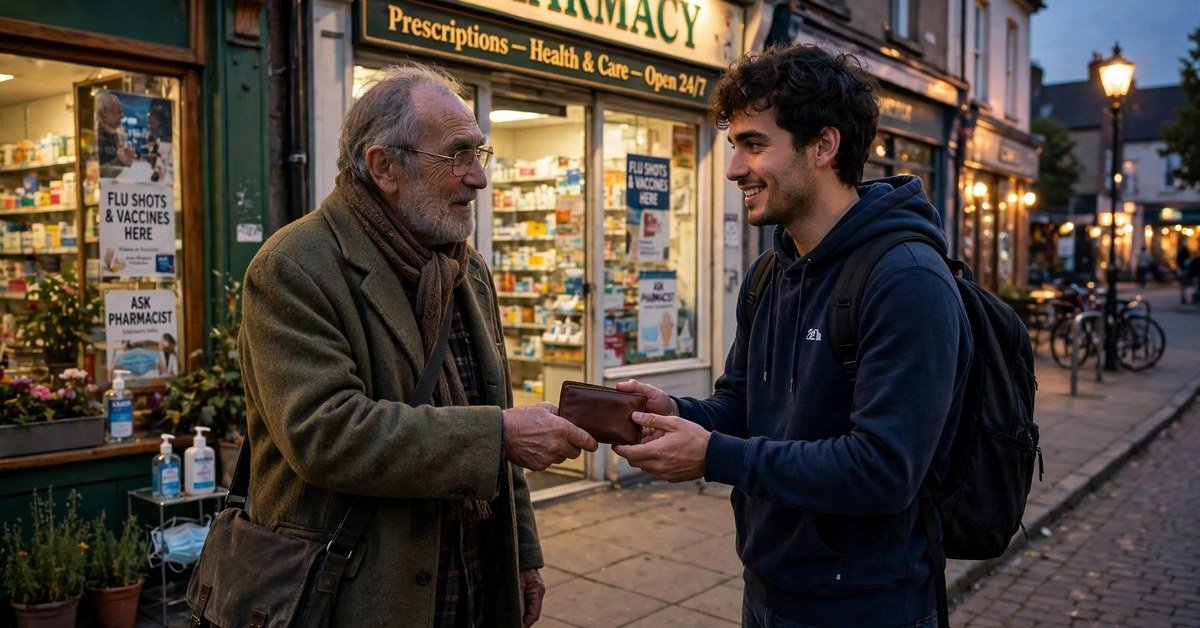
Hamza opened the wallet with shaking hands and counted. Sixty pounds — all there. He felt so relieved that, for a moment, he could not find any words.
“Sir,” he said at last, his voice not very steady, “this money is for my little brother’s school books. I saved it for three months. When I lost it, I felt sick. And now…” He laughed and wiped his eyes. “Now it is a weight off my shoulders. You are an honest man, sir, with a heart of gold.”
Mr. Patel smiled. “Well, Hamza,” he said, “your wallet was in good hands tonight, that’s for sure.”
Hamza quickly took out a ten-pound note. “Please, sir, take this. A small thank-you.”
But Mr. George pushed the note back gently. “No, my boy. Put that away — it is for the books. I was happy to lend a hand, that’s all. Kindness is not a job, and it does not need payment.”
“Then let me buy you a cup of tea,” said Hamza. “The little cafe next door is still open. Please — it would make me happy.” Mr. George laughed. “Tea,” he said, “I will never say no to.”

Over two cups of tea in the little cafe, Mr. George told him, “I am not really a stranger, you know. I am your neighbour — I live on Park Lane, two streets from your house.” Then he said, “I ask only one thing. One day you will see someone who needs help. Help them. That is my payment. Promise me.” “I promise,” said Hamza. “I will never forget.”
A week later, Hamza was walking home when he saw a young man on the corner of Green Street, looking at his phone and turning in a circle, lost. “Excuse me,” the young man called. “I am visiting my father in the city hospital, but I don’t know this town. Can you tell me the way?”
“Of course,” Hamza said with a warm, remembering smile. “It is ten minutes from here, and easy to go wrong. Come — I will walk with you and show you myself.”
The visitor thanked him again and again at the hospital door. Hamza felt grateful and happy — he had kept his promise. And somewhere across town, an old postman was drinking his evening tea, while kindness moved quietly through the streets, from hand to hand.
Idioms in the Story
Did you notice these six idioms while you were reading? Here is what each one means, in simple words.
- out of the blue — suddenly, when you are not expecting it at all.
- lend a hand — to help someone when they need it.
- in good hands — safe, with a person who will take good care of something.
- a heart of gold — a very kind way of being; always ready to help others.
- a weight off my shoulders — the happy feeling when a big worry is gone.
- safe and sound — safe and well; nothing is lost or hurt.
New Words
Here are eight useful words from the story. Read each meaning, then go back and find the word in the story again.
- wallet — a small, flat case that you carry money and cards in.
- pavement — the hard path at the side of a street, where people walk.
- honest — telling the truth and never stealing or cheating.
- grateful — feeling thankful because something good has happened.
- address — the number and street of the place where someone lives or works.
- neighbour — a person who lives near your home, on your street or close to it.
- promise — to say that you will certainly do something in the future.
- relieved — happy and calm again because a worry or problem has ended.
Check Your Understanding
Now try these four questions about the story. Think of your answer first — the correct answer is under each question, so you can check yourself.
1. Why was the money in Hamza’s wallet so important to him?
Answer: He saved it for three months to buy new school books for his younger brother, Bilal.
2. How did Mr. George know where to take the wallet?
Answer: He found a small card inside the wallet with the name and address of the pharmacy on Green Street.
3. What did Mr. George ask for instead of a reward?
Answer: He asked Hamza to promise that one day, when he saw someone who needed help, he would help them.
4. How did Hamza pass the kindness on a week later?
Answer: He met a lost visitor on Green Street and walked with him to show him the way to the city hospital.
Moral of the Story
Kindness costs nothing, but it can mean everything to the person who receives it. And when kindness is passed from one person to another, it never really ends.
Read Another Story
If you liked this story, try The Night Bus or The Lost Key next. And if you want to grow your English word by word, start with 100 Essential English Words for Beginners.
1 thought on “The Kind Stranger: A Short Story in English”