

Stories are one of the friendliest ways to learn English. You read for fun, and new words quietly stay in your memory. There is no test at the door — just a small world to step into for a few minutes.
This short story is about a young man, a busy station, and one missed train. It uses simple English, kind everyday words, and a few common idioms. Read slowly, enjoy it, and don’t worry if you miss a word here or there.
The Last Train Home
Daniel was twenty-four, and he worked in a small phone shop in the city. His home was in a quiet town, forty minutes away by train. Every evening, he took the 6:10 train, ate dinner with his family, and went to bed early.
But this Friday was different. Tomorrow morning at nine o’clock, Daniel had an interview for a new job — an office job at a delivery company. It was the job he really wanted. “I must sleep well tonight,” he told himself. “Tomorrow is a big day.”

At six o’clock, the station was full of people. Near the ticket machines, an old man in a grey coat suddenly stopped and put a hand on the wall. His bag fell to the floor. Papers flew everywhere, and his train ticket slid under a bench.
People walked past him. Everyone was in a hurry. The old man tried to pick up his papers, but his hands were shaking, and his face was pale.
Daniel looked at the big clock. His train was leaving in eight minutes. Then he looked at the old man again — and he walked over to him.
“Let me help you, sir,” Daniel said. He picked up the papers one by one. He found the ticket under the bench and put it safely in the old man’s hand. Then he helped him sit down on the bench.
“Thank you, son,” the old man said quietly. “I’m sorry. I’m feeling a bit under the weather today. A little dizzy. My son is coming to meet me, but his phone is dead, and I don’t know where he is.”
“Don’t worry,” Daniel said. “I’ll stay with you for a few minutes.” He bought a bottle of water from a small shop and gave it to the old man. “Drink slowly. You’ll feel better.”
“Shall I call your son for you?” Daniel asked, and took out his phone.
The old man shook his head and gave a weak smile. “Kind boy. But his number lives in my phone, not in my head. These days, nobody remembers numbers.” He drank a little more water. “He will come. He always comes.”
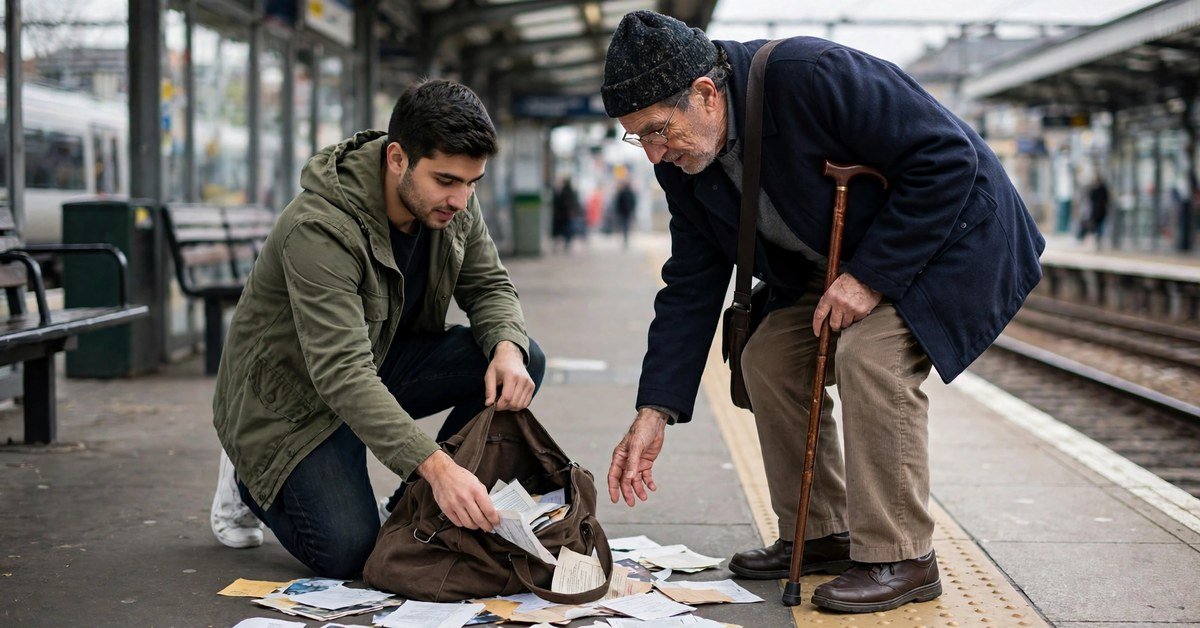
The old man drank some water, and the colour came back to his face. To break the ice, he smiled and said, “This station coffee could wake up the whole street. But your water is much better.” Daniel laughed, and the two men began to talk.
The old man’s name was Mr. Ellis. He was seventy-two. “I worked in an office for thirty years,” he said. “A delivery company, here in the city. I know offices, and I know bosses.”
“Then maybe you can help me, Mr. Ellis,” Daniel said. “Tomorrow I have an interview for an office job. I’m very nervous. I want that job so much.”
Mr. Ellis nodded slowly. “Listen to an old man,” he said. “Three things. First, arrive early — a calm man thinks clearly. Second, be honest. If you don’t know something, say so. Bosses trust honest people. Third, ask questions. It shows you care about the job.”
“That’s all?” Daniel asked.
“That’s all,” Mr. Ellis said with a smile. “An interview is just a conversation between two people. You know your work, Daniel. Walk in, be yourself, and it will be a piece of cake.”
Then the old man’s eyes went soft with memory. “At my first interview, I arrived late, with a dirty shirt,” he said. “I wanted to run away. But I walked in and told the truth about everything. The boss laughed and said, ‘An honest man is hard to find.’ I worked in that office for thirty years.”
Just then, Daniel heard a sound above them — the loud, rolling noise of a train leaving the station. He looked up at the clock. It was 6:12. His train was gone.
Daniel’s heart sank. The next train was at 7:30 — the last train home. He would arrive home late, eat late, and sleep late, the night before his big interview. For a moment, he felt that he had truly missed the boat.
But Mr. Ellis put a warm hand on his arm. “You gave me your time when I needed it,” he said. “Not many young men stop in a busy station. Your future boss will see that kind of man. Believe me.”
At seven o’clock, a tall man came running through the station. “Dad! There you are!” It was Mr. Ellis’s son. He thanked Daniel again and again and shook his hand. “You are a good man,” he said. “My father will not forget this.”
Mr. Ellis stood up slowly. “Good luck tomorrow,” he said. “Remember — early, honest, and just a conversation.”

Daniel took the last train home at 7:30. The train was quiet and almost empty. Outside the window, the city lights moved past like slow stars. At home, his mother was keeping his dinner warm, and his little sister was probably asleep already.
Daniel sat by the window and took out his small notebook. He wrote three lines: Arrive early. Be honest. Ask questions. Then he closed his eyes and rested. Strangely, he did not feel worried any more.
The next morning, Daniel arrived at the office twenty minutes early. But at the office door, he suddenly got cold feet. His heart beat fast, and a small voice in his head said, “Turn around. Go home.”
Then he remembered the old man’s warm hand on his arm. “Just a conversation,” he said to himself, and he opened the door.
The interview was friendly. Daniel answered every question honestly. “Why do you want this job?” the manager asked. “I want to learn office work and grow,” Daniel said. “And I want to make my family proud.” One question was hard, and he said, “I don’t know that yet, sir, but I can learn it quickly.” The manager smiled and wrote something down.
That evening, Daniel’s phone rang. “Daniel, this is the delivery company. We liked your honest answers. The job is yours.”
At the dinner table, Daniel told his family the whole story — the dropped bag, the kind old man, and the last train home. His mother listened with wet eyes. “You see?” she said. “A good heart is never late.”
Daniel put the phone down and smiled for a long time. Missing his train had felt like the worst luck in the world. But it was really a blessing in disguise — because one kind hour in a busy station gave him the calm heart he needed the next day.
The Moral of the Story
Kindness is never wasted time. Daniel lost one hour, but he won a calm mind and wise advice. When you stop to help someone, you often help yourself too — sometimes on the same day, and sometimes the day after.

New Words from the Story
platform — the long area in a station where people wait for a train. In the story, Daniel waits at the station and watches the trains leave.
crowded — full of people, with very little space. The station was crowded at six o’clock because everyone was going home.
dizzy — feeling that everything is moving around you, like you may fall. Mr. Ellis felt dizzy, so he had to hold the wall.
passenger — a person who is travelling in a train, bus or plane. On the last train, there were only a few passengers.
grateful — thankful; happy because someone helped you. Mr. Ellis and his son were grateful for Daniel’s help.
interview — a meeting where someone asks you questions to see if you can do a job. Daniel’s interview was at nine o’clock the next morning.
advice — words that tell someone what is best to do. The old man’s advice was: arrive early, be honest, ask questions.
nervous — worried and afraid about something in the future. Daniel felt nervous before his interview, and that is completely normal.
Idioms in This Story
Stories are a lovely way to meet idioms, because you see them inside real life. Here are the six idioms Daniel’s story used:
under the weather — feeling a little sick or unwell. Mr. Ellis felt under the weather at the station.
break the ice — to make people feel relaxed and start talking. Mr. Ellis broke the ice with a small joke.
a piece of cake — something very easy to do. “Be yourself, and it will be a piece of cake.”
cold feet — a sudden feeling of fear before an important event, when you want to run away. Daniel got cold feet at the office door.
missed the boat — to miss a good chance because you were too slow. When his train left, Daniel felt he had missed the boat.
a blessing in disguise — a bad thing that turns out to be good in the end. Missing the train was a blessing in disguise for Daniel.

Check Your Understanding
1. Why did Daniel miss his 6:10 train?
Because he stopped to help an old man who dropped his bag and his ticket at the station.
2. What three pieces of advice did Mr. Ellis give Daniel?
Arrive early, be honest, and ask questions — because an interview is just a conversation.
3. What happened at the office door the next morning?
Daniel got cold feet and wanted to turn around, but he remembered Mr. Ellis’s words and went in.
4. Why was missing the train a blessing in disguise?
Because helping Mr. Ellis gave Daniel the advice and the calm heart that helped him win the job.
Well done for finishing the story! Now test yourself with our free Idiom Quiz, and keep building your speaking with these English phrases for daily conversation — small steps, every day.