
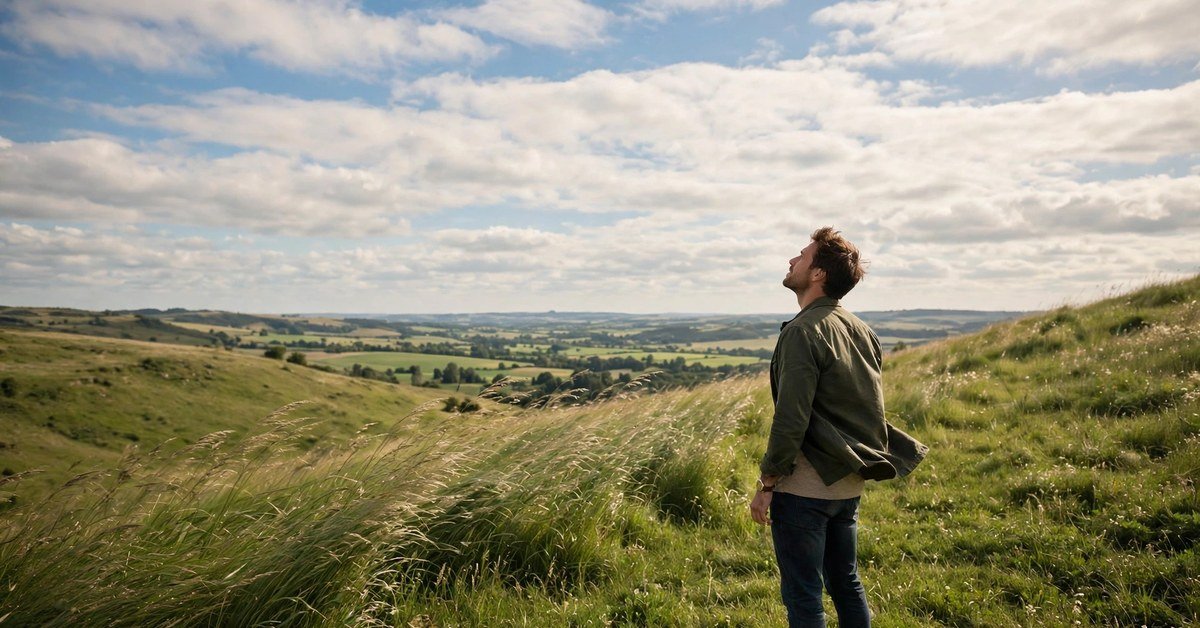
Ask anyone how to start a conversation, and the answer is the same: talk about the weather. It’s the world’s favourite small talk — safe, friendly, and always changing. But talking about the weather and nature in English is hard when the words won’t come. You point at the sky, you say “very… uh… very nice today,” and the moment passes.
This page fixes that. Below you’ll find 60 English words for weather and nature, organised like a walk: we start in the sky, come down through rain and seasons, cross the land and water, and finish among the plants at our feet.
If some everyday basics — sun, rain, wind, tree — seem to be missing, that’s on purpose: they live in our 100 essential English words list. Start there if you’re a beginner, then come back for this next set. It works exactly like our English words for house and home list — a room at a time there, a landscape at a time here.
Here’s the method: every morning, stand at your window for one minute and name everything you can see — the sky, the air, the ground, the plants. Words you use every day are words you keep. For ready-made lines about the day, our daily use English sentences (Part 4) has a whole group on weather and small talk.
English Words for Weather and Nature: The Sky & Everyday Weather
Let’s start by looking up. These twelve words describe the sky on an ordinary day — the light, the air, the changes from your window.
- sky — the space above the Earth where clouds and the sun appear — The sky turned pink just before dinner.
- sunshine — the warm, bright light from the sun — We ate our lunch outside in the sunshine.
- sunrise — the time in the morning when the sun first appears — We woke up early to watch the sunrise over the hills.
- sunset — the time in the evening when the sun goes down — The beach went quiet at sunset.
- daylight — the natural light of the day — In winter, we drive to work before daylight.
- breeze — a light, gentle wind — A cool breeze came through the open window.
- fog — thick cloud close to the ground that makes it hard to see — The fog was so thick that the buses ran slowly.
- mist — a light fog, often seen in the early morning — Mist covered the river in the early morning.
- overcast — (of the sky) completely covered with cloud, grey and dull — The sky was overcast all day, but it never rained.
- humid — (of air) warm and wet, making you feel sticky — July is hot and humid in our city.
- mild — (of weather) pleasantly warm; not too hot and not too cold — We had a mild winter this year, with hardly any frost.
- shade — an area the sun does not reach, cooler and darker — Let’s sit in the shade of that big tree.
Rain, Wind & Storms
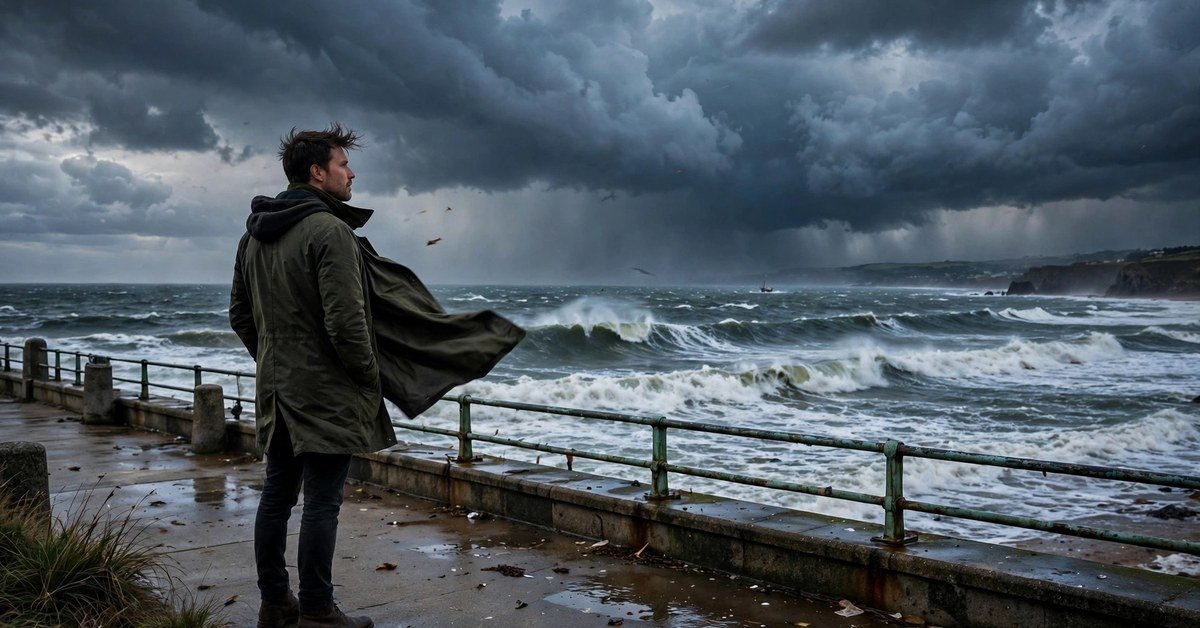
Now the sky opens. These twelve words describe rain in all its sizes, the wind when it gets serious, and the noisy shows storms put on.
- storm — very bad weather with strong wind and heavy rain — The storm broke two windows in our street.
- thunder — the loud noise in the sky that follows lightning during a storm — The children ran inside when they heard the thunder.
- lightning — a bright flash of light in the sky during a storm — Lightning lit up the valley for a second.
- drizzle — very light, fine rain — It wasn’t raining hard, just a soft drizzle.
- raindrop — one single drop of rain — A raindrop landed on my book.
- puddle — a small pool of water on the ground after rain — The children jumped over the puddles on the way home.
- rainbow — a colourful half-circle in the sky when the sun shines after rain — After the rain, a rainbow appeared over the fields.
- flood — a large amount of water covering land that is usually dry — The river rose and caused a flood in the village.
- hail — small, hard balls of ice that fall from the sky instead of rain — Hail made a loud noise on the car roof.
- gust — a sudden, strong blast of wind — A gust of wind blew my hat off.
- hurricane — a violent storm with extremely strong winds in tropical areas — The hurricane reached the coast on Friday night.
- drought — a long period with no rain, when the land becomes very dry — The drought lasted all summer and the wells dried up.

Hot, Cold & the Seasons
Heat and cold have their own vocabulary — and so do the four seasons that organise the year. Learn these twelve and you can describe any month on the calendar.
- spring — the season after winter, when plants begin to grow again — In spring, the garden fills with new green leaves.
- summer — the warmest season of the year — We swim in the lake almost every day in summer.
- autumn — the season after summer, when leaves fall from the trees (called “fall” in American English) — The park turns gold and red in autumn.
- winter — the coldest season of the year — Winter nights are long and dark here.
- warm — a little hot, in a pleasant way — It’s warm today — you don’t need a jacket.
- cool — a little cold, in a pleasant way — A cool evening followed the long, hot day.
- chilly — unpleasantly cold, though not freezing — It was a chilly morning, so I wore a scarf.
- frost — the thin, white layer of ice that covers things on cold mornings — There was frost on the car windows this morning.
- ice — water that has become solid because it is very cold — The pond was covered with ice in January.
- melt — to change from solid to liquid because of heat — The ice on the road began to melt at noon.
- scorching — extremely hot — It was a scorching afternoon — 41 degrees in the shade.
- shiver — to shake slightly because you are cold — He stood shivering at the bus stop without a coat.
Land & Water
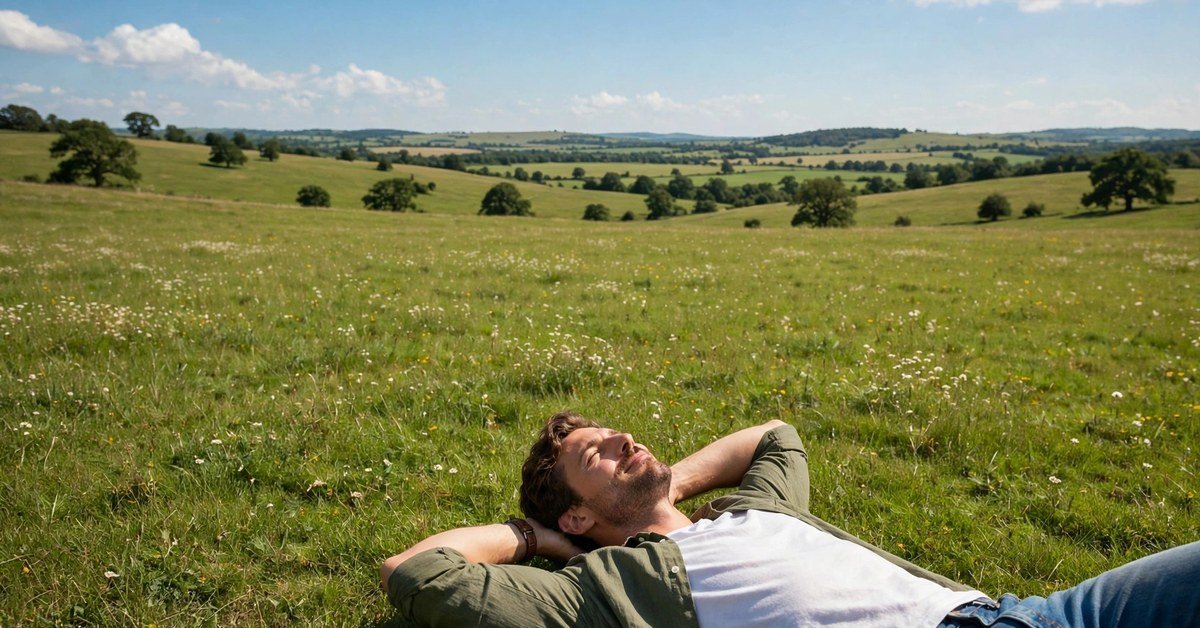
Time to look at the land, and the water that moves through it. These twelve words name the big shapes of the natural world — the shapes you see on maps and from train windows.
- mountain — a very high area of land, much higher than a hill — Snow sits on top of the mountain all year.
- valley — low land between mountains or hills, often with a river in it — Our village sits in a green valley.
- lake — a large area of water with land all around it — They rent a small house beside the lake.
- desert — a large, dry area of land with very little rain and few plants — Camels can cross the desert without water for days.
- forest — a large area of land thickly covered with trees — We walked in the forest for three hours.
- beach — the sandy or stony area beside the sea or a lake — The children built castles on the beach.
- island — a piece of land with water all around it — The island has only one small hotel.
- cliff — a high, steep rock face, often beside the sea — Don’t stand too close to the edge of the cliff.
- cave — a large, natural hole in a hill or under the ground — The cave was cool and dark inside.
- field — an area of land used for growing crops or keeping animals — The cows are standing in the field.
- waterfall — water falling from a high place to a lower place — You can hear the waterfall from far away.
- coast — the land beside the sea — Their town is on the south coast.
Living Nature
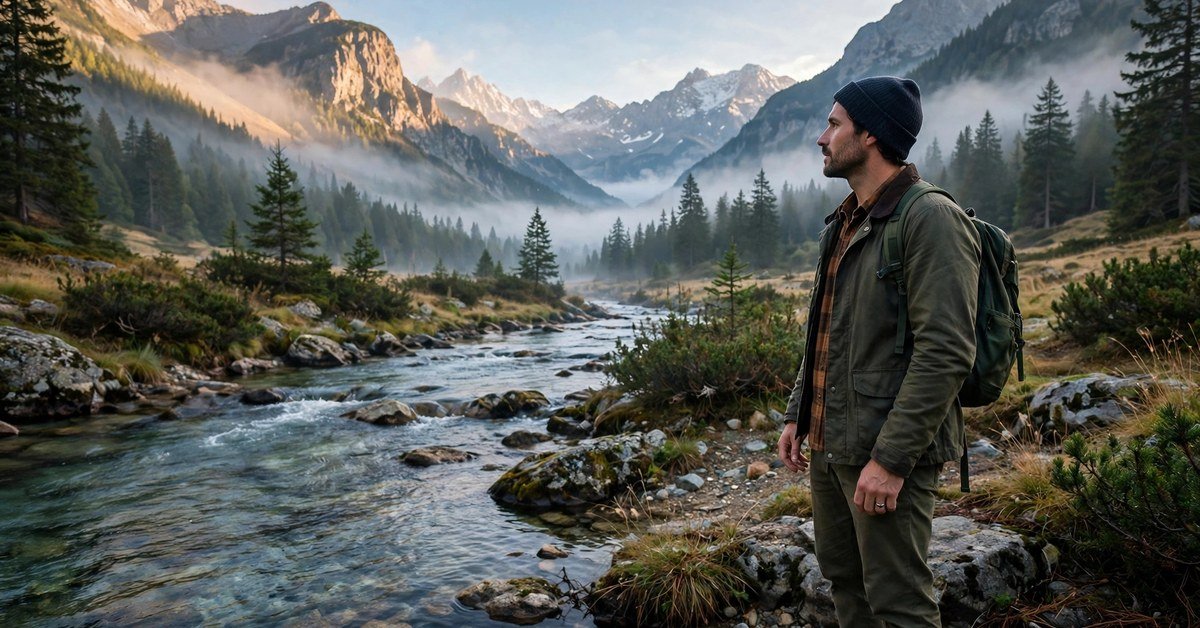
Finally, let’s look at the living world at our feet. The Cambridge Dictionary entry for “nature” covers everything from plants to the natural world — these twelve words name its everyday pieces.
- plant — a living thing that grows in the ground, with leaves and roots — Please water the plants while I’m on holiday.
- leaf — one of the flat, green parts of a tree or plant — A single leaf fell onto my book.
- grass — a common plant with thin, green leaves that covers the ground — The grass is still wet in the morning.
- branch — one of the “arms” of a tree that grows from the trunk — A small bird was singing on the top branch.
- root — the part of a plant that grows under the ground — The roots of the old tree lifted the pavement.
- seed — the small, hard part of a plant that grows into a new plant — He planted the seeds in March.
- petal — one of the soft, coloured parts of a flower — Pink petals covered the path under the tree.
- bush — a plant like a small, thick tree with many stems — Roses grow on that bush by the gate.
- stone — a small piece of rock — The children threw stones into the river.
- sand — very small, loose grains of rock that cover beaches and deserts — The sand was too hot to walk on.
- soil — the top layer of the earth in which plants grow — This soil is dark and good for vegetables.
- shell — the hard outer covering of a small sea animal, found on beaches — She collected shells along the beach.
Five Phrases About the Weather
Words travel in packs. These five phrases are fixed — learn each one whole, and you’ll understand half of every weather conversation.
- It’s pouring — it’s raining very heavily.
- a heatwave — a period of unusually hot weather lasting several days.
- freezing cold — extremely cold — stronger than just “cold”.
- clear skies — a sky with no clouds; good weather coming.
- not a cloud in the sky — the sky is completely clear and blue.
The Little Word “It”
Here’s some grammar learners often miss: in English, a weather sentence must have a subject, even when there is nothing to point at. That subject is the little word it. We say “It’s raining,” “It was windy yesterday,” and “It gets dark early in December.” This it names nothing — it’s just a placeholder that holds the subject’s seat so the sentence can begin.
The Cambridge Dictionary entry for “weather” uses exactly this pattern in its examples. So never say “Is raining today.” Give your sentence its little it, and it will sound right every time.
Frequently Asked Questions
Rain or raining — what’s the difference?
Rain works as a noun and a verb: “The rain stopped at noon,” and “It rained all night.” Raining is the -ing form, for weather happening now: “It’s raining — take an umbrella.” You can’t say “It is rain today”; choose rainy (“It’s rainy today”) or the -ing form.
Do season names take capital letters?
No. In English, spring, summer, autumn and winter are written with small letters: “in winter,” not “in Winter.” That’s different from days and months — Monday and June do take capitals. A season gets a capital only at the start of a sentence, like any other word.
What does “forecast” mean?
A forecast is a report that tells you what the weather will probably be like — tomorrow, or the next few days. You can “check the forecast” on your phone before a trip. It works as a verb too: “Rain is forecast for Friday, so the match may stop.”
Sunny or sunshiny — which one is right?
Say sunny. It’s the everyday adjective: “a sunny morning,” “It’s sunny today.” Sunshiny does exist in dictionaries, but people almost never use it. If you stick to sunny, you’ll always sound natural.
How can I practise weather words every day?
Use the window method from above: each morning, look outside and say three sentences about what you see — the sky, the air, the ground. Then check a forecast in English on your phone and read tomorrow’s weather aloud. Two minutes a day, and these 60 words will stay with you.

That’s your sky-to-ground tour complete — 60 words for weather and nature, ready for windows, walks and weather chats. This list is part of our English vocabulary collection.
When cold days keep you indoors, our English words for health and the body helps you describe how you feel, and our English words for school and education covers the words learners need in class. Learn a few words a day, say them out loud, and let the real weather do the rest of the teaching.