

Here’s some friendly news to start with: talking about tomorrow is one of the easiest jobs in English. The future simple tense uses one small word — will — and that word never changes its shape.
I will, you will, she will, they will: everybody gets the same will, and the main verb after it stays in its base form. No endings to add, no special form for he and she, nothing to memorise verb by verb.
In this guide, we’ll build the future simple tense step by step, the way a good teacher draws it on a whiteboard. You’ll learn the form, the five main jobs of will, and how will is different from going to.
We’ll also look at the signal words that travel with it, fix the five mistakes my students make most, and finish with a little practice. If you’d like the whole map first, our English tenses guide shows all twelve tenses together on one page.
And here’s a secret that should make you smile: you probably already say future simple sentences every day without noticing. Every time you tell a friend “I’ll see you tomorrow” or promise your mother “I won’t be late”, you’re using this tense perfectly. This lesson simply gives a name — and a tidy shape — to something your mouth already knows.
Future Simple Tense: The Form
The form is beautifully boring — and boring is a gift when you’re learning. Here it is, all in one table:
| Form | Pattern | Example |
|---|---|---|
| Positive | subject + will + base verb | She will call you tonight. |
| Negative | subject + will not (won’t) + base verb | We won’t be late. |
| Question | Will + subject + base verb? | Will they come tomorrow? |
| Short answers | Yes, I will. / No, I won’t. | “Will you help me?” — “Yes, I will.” |

In speech, we almost always glue will onto the word before it: I’ll, you’ll, he’ll, we’ll, they’ll. “I’ll do it” is the normal sound of English; the full “I will” is saved for strong promises and careful moments.
The negative short form is won’t — and yes, the spelling looks odd. Long ago, English had a cousin of will spelled “woll”, and won’t is a leftover from that old word. English keeps a few antiques on the shelf, and this is one of them. The Cambridge Dictionary entry for will shows just how many small jobs this one word does.
Compare all this with the past simple tense, where every verb has a past form of its own to learn — went, saw, took, ate. With will, the main verb simply stays calm and unchanged. One pattern, every person, every verb. That’s why so many teachers introduce the future simple early: it’s a tense you can use correctly on your very first day.
Questions with question words follow the same friendly pattern: just put the question word in front. “When will the shop open?” “What will you do on Sunday?” “Where will they stay?” The shape never breaks — question word + will + subject + base verb. If you can build the plain question, you can build every question.
One more antique: shall. In traditional British English, people made offers with I and we — “Shall I open the window?” and “Shall we go?” You’ll still hear those two polite questions, and they’re lovely. But for plain statements about the future, will is safe everywhere in the world today. Learn shall for listening; use will for speaking.
When Do We Use It? Five Jobs of ‘Will’
So when do we actually reach for will? It does five everyday jobs. Once you can see these five clearly, you’ll stop guessing — and start choosing.
1. Decisions made right now. You hear something, and you decide in the very same second. The sentence is born at the moment of speaking: “The phone is ringing — I’ll get it!” Or your friend yawns at the kitchen table and you say, “You look tired. I’ll make the tea.”
2. Promises. Will is the language of your word of honour: “I won’t tell anyone — your secret is safe with me.” “I’ll be there at nine, I promise.” This is also exactly the language of a job interview: “I’ll work hard, and I’ll learn quickly” is a promise about the future, and interviewers love hearing it.

3. Offers and requests. When you offer help, will is the natural choice: “Those bags look heavy — I’ll carry one for you.” And when you ask someone else to do something, you simply turn it into a question: “Will you hold the door for a moment?”
4. Predictions and opinions. When the future lives in your head — not in front of your eyes — use will, often together with I think, I hope, I’m sure or probably: “I think our team will win on Saturday.” “I’m sure you’ll love your new teacher.” “It will probably rain later, so take a coat.”
5. Future facts. Some future events are simply true, the way sunrise is true: “The sun will rise at about six tomorrow morning.” “I’ll be thirty next month.” No decision, no promise — just the future, stated plainly.
Will or Going To?
Here’s the question every learner asks, and here’s the honest answer: will and going to overlap a lot, and native speakers swap them more freely than textbooks admit. But there is a real difference in feeling, and this little table shows it:
| Will | Going to |
|---|---|
| A decision you make at this moment: “The doorbell! I’ll go.” | A plan you decided earlier: “I’m going to visit my sister this weekend — I decided last week.” |
| A prediction from your opinion: “I think he’ll pass his exam.” | A prediction from something you can see now: “Look at that ladder! He’s going to fall!” |
| An offer or a promise: “I’ll help you carry that.” | An intention you’ve already formed: “I’m going to learn French this year.” |
| A polite request: “Will you open the window?” | A question about someone’s plan: “Are you going to stay long?” |
One friendly warning: when an arrangement is fixed with another person — a time agreed, a ticket bought — English often chooses the present continuous instead: “We’re meeting Sara at six tomorrow.” Our guide to that tense explains the idea in full.
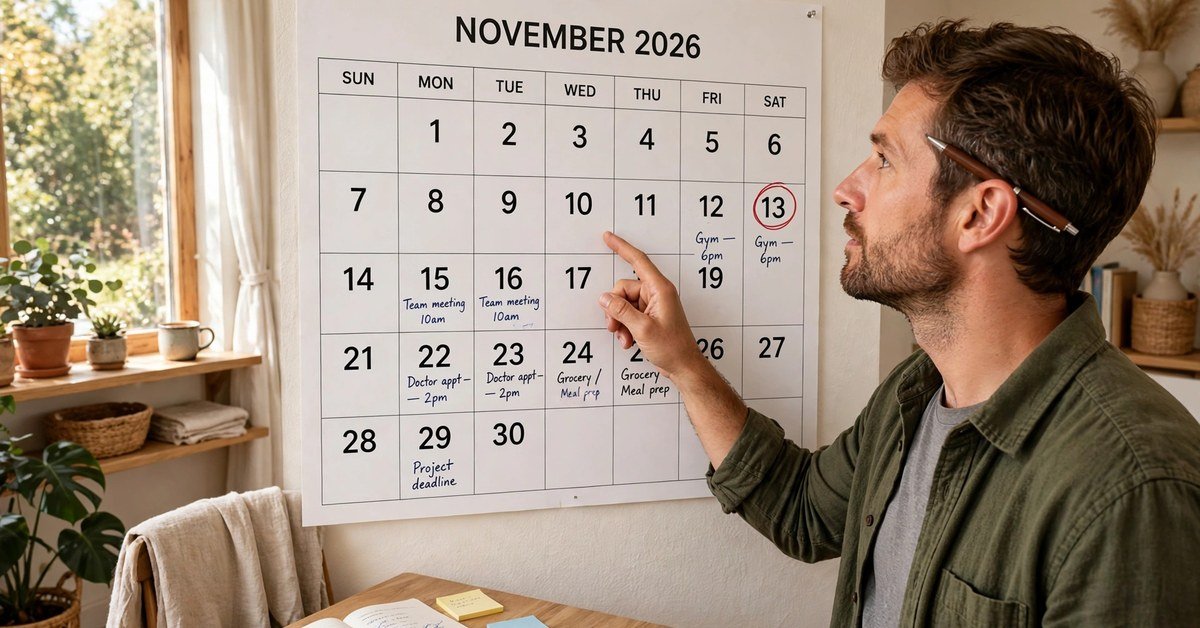
And if your brain freezes in the middle of a sentence? Choose will. For a learner, will is very rarely truly wrong. At worst, it sounds a tiny bit formal — and that’s a safe, polite mistake to make. Going to earns its place in plans and visible predictions, and you’ll grow into it naturally the more English you hear.
Words That Travel With the Future Simple
Some words shake hands with this tense so often that spotting one should make your brain whisper “will!” Here are the regular travellers:
- tomorrow — “We’ll finish the report tomorrow.”
- tonight — “Will you be home tonight?”
- next week — “She’ll start her new job next week.”
- next month — “They’ll move to a bigger flat next month.”
- next year — “We’ll travel more next year.”
- soon — “Dinner will be ready soon.”
- in the future — “In the future, I’ll plan my weeks better.”
- one day — “One day, he’ll write a book about his village.”
- I promise — “I promise I’ll write to you every week.”
- probably — “We’ll probably stay at home this evening.”
One small detail about probably: it sits between will and the main verb — “It will probably snow” — like a passenger in the middle seat. Keep it in that seat, and your sentence will sound natural every time.

Five Common Mistakes
Every learner makes these five — my students certainly do — so don’t feel bad if you spot one of your own sentences below. Look at each pattern once, and you’ll start catching it before it leaves your mouth.
Mistake 1: Adding “to” after will.
✗ I will to help you.
✓ I will help you.
After will, the verb comes bare — no to in front of it, ever.
Mistake 2: Putting -ing after will.
✗ Will you coming?
✓ Will you come?
Will is followed by the base verb, never by the -ing form.
Mistake 3: Using will for an arrangement that’s already fixed.
✗ I will meet Sara at six outside the cinema. (The tickets are bought, and Sara is already waiting.)
✓ I’m meeting Sara at six outside the cinema.
Your first sentence isn’t broken English — but when everything is arranged with another person, the present continuous is the natural, friendly choice.
Mistake 4: Adding -s to the verb.
✗ I will goes to the market later.
✓ I will go to the market later.
After will, the verb never takes an -s — not for I, not for he, not for anybody.
Mistake 5: Building the question with “do”.
✗ Do you will help me?
✓ Will you help me?
Will builds its own questions by jumping to the front of the sentence. It never needs do to help it.
Practise a Little
Your turn. Complete each sentence with will or won’t and the verb in brackets. The answers are waiting below them — no peeking until you’ve tried!
- I promise I ______ (not be) late for class tomorrow.
- ______ you ______ (open) the window, please? It’s warm in here.
- I think our teacher ______ (give) us a short test on Friday.
- Don’t worry about those heavy boxes. I ______ (carry) them upstairs for you.
- He ______ (be) eighteen on his next birthday.
Answers: 1. won’t be 2. Will … open 3. will give 4. will carry 5. will be
One more small thing: read each finished sentence out loud twice. Your ears will remember the rhythm of will long after your eyes have forgotten the page — and rhythm is half of speaking well.
Want more free practice after this? The British Council’s page on talking about the future walks you through will, going to and the present forms side by side, with exercises to try. Ten quiet minutes there will make everything in this lesson feel twice as solid.

Frequently Asked Questions
Is “gonna” the same as “going to”?
Nearly. Gonna is simply how going to sounds in fast, relaxed speech, and you’ll hear it in films, songs and everyday conversation. Understand it happily — but don’t write it in exams, work emails or formal writing. There, going to is the only safe choice.
Can I use “will” for timetables?
Be careful here. For public timetables — trains, planes, school terms — English usually picks the present simple: “The train leaves at seven.” But will is perfect for your own future facts: “My English course will finish in June, and then I’ll take the next level.”
What is the past of “will”?
It’s would. You’ll meet would in polite requests — “Would you help me?” — and in imaginary stories: “If I had wings, I would fly.” Learn will first and learn it well; would will feel like an old friend when you arrive at it.
Is “won’t” formal enough for writing?
For everyday writing — messages, friendly emails, most essays — won’t is completely fine and completely natural. In very formal writing, such as a legal letter or an official report, writers often choose the full form, will not. Both are correct; only the formality changes.
How do I talk about the weather tomorrow?
Say “It will rain tomorrow” or “It will be sunny at the weekend.” Notice the little word it at the front: English weather sentences always need it, even though it doesn’t point at anything real. Teachers call it a “dummy it”, and weather is where you’ll use it most.
That’s the future simple tense: one small word, five friendly jobs, and no verb endings to fear. The fastest way to own it is to talk about your own tomorrow — your plans, your promises, your predictions. And when you’re ready to connect the past with the present, our present perfect tense guide is the natural next lesson.