

Let me guess. Your teacher writes two sentences on the board: “I lost my keys” and “I have lost my keys.” Both sentences talk about the past. Both use the verb “lose.” So why don’t they mean exactly the same thing?
If that question has ever given you a headache, welcome to the club. The present perfect tense confuses almost every English learner at some point — even advanced students mix it up. But here’s the honest truth: the idea behind it is simple. Once it clicks, it stays clicked.
In this guide, we’ll build the tense step by step: the form, the four main uses, the signal words that travel with it, and the real difference between the present perfect and the past simple. You’ll also find the mistakes learners make most often, and a short set of exercises at the end.
If you want the full map first, our guide to all 12 English tenses shows where this tense sits in the whole system. Then come back here, and we’ll take this one tense apart slowly.
What Is the Present Perfect Tense?
Here’s the simplest way to think about it. The present perfect tense connects a past action to the present moment. The action happened before now — but it still matters now.
Think of it as a bridge. One end of the bridge stands in the past, where the action happened. The other end stands right here, in the present, where you can see the result.
Compare these two sentences:
- “I have lost my keys.” — The losing happened in the past, but the result is happening now: you’re standing at your door, and you can’t get in.
- “I lost my keys.” — This is just a past event. Maybe it happened last year. The story is finished, and it has no special link to now.
Notice something else: with the present perfect, we usually don’t say exactly when the action happened. The time isn’t the point. The connection to now is the point.
That’s the whole secret. Every use of this tense below is just this one idea wearing different clothes. If you’d like a second explanation with more examples, the Cambridge Dictionary grammar guide to the present perfect is a solid reference to keep open while you study.
The Form: Have/Has + Past Participle
Good news: the form never changes shape. You only need two pieces:
have / has + past participle
- Use have with I, you, we, and they: “I have finished.” / “They have arrived.”
- Use has with he, she, and it: “She has finished.” / “It has arrived.”
Now the three sentence shapes:
- Positive: subject + have/has + past participle — “We have seen that film.”
- Negative: subject + haven’t/hasn’t + past participle — “He hasn’t called me back.”
- Question: Have/Has + subject + past participle — “Have you seen that film?” Short answer: “Yes, I have.” / “No, I haven’t.”
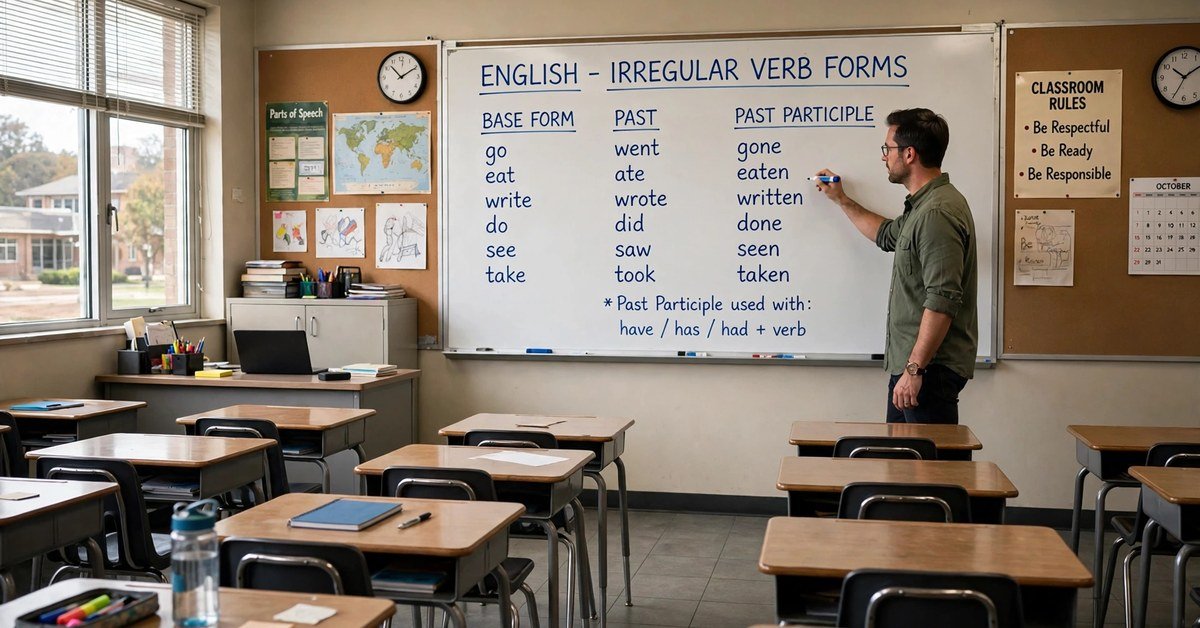
Regular verbs are easy: the past participle is just the verb + -ed — worked, finished, watched, played. Irregular verbs, as always, follow their own rules. Learn these eight first, because they appear everywhere:
- be → been
- do → done
- see → seen
- go → gone
- write → written
- eat → eaten
- take → taken
- make → made

One friendly warning: the past participle is often the same as the past simple form (worked, finished), but for irregular verbs it often isn’t — “went” is past simple, “gone” is the participle. We’ll come back to this in the mistakes section, because it catches everyone.
When to Use It: The 4 Main Uses
Teachers sometimes list ten uses for this tense, which is exactly why students panic. In real life, four uses do almost all the work. Master these four, and you can handle the present perfect in daily conversation without fear.
1. Life experience (with ever and never)
Use it to talk about things you have or haven’t done in your life up to now. There’s no time mentioned, because your life isn’t finished yet.
- “Have you ever ridden a horse?”
- “I have never flown in a plane.”
2. Recent actions with a result now (with just and already)
The action finished a short time ago, and you can see or feel the result right now.
- “I have just finished my homework, so I’m free now.”
- “She has already paid the bill — look, the receipt is here.”

3. Unfinished time (today, this week, this year)
The time period hasn’t ended yet, so more can still happen inside it.
- “I have drunk three cups of tea today.” (And the day isn’t over — there may be a fourth!)
- “We have had two meetings this week.”
4. Started in the past, still true now (with since and for)
The action or situation began earlier and continues up to this moment.
- “I have lived in this city since 2019.”
- “They have known each other for ten years.”
Look back at the four uses. Every single one connects the past to now — experience up to now, a result now, time that hasn’t finished, or something still true now. That’s the bridge again.
Signal Words: Already, Yet, Just, Ever, Never, Since, For
Some words love this tense so much that when you see them, your brain should immediately think “present perfect.” Here’s each one, where it sits, and how it sounds:
- already — sooner than expected; goes before the main verb, in positive sentences. “I have already seen this film.”
- yet — until now; goes at the end, in questions and negative sentences. “Have you finished yet?” / “I haven’t finished yet.”
- just — a very short time ago; goes before the main verb. “He has just left the office.”
- ever — at any time in your life; goes before the main verb, mostly in questions. “Have you ever tried sushi?”
- never — at no time; it makes the sentence negative, so don’t add “not” as well. “I have never been to Canada.”
- since — the starting point of a period: a year, a day, a month. “She has worked here since March.”
- for — the length of a period: two days, five years, a long time. “We have been friends for 15 years.”
Keep “since” and “for” apart with one small question: can I point at it on a calendar? If it’s a point in time, use “since.” If it’s a length of time, use “for.”
Present Perfect vs Past Simple: The Key Difference
This is the fight every learner has, so let’s settle it. The past simple is for finished time — the action sits in a closed box in the past. The present perfect is for time that is still open, connected to now.
Read these pairs slowly. Only the tense changes, but the meaning shifts:
- “I lost my keys yesterday.” / “I have lost my keys — and now I can’t get into my house!”
- “She visited Rome in 2019.” / “She has visited Rome three times.” (Her travelling days aren’t over.)
- “Did you see Ahmed yesterday?” / “Have you seen Ahmed today?” (Yesterday is closed; today is still open.)
- “He broke his arm two years ago.” / “He has broken his arm, so he can’t play in tomorrow’s match.”

And here is the golden rule — print it, save it, stick it on your notebook: if the sentence names a finished time — yesterday, last week, in 2020, two days ago — use the past simple. The present perfect and finished-time words never sit in the same sentence.
Common Mistakes to Avoid
Almost every learner makes these four mistakes. Now that you can see them coming, you won’t be “almost every learner” anymore.
Mistake 1: Using the present perfect with a finished time
- ✗ “I have seen him yesterday.”
- ✓ “I saw him yesterday.”
Mistake 2: Mixing up since and for
- ✗ “I have lived here since five years.”
- ✓ “I have lived here for five years.”
Mistake 3: Using the past simple form instead of the past participle
- ✗ “She has went home.”
- ✓ “She has gone home.”
Mistake 4: Adding “not” together with never
- ✗ “I haven’t never been to London.”
- ✓ “I have never been to London.”
See the pattern? Most of these mistakes are really one problem: pieces of the past simple sneaking into a present perfect sentence. Keep the pieces separate, and you’re safe.
Practice Exercises
Time to test the bridge in your own head. Complete each sentence with the present perfect form of the verb in brackets. If you want to see these forms working inside real dialogues afterwards, our English conversation practice page is full of them.
- I ______ (never / be) to London.
- She ______ (just / finish) her homework.
- ______ you ______ (ever / eat) Japanese food?
- We ______ (live) in this town since 2015.
- He ______ (already / read) the whole book.

Answers
- have never been
- has just finished
- Have … ever eaten
- have lived
- has already read
Got four or five right? The tense is yours. Got fewer? Don’t worry — read the “4 Main Uses” section once more and try again. For more free practice at every level, the British Council’s LearnEnglish grammar section is an excellent next stop.
Frequently Asked Questions
What is the difference between “have been” and “have gone”?
“Have been” means someone went somewhere and came back: “I have been to Turkey” means the trip is over and I’m home. “Have gone” means they went and are still there: “He has gone to Turkey” — don’t expect him at dinner tonight. Same verb, very different news.
Can I use the present perfect with “yesterday” or “last year”?
No — and this is the mistake even strong students make. Words like “yesterday,” “last year,” and “in 2020” name finished time, and finished time belongs to the past simple. Say “I visited my uncle last year,” never “I have visited my uncle last year.” When a time word closes the door, the bridge to now is gone.
Is the present perfect important for exams like IELTS?
Very. Examiners listen for a range of tenses, and the present perfect is one of the first “advanced” forms that lifts a speaking or writing score. A sentence like “I have lived in my city for ten years” sounds natural and controlled. If you’re preparing for the test, you can estimate your current level with our IELTS band calculator and plan your grammar work from there.
Do native speakers really use the present perfect, or is it just a classroom tense?
They use it constantly — in news headlines (“The team has won the cup”), at work (“I have just sent the report”), and at home (“Have you eaten yet?”). American speakers sometimes choose the past simple with “just,” “yet,” and “already” in casual speech, but the present perfect is never wrong there, and in British English it’s the natural choice.
How can I practise the present perfect every day?
Keep it small and daily. Each evening, say three true sentences about your day: “I have drunk two coffees today.” “I have finished my homework.” “I haven’t called my mother yet.” Real sentences about your real life stick far better than textbook lists. It also helps to understand the sentence shapes underneath — our guide to the types of sentences in English shows how statements and questions are built, which makes question forms like “Have you ever…?” much easier.
3 thoughts on “Present Perfect Tense: A Simple Guide with Examples and Exercises”