

There’s a moment every English learner knows. You understand the words in your book, you can read whole pages — and then a real person speaks to you, and your mind goes blank. The good news? That gap closes fastest with English conversation practice: short, real dialogues like the ones you live every day.
On this page you’ll find ten simple dialogues for everyday situations — ordering coffee, visiting the doctor, checking in at a hotel, and even the first minutes of a job interview. Every dialogue uses short, natural sentences at A2–B1 level, so you can read one in two minutes and start speaking today.
If you’d like to warm up first, learn these English phrases for daily conversation — you’ll meet many of them again inside the dialogues below. Then pick one dialogue, read it aloud, and don’t worry about mistakes. Speaking grows from speaking, not from waiting until you’re perfect.
English Conversation Practice: Why Dialogues Work
A dialogue shows you more than single words. It shows you how a conversation opens, how people answer politely, and how it ends — the full shape of real talk. When you practise a dialogue, you’re not memorising grammar rules; you’re borrowing ready-made English that people actually use.
Dialogues also build courage. The first time you say “Can I have a coffee, please?” out loud at home, it feels strange. The tenth time, it’s easy — and when the real moment comes in a café, the words are already in your mouth.
A good way to begin: choose the dialogue closest to your real life. Travelling soon? Start with the airport and the hotel. Want English for work? Start with the new colleague and the job interview. Relevance keeps you practising on the days when motivation is low.
How to Practise These Dialogues
You don’t need a teacher or a classroom. Try these three honest methods — they work because they’re simple enough to repeat every day.
Shadow the lines. Read one line, pause, and copy it out loud in the same rhythm and music. You can listen to any sentence with our free text to speech tool — type the line, listen, and repeat after it.
Practise with a partner. Take one role each, and swap after two rounds. No partner? Play both roles yourself — thousands of learners do exactly this, and it works.
Record yourself. Your phone is enough. Record one dialogue today and again next week; hearing your own progress is the best motivation there is. If a sound feels hard, spend five minutes with our guide to the 44 English sounds.
Want more listening practice? The British Council’s free speaking lessons include videos of real conversations at every level. And when a new word stops you, look it up in the Cambridge Dictionary to hear how it sounds.
10 Everyday English Dialogues for Beginners
Read each dialogue once quietly, then read it aloud twice. The useful phrases after each dialogue are the lines worth keeping in your notebook.
Dialogue 1: Ordering Coffee at a Café
Barista: Good morning! What can I get for you?
Tom: Good morning. Can I have a coffee, please?
Barista: Of course. Small or large?
Tom: A large one, please. And a glass of water.
Barista: No problem. Anything else?
Tom: Yes, one chocolate cake, please.
Barista: That’s six pounds fifty, please.
Tom: Can I pay by card?
Barista: Yes, of course. Here you are — your coffee and cake.
Tom: Thank you very much. Have a nice day!
Useful phrases: Can I have … , please? · Anything else? · Here you are

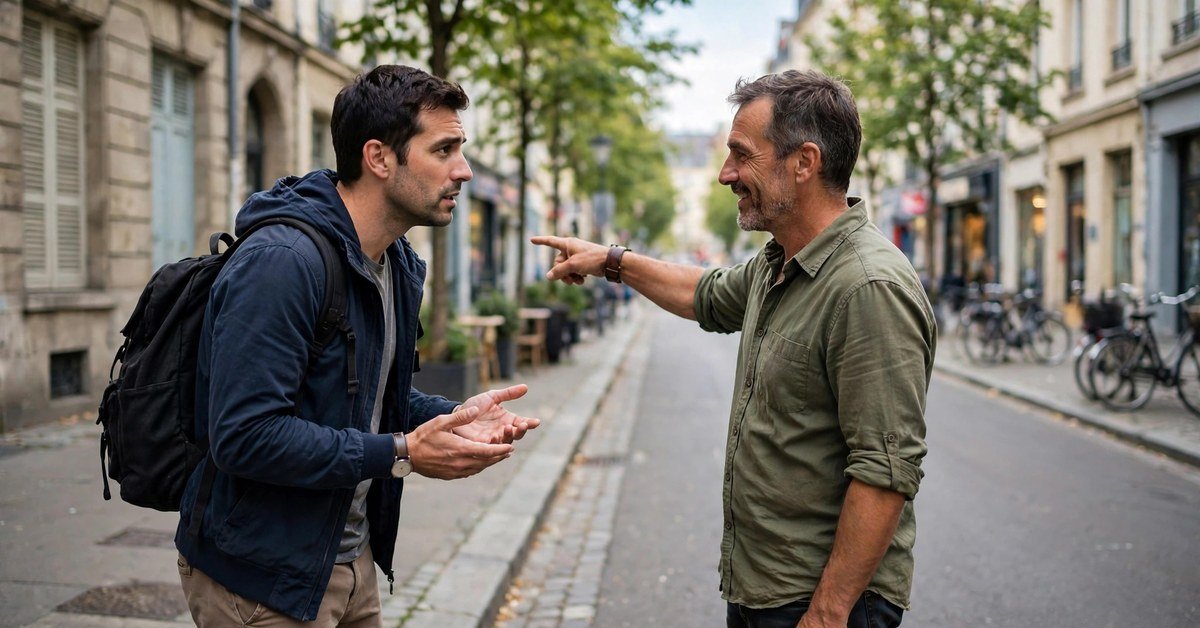
Dialogue 2: Asking for Directions
Omar: Excuse me, can you help me, please?
Emma: Yes, of course. What’s the matter?
Omar: I’m looking for the train station. Is it far from here?
Emma: No, it’s about ten minutes on foot.
Omar: Great. Which way do I go?
Emma: Go straight on, then turn left at the bank.
Omar: Straight on, then left at the bank.
Emma: Yes. The station is on your right, next to the park.
Omar: Thank you so much!
Emma: You’re welcome. Good luck!
Useful phrases: Excuse me · Is it far from here? · on your right
Dialogue 3: At the Doctor
Doctor: Good morning, Sara. How are you feeling today?
Sara: Not very well, doctor. I have a headache and a sore throat.
Doctor: When did it start?
Sara: Two days ago. I also feel very tired.
Doctor: Do you have a temperature?
Sara: Yes, a little. About thirty-eight degrees.
Doctor: I see. It’s probably a cold. You need rest and lots of water.
Sara: Do I need any medicine?
Doctor: Take these tablets twice a day, after food.
Sara: Thank you, doctor. When can I go back to work?
Doctor: Rest for two days, then come back if you don’t feel better.
Useful phrases: Not very well · twice a day · feel better

Dialogue 4: Shopping for Clothes
Assistant: Hello, can I help you?
Liam: Yes, I’m looking for a blue shirt.
Assistant: What size do you wear?
Liam: Medium, I think.
Assistant: Here’s a medium. Would you like to try it on?
Liam: Yes, please. Where are the changing rooms?
Assistant: Over there, on the left.
Liam: It fits well. How much is it?
Assistant: It’s twenty-five pounds.
Liam: Great, I’ll take it.
Assistant: Perfect. You can pay at the till.
Useful phrases: I’m looking for … · try it on · I’ll take it
Dialogue 5: Airport Check-In
Agent: Good afternoon. Can I see your passport and ticket, please?
Yusuf: Yes, here they are.
Agent: Thank you. Are you travelling to Dubai today?
Yusuf: Yes, that’s right.
Agent: Do you have any bags to check in?
Yusuf: Just this one suitcase.
Agent: Please put it on the scales. That’s fine — eighteen kilos.
Yusuf: Can I have a window seat, please?
Agent: Of course. Here’s your boarding pass. Boarding starts at four thirty.
Yusuf: Which gate is it?
Agent: Gate twelve. Have a good flight!
Yusuf: Thank you!
Useful phrases: bags to check in · a window seat · boarding pass

Dialogue 6: Checking In at a Hotel
Receptionist: Good evening. Welcome to the River Hotel. How can I help you?
Anna: Good evening. I have a booking for two nights. My name is Anna Petrova.
Receptionist: Let me check… Yes, a double room for two nights.
Anna: Does the room have free Wi-Fi?
Receptionist: Yes, it does. Breakfast is from seven to ten in the restaurant.
Anna: Great. What time is check-out?
Receptionist: Check-out is at eleven. Here’s your key card — room 204, on the second floor.
Anna: Thank you. Is there a lift?
Receptionist: Yes, just over there. Enjoy your stay!
Anna: Thank you very much.
Useful phrases: I have a booking · key card · Enjoy your stay!
Dialogue 7: Booking a Restaurant Table by Phone
Staff: Good afternoon, Bella Italia Restaurant. How can I help?
David: Hello, I’d like to book a table for this Saturday, please.
Staff: Of course. For how many people?
David: For four people.
Staff: And what time?
David: At seven thirty, if possible.
Staff: Let me check… Yes, we have a table at seven thirty.
David: Perfect. My name is David Brown.
Staff: Thank you, Mr Brown. Your table is booked for Saturday at seven thirty.
David: Great, thank you. See you on Saturday!
Useful phrases: I’d like to book a table · For how many people? · Your table is booked
Dialogue 8: Meeting a New Colleague at Work
Kate: Hi, you must be Ben. I’m Kate — I work in the sales team.
Ben: Hi Kate, nice to meet you. Yes, today is my first day.
Kate: Welcome! Where did you work before?
Ben: I worked in a small shop in my town.
Kate: And what will you do here?
Ben: I’ll help customers and answer emails.
Kate: That’s great. This is your desk, next to mine.
Ben: Thank you. Where can I get a coffee around here?
Kate: There’s a small kitchen down the hall. Come on, I’ll show you.
Ben: That’s very kind. Thank you!
Useful phrases: nice to meet you · my first day · I’ll show you

Dialogue 9: Talking About Weekend Plans
Mia: Hi Sam! Do you have any plans for the weekend?
Sam: Not yet. Maybe I’ll stay at home and watch a film. What about you?
Mia: I’m going to visit my sister in the country on Saturday.
Sam: That sounds nice. How will you get there?
Mia: By train, in the morning. On Sunday, I want to try a new recipe.
Sam: Cooking? I didn’t know you liked cooking!
Mia: I love it. Why don’t you come for lunch on Sunday?
Sam: I’d love to! What time?
Mia: Come at one o’clock. Bring some bread if you can.
Sam: Perfect. See you on Sunday!
Useful phrases: Do you have any plans? · What about you? · Why don’t you … ?
Dialogue 10: The Start of a Job Interview
Interviewer: Good morning. Please, take a seat.
Daniel: Good morning. Thank you for inviting me.
Interviewer: So, Daniel, tell me a little about yourself.
Daniel: I’m twenty-six, and I worked in a phone shop for three years.
Interviewer: Why do you want this job?
Daniel: I want to learn office work and help customers.
Interviewer: What are your strengths?
Daniel: I’m honest, I arrive early, and I learn quickly.
Interviewer: Do you have any questions for me?
Daniel: Yes — when does the job start?
Interviewer: We hope next Monday. We’ll call you on Friday.
Daniel: Thank you for your time. I look forward to hearing from you.
Useful phrases: take a seat · tell me about yourself · I look forward to hearing from you
Keep Practising, Little and Often
Ten dialogues are a strong start, but fluency grows from daily crumbs, not weekend feasts. Tomorrow, add these 100 daily use English sentences to your routine, and grow your word bank with these 100 essential English words for beginners. One dialogue a day, and real conversations stop feeling scary surprisingly fast.
Frequently Asked Questions
1. How often should I practise these dialogues?
A little every day works best. Ten to fifteen minutes daily builds a stronger habit than one long session on Sunday, and short sessions are easier to keep.
2. I don’t have a partner. Can I practise alone?
Yes, absolutely. Play both roles out loud, record yourself on your phone, and shadow the lines. Many successful learners practise alone for months — the speaking still counts.
3. Should I memorise the dialogues word for word?
Learn the pattern, not just the page. Once a dialogue feels easy, change small things — order tea instead of coffee, ask about a bus instead of a train. That step turns practice into real speaking.
4. What level are these dialogues?
They’re written for A2 to B1 learners, with short sentences and everyday words. If one feels hard, start with Dialogue 1 and repeat it for a few days before moving on.
5. How can I improve my pronunciation while practising?
Record one dialogue and listen honestly. Pick just two or three sounds that feel difficult and work on those for a week, instead of trying to fix everything at once.
6. What should I study after these dialogues?
Move on to phrases and sentences for new situations, and learn the words behind them. When you can handle these ten dialogues without reading, you’re ready for longer conversations.
7 thoughts on “English Conversation Practice: 10 Everyday Dialogues for Beginners”