
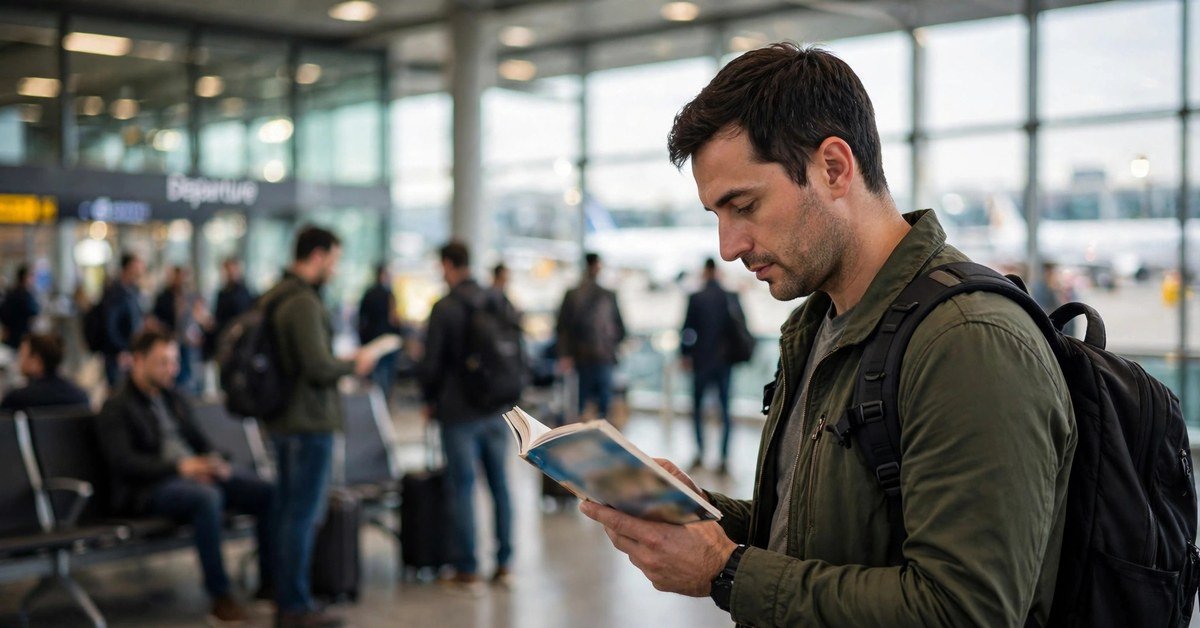
There’s a special panic that only travellers know. The officer at the desk asks you something simple, the loudspeaker calls your flight — and every English word you own quietly leaves the room. The fix is not more grammar. It’s a small set of English words for travel — the right sixty words.
Here are 60 English words for travel, grouped by the moments of a real journey: the airport, the plane, the hotel, city transport, asking the way, and — just in case — asking for help. Every word has a plain meaning and a real example, so you can use it the day you learn it.
English Words for Travel: How to Learn Them
Don’t try to swallow all 60 the night before your flight. Learn one group at a time — ten words — and picture the moment where each word lives. Words learned with a place attached are words you keep.
Learn the moment, not the list. When you study boarding pass, see yourself at the gate, holding it. Your brain stores the little film with the word, and at the real gate both come back together.
Say every word out loud. Travel English is spoken English — words must live in your mouth, not just on the page. For sounds that trip learners up, like the silent start of aisle, our guide to the 44 English sounds shows how each sound is made.
Grow words into lines. A word on its own rarely saves you; a ready sentence does. If single words still feel new, begin with our 100 essential English words for beginners, then turn travel words into full lines with our 40 English phrases for daily conversation.
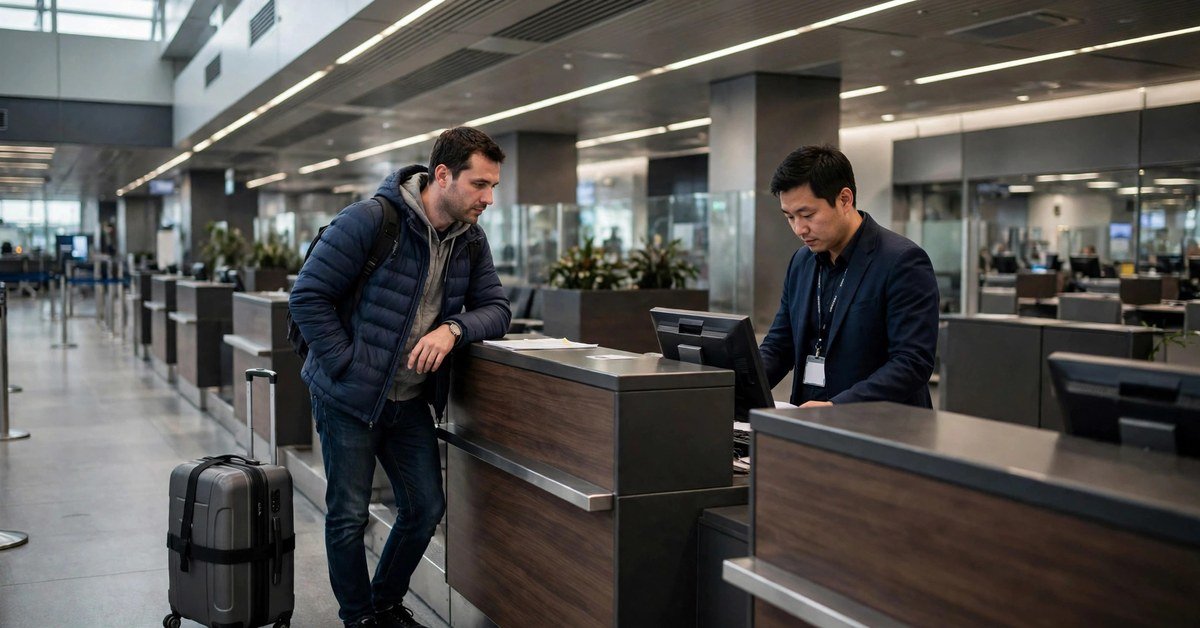
1. At the Airport
Everything at the airport happens fast, in English — signs, screens, loudspeakers. These ten words unlock most of it.
- passport — the official book that proves who you are abroad. “Please show your passport at check-in.”
- ticket — the paper or phone document that lets you travel. “I keep my ticket in my email, just in case.”
- check-in — where you register for your flight and hand over big bags. “Check-in for our flight closes in twenty minutes.”
- boarding pass — the card or phone pass that lets you walk onto the plane. “Your boarding pass shows your gate and seat number.”
- luggage — all the bags and suitcases you take on a trip. “My luggage was two kilos too heavy.”
- suitcase — a large case with a handle for carrying clothes. “He packed his suitcase the night before the trip.”
- security check — the place where officers scan you and your bags before the flight. “Take your laptop out at the security check.”
- gate — the waiting area where passengers enter the plane. “Our gate is at the far end of the airport.”
- flight — a journey in a plane. “The flight to Dubai takes about three hours.”
- departure — the time a plane leaves and starts its journey. “Departure is at 7:30, so let’s reach the gate by seven.”
2. On the Plane
In your seat, the vocabulary shrinks to a small, friendly set — the words the crew will use around you.
- seat — the chair that is yours for the flight. “Excuse me, I think this is my seat.”
- window seat — a seat beside the window of the plane. “I always choose a window seat for the view.”
- aisle — the long space between the rows of seats. “Please don’t leave your bag in the aisle.”
- seat belt — the strap you wear across your body to stay safe. “Fasten your seat belt and keep it on.”
- take-off — the moment the plane leaves the ground. “The little boy clapped at take-off.”
- landing — the moment the plane comes back down to the ground. “It was a soft landing, and everyone smiled.”
- pilot — the person who flies the plane. “The pilot said we would arrive early.”
- cabin crew — the people who look after passengers during the flight. “Ask a cabin crew member if you feel sick.”
- turbulence — sudden, bumpy movement of the plane in rough air. “There was some turbulence, but it passed quickly.”
- headphones — the small speakers you wear on your ears for films and music. “The crew gave us headphones after take-off.”
3. At the Hotel
Hotel English is polite and predictable — the same small exchanges happen everywhere. Learn the words, and check-in stops being a test.
- reception — the front desk where hotel workers welcome and help guests. “You can ask for a city map at reception.”
- reservation — a room the hotel keeps for you because you booked it earlier. “I have a reservation for two nights, under the name Ahmed.”
- single room — a room with a bed for one person. “A single room is cheaper, and I travel alone.”
- double room — a room for two people. “We booked a double room with a view of the sea.”
- key card — the plastic card that opens your hotel room door. “If your key card stops working, go to reception.”
- floor — one level of a building. “Our room is on the fifth floor, near the lift.”
- lift — a small moving room that carries people up and down (Americans say elevator). “The lift is just past the restaurant.”
- towel — a soft cloth for drying your body after washing. “Could we have two clean towels, please?”
- wake-up call — a phone call from the hotel that wakes you at the time you choose. “I asked for a wake-up call at six.”
- check-out — the time when you must leave your room and pay your bill. “Check-out is at eleven, but bags can stay at reception.”

4. Transport in the City
Cities move on buses, trains and taxis. These words help you pay the right money and get off at the right stop.
- bus stop — the place where buses stop for passengers. “The bus stop is right outside the station.”
- fare — the money you pay for a journey in a bus, taxi or train. “What’s the fare to the old town, please?”
- platform — the raised area in a station where you board a train. “The train to Oxford leaves from platform three.”
- taxi — a car with a driver that you pay to take you somewhere. “We took a taxi because it was raining hard.”
- driver — the person who drives a bus, taxi or train. “The driver told us the next stop was ours.”
- passenger — a person who travels in a vehicle but does not drive it. “The bus was full of passengers with shopping bags.”
- single ticket — a ticket for one journey in one direction. “A single ticket to the airport, please.”
- return ticket — a ticket that takes you somewhere and brings you back. “A return ticket costs less than two singles.”
- traffic — all the cars and buses moving on the roads. “We were late because the traffic was terrible.”
- journey — the act of travelling from one place to another. “The journey by train takes about two hours.”
5. Directions & Places
Most direction words are tiny — left, right, opposite, next to — but they decide whether you find the museum or a motorway.
- map — a drawing of streets and places that helps you find your way. “This map shows every street in the old town.”
- straight on — in a line forward, without turning. “Go straight on until you see the river.”
- turn left — to change direction towards the left. “Turn left at the bank, then walk for a minute.”
- turn right — to change direction towards the right. “Turn right at the traffic lights.”
- corner — the point where two streets meet. “There’s a small café on the corner.”
- bridge — a road or path built over a river or another road. “Cross the bridge, and the museum is in front of you.”
- opposite — on the other side of a street, facing something. “The hotel is opposite the station — you can’t miss it.”
- next to — very close beside something. “The pharmacy is next to the post office.”
- behind — at the back of something. “There’s a quiet garden behind the hotel.”
- in front of — before something, facing it. “The taxi is waiting in front of the hotel.”
6. Problems & Help
Nobody plans problems, but travellers who can name them solve them faster. Practise saying these lines out loud in our English conversation practice dialogues, so they’re ready on the one day you hope never comes.
- lost — not knowing where you are. “We’re lost — could you show us on the map?”
- help — something you do to make life easier for someone. “Excuse me, I need some help with my bags.”
- emergency — a sudden, dangerous situation that needs quick action. “This phone number is only for an emergency.”
- police — the people whose job is to keep places safe. “Let’s ask the police officer over there.”
- hospital — a place where doctors treat sick and hurt people. “He fell on the ice and went to hospital.”
- pharmacy — a shop where you buy medicines. “Is there a pharmacy near the hotel?”
- embassy — the office of your country’s government in another country. “I lost my passport, so I phoned my embassy.”
- travel insurance — an agreement that pays your costs when things go wrong on a trip. “Travel insurance paid for my new ticket home.”
- delay — a late start; extra waiting time. “Our train had a delay of forty minutes.”
- cancel — to decide that something planned will not happen. “We had to cancel the hotel booking when our flight changed.”
Quick Practice
Try these without looking back up the page. One: “Please show your ___ and ticket at check-in.” Two: “Fasten your ___ before take-off.” Three: “Our room is on the fourth ___.” Four: “A ___ ticket takes you there and brings you back.” Five: “The pharmacy is ___ the post office, right beside it.” Six: “We had to ___ the booking when our flight changed.”
Answers: 1. passport. 2. seat belt. 3. floor. 4. return. 5. next to. 6. cancel. All six right? These words are becoming yours. Missed one? Spend five minutes with that group tonight — the second visit is where words move in. Then hear them working inside full lines in our 100 daily use English sentences.
Ready to hear real travel English in the wild? The British Council’s B1 listening lessons include transport announcements — the actual loudspeaker English of stations and airports, with exercises. And when a new word stops you mid-trip, the Cambridge Dictionary entry for “travel” gives clear meanings and examples you can trust.
Frequently Asked Questions
How many travel words do I really need?
These sixty cover the skeleton of a trip — every routine moment from check-in to check-out. Add please, excuse me and thank you, and you’ll be surprised how far they carry you.
Should I learn British or American travel words?
Most travel words are the same in Britain and America. A few pairs differ — lift and elevator, return ticket and round-trip ticket. Learn one as your speaking word; simply recognise the other.
When is the best time to learn these words?
Two or three weeks before a real trip. Words learned for a journey you’ll actually take stick far better — your brain knows the practice is not pretend. No trip planned? Learn them anyway; the next one will thank you.
I know the words, but I freeze at the desk. What helps?
Freezing is normal, and it isn’t a language problem — it’s a pressure problem. Prepare five lines you expect to say, and repeat them at home until they’re boring. Then smile, speak slowly, and point at the word on your phone if you must. Communication wins; perfection can wait.
Are 60 words really enough at an airport?
Yes — for the routine journey. Check-in, bags, security, the gate, boarding: it all runs on this small vocabulary, and signs help with pictures at every step. Harder moments, like a missed flight, are what group 6 is for.
How can I practise pronunciation before I go?
Say every example sentence out loud — quietly in a queue counts. Then pick your three hardest words, record them on your phone, and repeat them daily for a week. By travel day, your mouth will know them by heart.
2 thoughts on “60 English Words for Travel (Airport, Hotel & Transport)”