
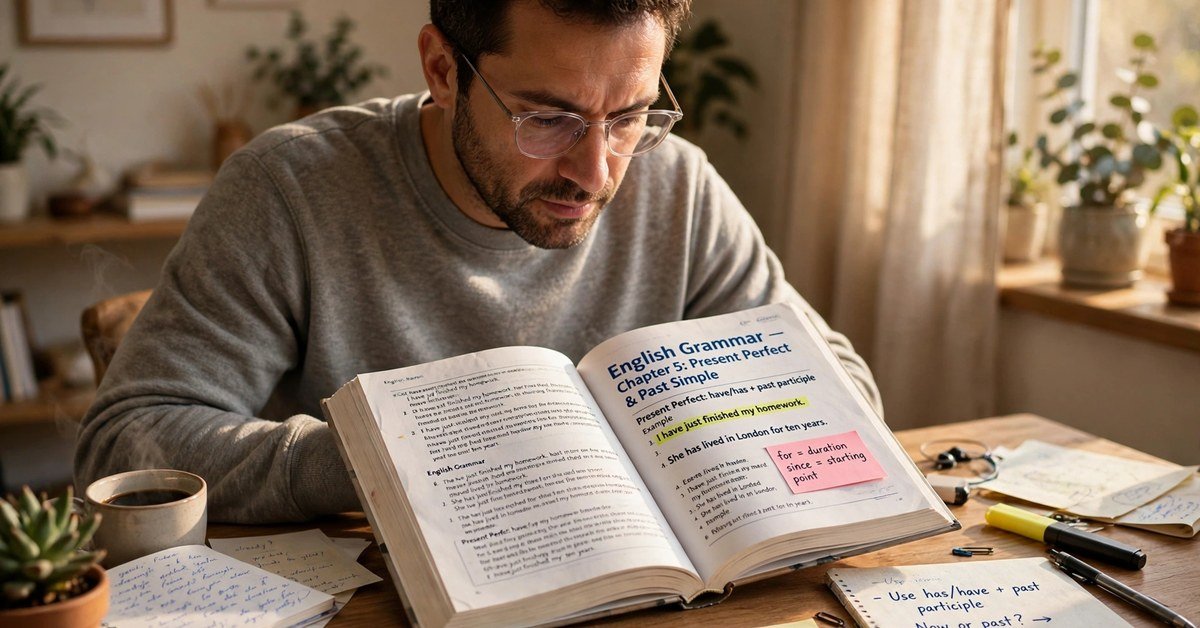
You say sentences like this all the time: “If I finish work early, I’ll call you.” It looks simple, but it’s clever — it ties two things together: one thing happens first, and the other follows.
That’s all a conditional sentence is: a sentence with two halves. The first half gives the condition (the “if” part), and the second half gives the result. English has four famous types — zero, first, second and third — and learners panic about them. Don’t. The four types are just four answers to one friendly question: how real is this situation?
Always true? A real plan for tomorrow? A daydream? A “what if” about a past you can’t change? Answer that, and the right form usually falls into place. Let’s walk through all four, slowly.

What Are Conditional Sentences?
Every conditional sentence has two clauses. The if-clause carries the condition — it starts with if and describes the situation. The main clause carries the result: what happens, will happen, would happen or would have happened.
Take “If the shop is open, I’ll buy some bread.” The condition is the shop is open; the result is I’ll buy some bread. Swap the halves — “I’ll buy some bread if the shop is open” — and the meaning is identical. Only the punctuation changes.
The comma rule is a kind one: when the if-clause comes first, put a comma after it (“If the shop is open, I’ll buy some bread”); when it comes second, no comma (“I’ll buy some bread if the shop is open”).
Both halves are built from tenses you already know. If verb forms still feel wobbly, our guide to English tenses walks through all twelve, and the present continuous guide covers actions in progress. Here’s the whole family on one map:
| Type | Form | Used for | Example |
|---|---|---|---|
| Zero | If + present simple, present simple | Facts that are always true | If you drop a glass on stone, it breaks. |
| First | If + present simple, will + verb | Real future possibilities | If it rains tonight, we’ll stay in. |
| Second | If + past simple, would + verb | Imaginary situations now | If I had wings, I would fly to work. |
| Third | If + past perfect, would have + past participle | Imagining a different past | If you had called, I would have come. |
Keep this map nearby.
Zero Conditional — Facts That Are Always True
Form: If + present simple, present simple. Both halves stay in the present simple — this isn’t about one special moment; it’s about how the world works.
Use it for science, rules and personal habits — things that happen every time. Heat it, drop it, forget it: the result never changes, guaranteed.
- If you mix blue and yellow paint, you get green.
- If the temperature falls below zero, the lake freezes.
- If my little brother eats peanuts, his face goes red.
- If I drink tea after nine in the evening, I sleep badly.
- If you press the red button twice, the machine stops.
- If students don’t drink enough water, they get headaches.
Notice: no will, no would anywhere. The result isn’t a plan or a dream — it’s simply what always happens.
First Conditional — Real Plans for the Future
Form: If + present simple, will + verb. Use the first conditional for real possibilities in the future: real plans, possible weather changes, promises and warnings about tomorrow.
“If the bus is late again, I’ll take a taxi.” Nothing imaginary here — a real plan for a real tomorrow, and the conditional of plans, offers and “let’s see what happens.”

- If it rains this evening, we’ll stay at home and watch a film.
- If you finish your homework early, we’ll go for a walk.
- If she studies hard this week, she’ll pass Friday’s test.
- If we leave at six, we’ll catch the early train.
- If you need help with those heavy bags, I’ll carry them upstairs.
- If the shop is still open, I’ll buy milk on my way home.
One warning — the most famous rule in this topic: will stays OUT of the if-clause. The if-half uses the present simple, even for the future. “If it will rain” is wrong; “If it rains, I’ll take an umbrella” is right. Will lives in the result half only. (To revise will itself, see our future simple tense guide.)
Second Conditional — Imaginary Situations Now
Form: If + past simple, would + verb. Don’t let the past simple fool you: this isn’t about the past at all. The past form is English’s way of saying “this is imaginary.” Use it for dreams, wishes and situations that aren’t true right now.

- If I had a bigger kitchen, I would cook for the whole family every Sunday.
- If we lived near the sea, we would swim every morning.
- If he spoke French, he would get that job in Paris.
- If I won a free plane ticket, I would visit my cousin in Canada.
- If the roads were quieter, I would cycle to work.
- If I were you, I would tell the teacher the truth.
That last example hides a famous detail. In the second conditional, careful English uses were for every person after if — I were, he were, she were, it were — even though was is the normal past form of be. That’s why the classic advice begins “If I were you…” You’ll hear “If I was you” in everyday speech (see the mistakes below), but were is the safe, standard choice. The rest of the if-clause is plain past simple.
Third Conditional — Imagining a Different Past
Form: If + past perfect, would have + past participle. The third conditional looks backwards. It imagines a past that didn’t happen, and a result that never happened either. It’s the conditional of regrets, relief and “if only.”
“If we had left ten minutes earlier, we would have caught the train.” We didn’t leave earlier. We didn’t catch the train. This form lets us replay the past in our heads — kindly or cruelly.
- If you had set an alarm, you wouldn’t have missed the bus.
- If she had saved her work, she wouldn’t have lost the whole file.
- If I had known it was your birthday, I would have baked a cake.
- If the goalkeeper had jumped the other way, he would have saved the goal.
- If they had booked the tickets in May, they would have paid half the price.
- If we had taken an umbrella, we wouldn’t have got so wet.
One honest extra: real English also mixes conditionals. A past condition can have a present result — “If you had eaten breakfast, you wouldn’t be hungry now.” That’s a third-conditional if-half with a second-conditional result. It’s common — no panic needed; you’ll meet it naturally once the main types feel easy.

If, When and Unless
Three small words guard this topic, and learners mix them up constantly. When says the speaker is sure something will happen. If says it might happen — or might not.
“When I get home, I’ll cook dinner” — the speaker will definitely get home; it’s only a matter of time. “If I get home early, I’ll cook dinner” — maybe work runs late, so the cooking isn’t promised. Same evening, same kitchen, different certainty.
Unless means “if… not”, squeezed into one word. “Unless you hurry, you’ll miss the bus” means “If you don’t hurry, you’ll miss the bus.” And “We won’t go to the park unless the rain stops” = “We won’t go if the rain doesn’t stop.” One caution: unless already carries the “not”, so don’t add another one.
5 Common Mistakes
Five mistakes appear in almost every learner’s notebook. Here’s each one with the fix:
1. Will in the if-clause
✗ If it will rain tomorrow, I’ll stay at home.
✓ If it rains tomorrow, I’ll stay at home.
Why: the if-clause sets the scene with the present simple; will belongs in the result half only.
2. Would in a second-conditional if-clause
✗ If I would have more time, I would learn the piano.
✓ If I had more time, I would learn the piano.
Why: in the second conditional, the if-half takes the past simple; would stays in the result half.
3. “If I was you”
✗ If I was you, I’d apologise.
✓ If I were you, I’d apologise.
Why — honestly: you WILL hear “If I was you” in films and everyday chat, and everyone will understand you. But were is the form exams and careful writers expect — build it as your habit.
4. The wandering comma
✗ I’ll text you, if the train is late.
✓ If the train is late, I’ll text you. / I’ll text you if the train is late.
Why: comma after the if-clause when it comes first; no comma when it comes second.
5. Would in both halves of a third conditional
✗ If you would have called me, I would have come.
✓ If you had called me, I would have come.
Why: the if-half uses the past perfect (had + participle); would have lives only in the result half.
Quick Practice
Complete each sentence with the correct form of the verb in brackets. Answers below — no peeking until you’ve tried all ten!
- If you ______ (heat) butter in a pan, it ______ (melt).
- If we ______ (not leave) now, we ______ (miss) the train.
- If I ______ (be) taller, I ______ (play) basketball.
- She ______ (not fail) the exam if she ______ (revise) more.
- If he ______ (save) a little money every month, he ______ (buy) a bike by summer.
- If they ______ (take) a map, they ______ (not get) lost yesterday.
- If I ______ (know) his phone number, I ______ (call) him right now.
- If you ______ (not water) the plants, they ______ (die).
- If we ______ (win) the match tomorrow, we ______ (celebrate) with pizza.
- If she ______ (speak) more slowly, everyone ______ (understand) her yesterday.
Answers
- heat, melts — zero conditional: a fact that’s always true.
- don’t leave, will miss — first conditional: a real future result.
- were, would play — second conditional: an imaginary present.
- wouldn’t have failed, had revised — third conditional: a different imagined past.
- saves, will buy — first conditional: a real, possible plan.
- had taken, wouldn’t have got — third conditional: “yesterday” means past.
- knew, would call — second conditional: “right now”, but imaginary.
- don’t water, die — zero conditional: what always happens.
- win, will celebrate — first conditional: tomorrow could really happen.
- had spoken, would have understood — third conditional: a finished past moment.

Frequently Asked Questions
Can I start with the result clause first?
Yes — the meaning doesn’t change at all. “If you’re hungry, I’ll make sandwiches” and “I’ll make sandwiches if you’re hungry” say the same thing. Just remember the comma rule: a comma after a first if-clause, and no comma when it comes second. For extra exercises, the British Council’s conditionals lesson is a friendly place to practise.
Why is there no “will” after if?
Because the if-clause sets the scene, and English sets it in the present simple — even for the future. The will does its job in the result half instead. Think of it as one will per sentence, living with the result.
“If I was” or “If I were” — the final honest answer?
Use were. It’s correct with every person (I were, she were), it’s what exams expect, and it never sounds wrong. Was is genuinely common in relaxed speech — but were works everywhere, so make it your default.
Are there more than four conditionals?
Yes — mixed conditionals combine a past condition with a present result (“If you had eaten breakfast, you wouldn’t be hungry now”), plus cousins built with unless, as long as and in case. The four types are still the map to learn first; the Cambridge Dictionary grammar pages on conditionals explore the whole family when you’re ready.
How do I know which type to use?
Ask one question: how real is it? Always true → zero. A real future possibility → first. Imaginary now → second. An imaginary different past → third. That “reality test” picks the right form in almost every sentence.
Conditionals look big on a grammar chart and feel small in conversation — the reality test becomes automatic faster than you’d think. And if tiny words are your weakness, our guide to prepositions in, on and at fixes another classic mix-up.
1 thought on “Conditional Sentences in English: Zero, First, Second and Third”