

Three of the smallest words in English cause some of the biggest headaches. In, on and at are only two or three letters long, but between them they carry the whole job of saying when something happens and where something is. If you’ve ever frozen mid-sentence — “The meeting is ___ Monday… ___ the morning…” — you’re in very good company. Almost every learner on the planet has stood exactly where you’re standing.
Here’s the good news: these three prepositions aren’t random. There’s one simple picture behind all of them, and once you see it, the rules start to feel almost obvious.
- at = a point. Think of a pin dropped on a map, or one exact minute on a clock.
- on = a surface, or one day on the calendar. Think of a cup on a table, or a red circle around one date.
- in = inside something bigger. Think of water inside a bottle — a month, a year, a city, a room.
Point, surface, inside. Hold that picture in your mind and let’s walk through the details together. And if tenses still trip you up as well, our guide to English tenses makes a friendly companion read — time words and tenses love working as a team.
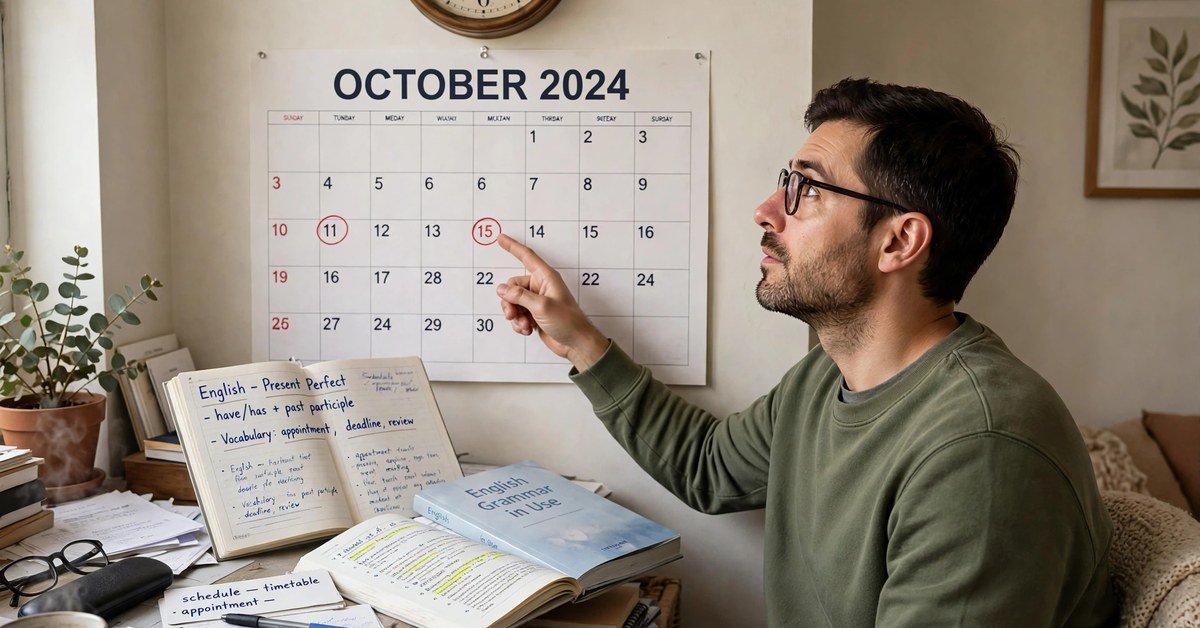
Prepositions of Time: In, On, At
Let’s start with time, because that’s where these three work the hardest — and where the pattern is clearest. Small, precise times take at. Single days take on. Longer stretches take in.
| Preposition | Use it for | Examples |
|---|---|---|
| at | exact clock times; night; the weekend (British English); festivals | at 7 o’clock, at midnight, at night, at the weekend, at Christmas |
| on | days of the week; dates; a day plus a part of the day | on Monday, on 3 June, on Friday evening, on my birthday |
| in | months, years and seasons; parts of the day; longer periods, and “after a length of time from now” | in April, in 2015, in winter, in the morning, in two hours |
Now listen to one ordinary day, told by one ordinary family. Ahmed wakes up at 6 o’clock and leaves home at 7.30. His English class is on Tuesdays and Thursdays, and this week there’s a test on Friday morning. He was born in June, in 2009, and his family always drives to the hills in summer.
His sister reads in the evening, but she refuses to study at night — she says her brain shuts down at midnight. The family is planning a picnic at the weekend — that’s the British way to say it; Americans usually say on the weekend — and if the weather behaves, they’ll be sitting by the river in two days’ time.
That last example surprises a lot of learners, so it deserves its own line: in + a length of time points into the future. The class starts in ten minutes means ten minutes from now, not ten minutes long. Keep that in your pocket; you’ll hear it every day.
One more thing before we move on. When you talk about finished events, these little words usually travel with the past tense — we travelled in June, not we travel in June. Our past simple tense guide shows you how that tense works, with plenty of examples. And if you’d like extra exercises at exactly this level, the British Council’s page on prepositions of time is a lovely next stop.
Prepositions of Place: In, On, At
Place works with the same picture. At treats a place as one point on the map. On treats it as a surface or a line. In puts something inside a space or a bigger area.
| Preposition | Use it for | Examples |
|---|---|---|
| at | a point or exact spot; home, work and school as activities | at the door, at the station, at the bus stop, at home, at work, at school |
| on | a surface, a street or road, a floor of a building | on the table, on the wall, on this street, on the second floor |
| in | inside a space; rooms, cities, countries and other larger areas | in the room, in a box, in Lahore, in Pakistan, in a queue |
Let’s walk down one street together and watch the picture do its work. A man is waiting at the bus stop, opposite a baker standing at the door of his shop. Inside, fresh cakes are sitting in a glass box, and a big price list hangs on the wall. Across the road, children are playing in the park, and an old man has fallen asleep on a bench in the sun.

Now zoom in closer. My keys are in my pocket, my phone is on the table, and my little brother is hiding in his room — which is on the third floor of a tall building in Karachi, the biggest city in Pakistan. And me? I’m sitting at my desk, at home, writing this for you. Count them: point, surface, inside — every single one follows the picture.
You’ll notice at work and at home in that table. Workplaces love at when we mean the activity, not the building, and our list of English words for work is full of phrases like these in the wild.

Transport: On the Bus, In the Car
Transport confuses everyone at first, so here’s the trick: if you can stand up and walk around inside the vehicle, English uses on. That’s why we get on a bus, on a train, on a plane and on a ship. You step up and walk down the middle to find a seat — you’re on it, like a big moving floor.
You can’t walk around inside a car or a taxi, so those take in: get in the car, sitting in a taxi. Bikes and motorbikes are different again — you sit on top of them, so it’s on a bicycle and on a motorbike. The same goes for a horse, if you’re lucky enough to ride one.
And now the famous exception: walking. There’s no vehicle at all, and the fixed phrase is on foot. Yesterday I went on the bus to the market, came home in a taxi because it started raining, and my cousin arrived on his bicycle, smiling and completely dry. Then he walked the last street on foot with me. I still don’t know how he stayed dry.
Right now, all over the world, people are sitting in cars and are standing on trains. If that -ing form is still new to you, our present continuous tense guide explains it simply, step by step.

Fixed Phrases Worth Memorising
Some phrases don’t stop to ask the picture for permission — they come as fixed chunks, and native speakers expect them whole. Learn these ten as complete blocks and you’ll sound natural straight away.
- at night — night takes at, not in. The streets are quiet at night, and that’s when I study best.
- at the moment — it means “right now”. At the moment, I’m learning three new words a day.
- in the morning — mornings sit inside in, like the other parts of the day. In the morning, our whole house smells of tea and toast.
- on Monday morning — when a day and a part of the day arrive together, the day wins, so we use on. The new course starts on Monday morning.
- in time — early enough, before it was too late. We reached the station in time and caught the train.
- on time — at exactly the planned time; punctual. The train left on time, at 7.15 sharp. Compare the two: a good passenger arrives in time; a good train leaves on time.
- at home — no in, no article, just at home. My grandfather is at home today, resting.
- in hospital — British English uses in hospital for a patient; Americans usually say in the hospital. After the accident, he stayed in hospital for a week.
- on the phone — talking on a call. Sorry, she’s on the phone — can she call you back?
- at the end (of) — the finishing point of something. At the end of the story, the two friends meet again.
5 Common Mistakes
Teachers see the same five slips again and again. If you recognise your own English here, don’t worry — you’re about thirty seconds away from fixing all five.
- ✗ I’ll see you in Monday. → ✓ I’ll see you on Monday. Days are single pages on the calendar, so they take on.
- ✗ We study at the morning. → ✓ We study in the morning. Parts of the day take in — night is the one famous exception.
- ✗ He is in home today. → ✓ He is at home today. At home, at work and at school are fixed chunks; learn them whole.
- ✗ Her birthday is on June. → ✓ Her birthday is in June. Months are long stretches, so they take in; on waits for the exact day — on 5 June.
- ✗ We arrived in the airport at midnight. → ✓ We arrived at the airport at midnight. Buildings and points take at; save in for cities and countries — arrived in Lahore.

Quick Practice
Your turn. Fill each gap with in, on or at, then check the answers underneath. No peeking — the picture is in your head now: point, surface, inside.
- The shop opens ___ 9 o’clock.
- My exams start ___ Monday.
- She was born ___ 2015.
- We go to the mountains ___ summer.
- The train arrives ___ twenty minutes.
- There’s a clock ___ the wall.
- I’ll wait for you ___ the station.
- His office is ___ the fourth floor.
- The children are playing ___ the garden.
- He goes to work ___ foot.
Answers:
1. at
2. on
3. in
4. in
5. in
6. on
7. at
8. on
9. in
10. on
How did you do? Eight or more — the picture is working. And the fastest way to make it permanent is to use these words in real sentences about your own day, like the ones in our daily use English sentences collection.
Frequently Asked Questions
Why do we say “at night” but “in the morning”?
Honestly? Because English grew up that way, and nobody voted on it. Morning, afternoon and evening are treated as stretches of time you sit inside, so they take in. Night became a fixed point-phrase instead: at night. There is one small extra: in the night exists too, but it means one specific moment during one particular night — the baby woke twice in the night.
Is it “in the weekend”, “at the weekend” or “on the weekend”?
British English says at the weekend, and American English says on the weekend. Both are correct in their own homes. In the weekend is wrong in both, so cross that one off your list. Pick the variety you hear most often around you, and stay loyal to it.
Do we say “arrive in” or “arrive at”?
Both — it depends on the size of the place. Use arrive in for cities and countries: we arrived in Karachi at noon. Use arrive at for buildings, stations and other points: we arrived at the hotel tired and hungry. And never say arrive to — English simply doesn’t allow it.
Is it “in a photo” or “on a photo”?
It’s in a photo, because you are inside the scene the photo shows: that’s me in this photo, standing next to my brother. The same goes for in a picture and in a video. On would mean physically on top of the paper — like a coffee mark on a photo — which is rarely what anybody means.
How do I stop mixing up in, on and at?
Learn one anchor phrase for each word and hang everything on those three hooks: at 7 o’clock, on Monday, in June. Then, every morning for one week, describe your own day out loud using all three — it takes twenty seconds and it works surprisingly fast. When you want to go deeper, the Cambridge grammar page on at, on and in for time is a clear, trustworthy next read.
Point, surface, inside — that’s the whole secret, and now it’s yours. Go and use all three before lunch; your English will feel the difference today, not someday.