

“It felt surreal.” A footballer says it after lifting a trophy, still out of breath. An actor says it on a red carpet, blinking into the cameras. And honestly, you have probably said it too, standing somewhere you never expected to be, half waiting to wake up.
But where does that word come from? And what is the surrealism meaning hiding behind it? Because “surreal” did not start as interview small talk. It started as the name of one of the strangest and boldest art movements of the last hundred years.
In this guide, I will explain surrealism in plain English: what it means, where the word comes from, what makes something surreal, and how to use both “surrealism” and “surreal” naturally in your own sentences.
Surrealism Meaning in Simple Words
Here is the simplest way to put it. Surrealism is a movement in art and literature that tried to show the world of dreams and the hidden mind, instead of the tidy world we see while we are awake.
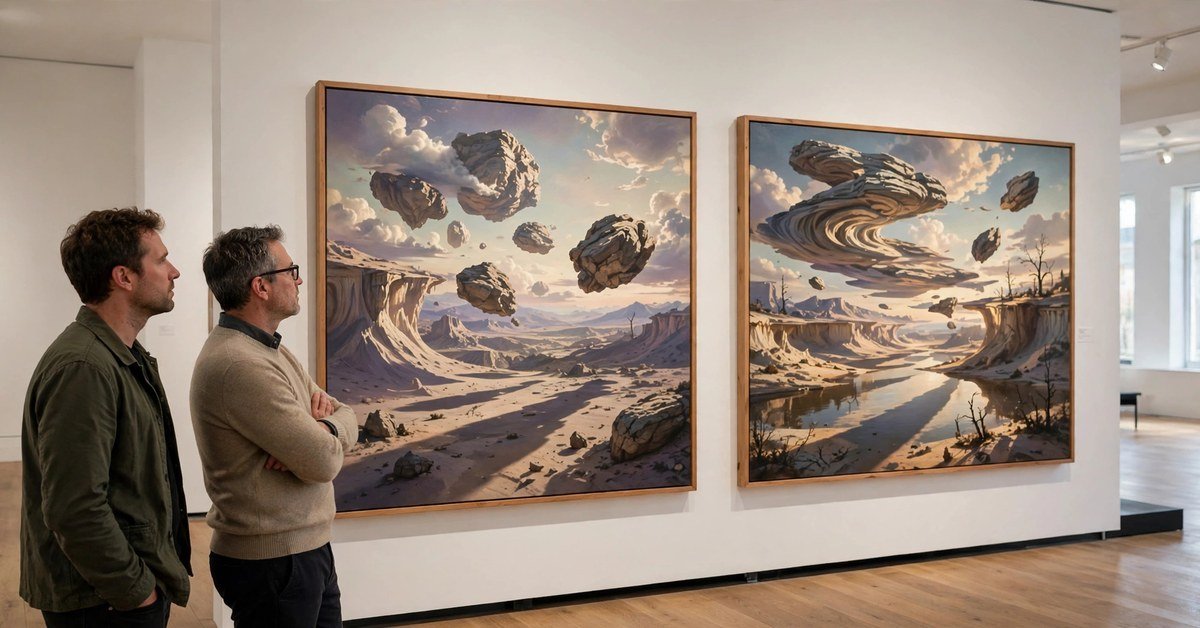
A surreal image puts ordinary things together in ways that could never happen in real life. A clock melts over a branch. A train rolls out of a fireplace. It is not random, exactly. It just follows dream logic instead of waking logic.
That is also why the word escaped into everyday speech. When people today call a moment “surreal,” they are borrowing that old idea: the moment feels too strange, too dreamlike, to be quite real.
If you want the dictionary’s own wording, Merriam-Webster describes surrealism as producing fantastic imagery through unnatural or irrational combinations. Same idea, dressed in formal clothes.

Where the Word Comes From
The word comes from French: surréalisme. Split it in two and it tells its own story. Sur means “beyond,” and réalisme means “realism.” Beyond realism. Something more than real.
The French poet Guillaume Apollinaire first used the word in 1917. He was writing about a ballet that mixed dance, music, and design in ways audiences had never seen, and ordinary words like “realistic” simply did not fit. So he built a new one.
Surrealism as an organised movement starts a little later, in Paris, in 1924. That is when the poet André Breton published his Surrealist Manifesto, and the loose idea suddenly had a leader, a group, and a mission.
The timing matters. Europe had just come through the First World War, and many young artists felt that cold, rational thinking had hardly covered itself in glory. Before surrealism there was Dada, a noisy, anti-art movement born from the same frustration. Breton’s group took Dada’s rebellious energy and aimed it somewhere new: inward, at dreams.
What Makes Something Surreal?
So what actually makes a painting, a film, or even a moment surreal? A few ingredients show up again and again.
Dream logic. In dreams, one room melts into another, dead friends chat with you at bus stops, and nobody finds any of it odd. Surreal art copies that. Cause and effect take the afternoon off.
Impossible combinations. A lobster resting on a telephone. A fish swimming through the sky. Two completely ordinary things, one impossible meeting. Your brain keeps trying to make sense of it, and that struggle is exactly the point.

The unconscious mind. Breton and his friends were fascinated by Sigmund Freud, who argued that dreams reveal thoughts we hide while awake. The surrealists wanted art from that hidden place. Some wrote or drew “automatically,” letting their hands move before their sensible minds could tidy anything up.
Ordinary things made strange. It does not have to be wild. A perfectly normal object, placed in the wrong spot or drawn at the wrong size, can feel deeply surreal. A giant apple in a small room unsettles us precisely because everything else looks so calm.
Surrealism in Art
When most of us picture surrealism, we picture paintings. And the first name that arrives is usually Salvador Dalí, the Spanish artist with the famous upturned moustache and an imagination like a fever dream.
His best-known painting shows pocket watches draped over a branch and the edge of a cliff, gone soft as warm cheese. Time itself seems to be melting in the heat. Once you have seen those clocks, you never quite forget them.
René Magritte, a Belgian painter, played a quieter game. His men wear bowler hats and ordinary suits, but a green apple floats in front of a face, and a painted pipe calmly insists that it is not a pipe. Everything looks respectable. Nothing behaves.
Max Ernst, a German artist in the same circle, took yet another route. He rubbed pencil over wood grain and floorboards, then let the textures suggest strange creatures and forests, which he drew into finished pictures.
Three artists, three very different styles. What they shared was not a look. It was a way of thinking. If you would like to see how the art world itself tells this story, the Tate’s page on surrealism is a friendly next stop.
Surrealism Beyond Art
Surrealism was never only about paint. It slipped out of the gallery almost immediately, and honestly, it never really went back.
Filmmakers loved it from the start. Early surrealist films jumped from one impossible scene to another, the way dreams do, and directors still borrow the trick whenever a character sinks into a dream or a memory. If a film suddenly stops obeying the rules of time and place, surrealism is usually somewhere in its family tree.
Photographers joined in too, bending darkroom techniques to make bodies stretch, merge, and float. Then advertising noticed. A perfume bottle the size of a building, a car parked on a cloud — selling things through impossible images is surrealism wearing a suit.
And memes? Internet humour runs on surreal fuel. Random combinations, captions that make emotional sense but no logical sense, images that get funnier the less they explain themselves. Your group chat, most days, is more surrealist than it knows.
“Surreal” in Everyday English
Here is the funny thing, though. Most people who say “surreal” today are not thinking about Dalí at all.
In everyday English, surreal is an adjective. It describes a real experience that feels like a dream: “Winning the scholarship felt surreal.” “Seeing my name on the book cover was completely surreal.” “After a year of video calls, meeting her in person felt surreal.”

Notice the pattern in those examples. The event really happened. That is the whole point of the word. Surreal does not mean fake. It means real, but with a dream wrapped around it.
It also helps to separate three words learners often mix up. Surreal is the adjective for experiences and images. Surrealism is the noun: the art movement, or a style that borrows from it. Unreal is different again; it means not real, or, in casual speech, astonishingly good, as in “the food there is unreal.”
Think of it this way: surreal sits at the dreamy, impractical end of English. It is the natural opposite of a phrase like down to earth, which describes someone practical, sensible, and firmly planted in the real world.
How to Use Surrealism and Surreal in Sentences
Reading definitions is one thing. Using the words without sounding like a dictionary is another. Here are some natural examples to steal:
- Walking through the empty airport at 3 a.m. was a surreal experience; even the announcements sounded like they were underwater.
- His paintings are full of surrealism: birds with human legs, and staircases that climb into the sky.
- Graduating after four hard years felt surreal. I kept expecting someone to tell me there had been a mistake.
- The film uses surrealism to show the hero’s fears instead of explaining them in dialogue.
- The old house, full of strangers’ furniture and ticking clocks, felt completely surreal to her.
- Many advertisements borrow surrealism, placing products in impossible dream worlds so that viewers remember them.
- In his essay, he argued that surrealism was a quiet protest against a world that had stopped making sense.
- It was a surreal morning: no traffic, no queues, and my train arrived early. I checked twice that I was awake.
Words Like Surrealism
A few near-synonyms are worth knowing, because they are close but not twins.
Dreamlike is the nearest and gentlest: soft, calm, and pleasant, like a happy dream. Bizarre means very strange, and it often carries a raised eyebrow; it can sound critical. Fantastical belongs to stories and imagination, playful rather than unsettling.
Uncanny is the interesting cousin. It describes something familiar that feels wrong in a way you cannot quite name, and it sits very close to the surrealist mood. Absurd, finally, stresses the illogical and ridiculous; people often use it when something is so unreasonable it becomes funny, or worth criticising.
So a dreamlike morning is peaceful, an uncanny one makes your skin prickle, and a surreal one does a bit of both at once.
Quick Practice
Try these three. Fill each gap with surreal, surrealism, or uncanny:
- Seeing the northern lights for the first time felt completely ______; I understood the photos had not been exaggerating.
- Dalí was a leading figure in the ______ movement.
- The empty playground at midnight had an ______ stillness, as if it were waiting for children who never came.
Answers: 1. surreal 2. surrealism 3. uncanny
If word meanings are your thing, keep exploring: our guide to what a phrasal verb is explains another everyday mystery of English.
Learners also often ask us about easy idioms like piece of cake and burn the midnight oil, and you can look up dozens more in our Idiom Finder.

Frequently Asked Questions
Is surrealism a compliment?
Usually, yes. Calling a film, a book, or an experience surreal suggests it was strange in a memorable, impressive way. Context matters, though: describing a meeting or a plan as surreal can gently suggest it was chaotic and hard to follow. Tone decides.
Can a real event be surreal?
Absolutely, and that is the word’s most common modern use. Weddings, victories, reunions, even disasters are described as surreal precisely because they really happened but felt like dreams. If it were simply imaginary, we would reach for a different word.
What is the difference between surreal and surrealism?
Surreal is an adjective: a surreal evening, a surreal image. Surrealism is a noun: the historical art and literature movement, or a style influenced by it. A photograph can look surreal without belonging to surrealism the movement, in the same way a song can sound jazzy without coming from the birth of jazz.
Is surrealism still alive today?
The original movement faded decades ago, but its ideas never left. Dream logic, impossible combinations, and images from the unconscious are everywhere in modern film, photography, fashion, advertising, and online humour. As a group it ended; as a way of seeing, it is still working.
How do you pronounce surrealism?
Surrealism is pronounced /səˈrɪəˌlɪzəm/, roughly “suh-REER-liz-um,” with the stress on the second syllable. Surreal follows the same pattern: /səˈrɪəl/, “suh-REERl.” Say it a few times out loud and it will start to feel natural.
Can I use “surreal” in a formal essay?
Yes, with a little care. In essays about art, film, or literature, surreal and surrealism are perfectly respectable words. In everyday formal writing, surreal can sound slightly informal, so writers sometimes swap in “dreamlike” or “strangely unreal.” But if you are describing the movement itself, surrealism is the only correct term.