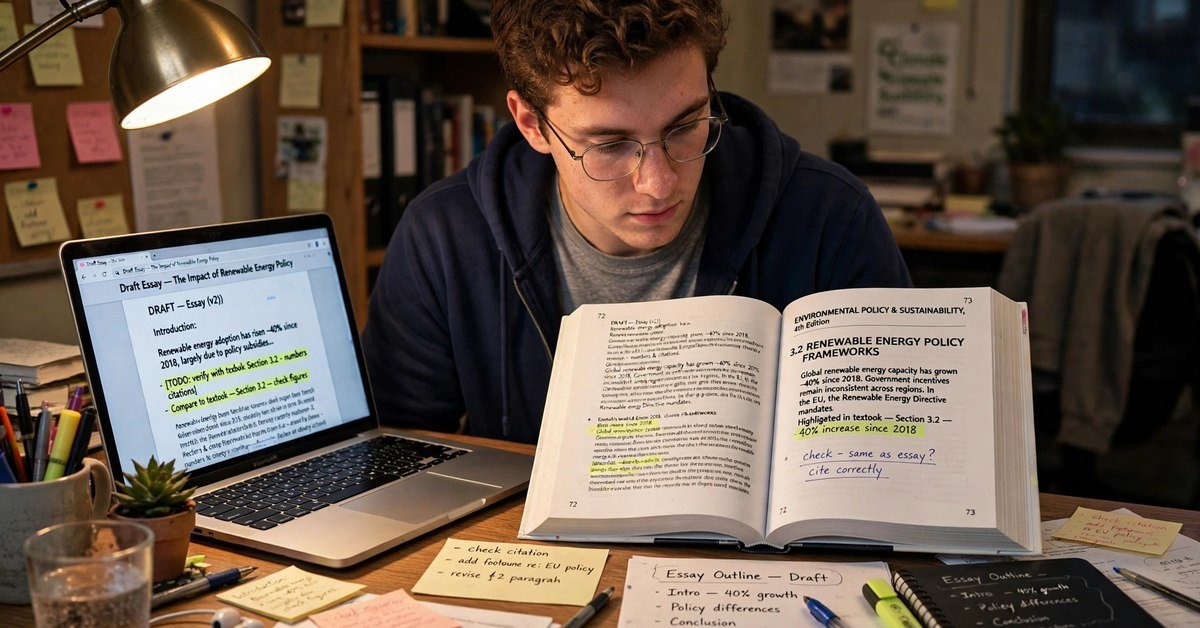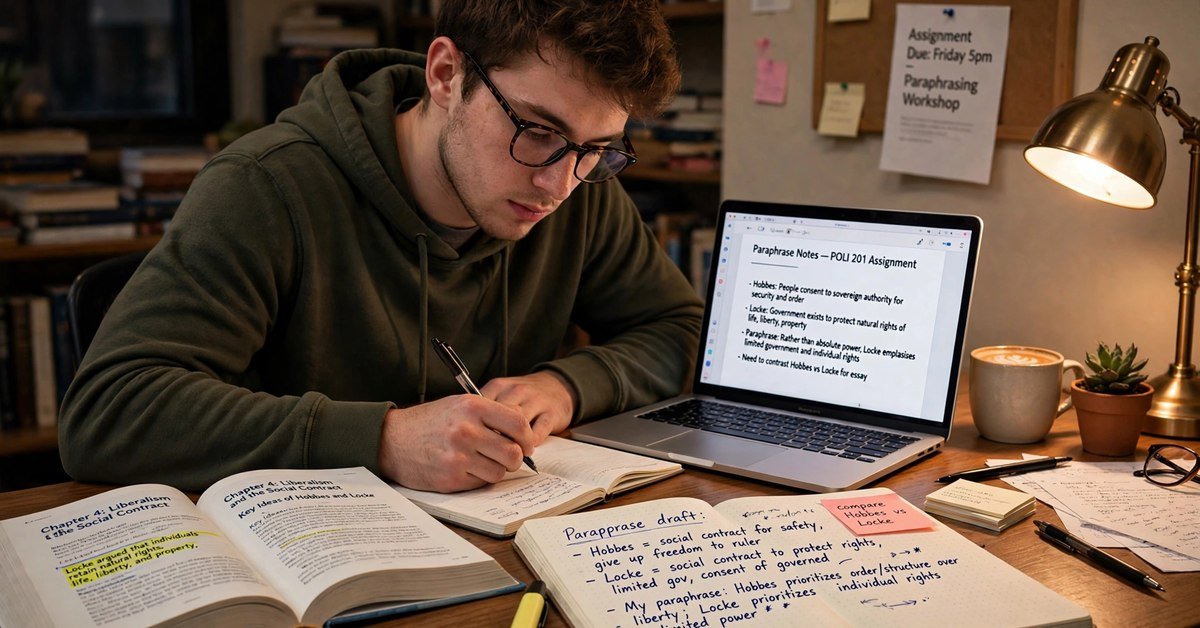
Your lecturer sets an essay. You read a good paragraph in a journal article, and it says exactly what you want to say — better than you could say it yourself. So what do you do? Copy it word for word and hope nobody notices? That is the fastest way to lose marks, and at most universities it counts as plagiarism, even if you did not mean to cheat.
Paraphrasing in academic writing is the honest way out of that trap. You take someone else’s idea, rebuild it in your own words and your own sentence shape, and you still give them the credit. Done well, it shows your lecturer you actually understood the reading — and it lets your own voice come through instead of a string of other people’s sentences.
This guide shows you how: a simple four-step method, four worked examples, the mistakes that catch most students, and a short practice set at the end.
Quick Answer: What Is Paraphrasing?
Quick answer: Paraphrasing means restating someone else’s idea in your own words, keeping the meaning the same — and still citing the source.
It is not the same as quoting. A quotation copies the exact words inside quotation marks. It is not the same as summarising either. A summary shortens a whole passage into its main points. A paraphrase keeps the full idea and roughly the same length, but the wording and the sentence shape are yours.
Here is the test that matters most. If you change only two or three words in a sentence and keep everything else — the order, the structure, the rhythm — that is not a paraphrase. That is copying with a small disguise, and plagiarism software will spot it in seconds. A real paraphrase could not be mistaken for the original, even though it says the same thing.

Why Universities Care So Much About It
It is easy to think of paraphrasing as a fussy rule. It is not — there are three practical reasons it sits at the centre of academic writing.
First, it proves understanding. Anyone can copy a sentence. Rebuilding it in different words proves you actually followed the argument, and that is what the marks are for.
Second, it keeps your essay yours. An essay built from long quotations reads like a collage of other writers. One built from paraphrases reads like one person thinking clearly, using sources to support their own argument.
Third, it protects you. Universities check submitted work against huge databases of published writing. A copied sentence, even one you forgot to reference, can trigger a match and a difficult conversation. A genuine paraphrase with a citation does not. If you are writing to a professor about an assignment, the same honesty applies — our guide on how to email your professor shows how to ask for help politely when you are unsure about the rules.
Paraphrasing vs Quoting vs Summarising
Students mix these three up all the time, so here is the difference in plain terms.
Quoting copies the exact words. Use it when the original wording is famous, precise, or impossible to improve — a definition, a striking phrase, a line of data. Keep quotations short and rare. An essay that is mostly quotations looks like the writer had nothing to add.
Paraphrasing restates one idea in your own words, at about the same length. This is your default tool. Most of the source material in a good essay should arrive this way.
Summarising shrinks a whole section, chapter or article into its main points. Use it when you need the background quickly and the detail does not matter for your argument.
A simple rule of thumb: quote the words you cannot improve, paraphrase the ideas you need in full, and summarise the background your reader only needs briefly.
The 4-Step Method
You do not need talent for this. You need a method, and you need to follow it in order. Skip a step and the paraphrase usually fails.
Step 1: Read until you can explain it aloud
Read the sentence or paragraph twice. Then look away and explain it to yourself in one or two plain sentences, as if you were telling a friend. If you cannot do that yet, read it again — students who skip this step end up shuffling words around a sentence they never understood, and the result is usually wrong as well as copied.
Step 2: Cover the original and write from memory
This is the step that does most of the work. Put the book down, close the tab, turn the page over — and write your version without looking. When the original is in front of you, your brain copies its shape without asking. When it is hidden, your brain is forced to rebuild the idea in your own words. That is the whole trick.
Step 3: Change the words AND the sentence shape
A good paraphrase changes two things, not one. Swap words for synonyms where the meaning truly matches, but also rebuild the sentence: turn a long sentence into two short ones, turn a passive sentence into an active one, move the main point to the front. Our guide to the passive voice is useful here, because switching between active and passive is one of the easiest ways to change a sentence’s shape without changing its meaning.
Step 4: Compare, then cite
Now look at the original again and check three things: does your version say the same thing, nothing more and nothing less? Does it look and sound different? Is every key term still accurate — especially numbers, names and technical words, which you should not change? Then add the citation. A paraphrase without a citation is still plagiarism, even when the words are fully your own.
The Purdue Online Writing Lab explains the same point clearly: a paraphrase must be “your own rendition of essential information and ideas expressed by someone else, presented in a new form” — and it still needs a citation. You can read their full guidance on paraphrasing if you want the academic version of this rule.

4 Worked Examples: Weak vs Good Paraphrase
Examples teach this faster than rules do. In each pair below, the first version is the kind of near-copy that gets students into trouble. The second is a genuine paraphrase.
Example 1 — original: “Regular exercise improves memory in older adults by increasing blood flow to the brain.”
Weak: “Regular exercise improves memory in older people by increasing blood flow to the brain.” Only two words changed. This is copying.
Good: “Older adults who exercise often tend to remember things better, because physical activity sends more blood to the brain (Smith, 2023).” New words, new shape, same meaning, citation included.
Example 2 — original: “Students who take notes by hand remember lectures better than students who type their notes.”
Weak: “Students who write notes by hand remember lectures better than students who type them.” Same sentence, same order. Still copying.
Good: “Typing notes during a lecture may feel faster, but the research suggests handwriting helps the material stick. Students who wrote by hand recalled more of the lecture afterwards (Mueller & Oppenheimer, 2014).” The idea is split, the order is reversed, and the meaning survives.
Example 3 — original: “Many international students find academic writing difficult because the style is very different from the English they learned at school.”
Weak: “A lot of international students find academic writing hard because the style differs greatly from the English they learnt in school.” Same bones, different skin. Not enough.
Good: “The English taught in school and the English expected in university essays are two different styles, and that gap is one reason many international students struggle with academic writing.” The sentence is turned around completely, and the meaning is intact. If this sounds like your own experience, our campus English phrases guide covers the everyday language of university life alongside the academic kind.
Example 4 — original: “The author argues that social media has changed the way young people form friendships.”
Weak: “The writer claims that social media has altered how young people make friends.” Close, but the structure is identical.
Good: “According to the author, friendships among young people now develop differently — and social media is the reason why (Jones, 2022).” Reporting verbs matter here: “argues”, “claims”, “suggests” and “notes” each carry a different shade of meaning, and choosing the right one is part of good paraphrasing. Our guide to reported speech explains those verbs in detail.
Notice the pattern in every good version: the words changed, the shape changed, the meaning stayed, and the source got its credit.
5 Mistakes That Catch Most Students
1. Changing only a few words. This is the most common mistake, and the most dangerous, because it feels like you did the work. If your sentence still follows the original word for word, start again from step 2.
2. Changing the meaning by accident. Synonyms are rarely exact. “Cheap” and “inexpensive” look similar, but one sounds like poor quality and the other does not. “Problem” and “crisis” are not the same size. When a word carries a judgement or a number, keep it or check it twice.
3. Forgetting the citation. Students often think citations belong only to quotations. They do not. Any idea that came from a source needs one, however thoroughly you rewrote it. No citation, no credit — and a possible plagiarism flag.
4. Paraphrasing sentence by sentence. If you work through a paragraph one sentence at a time, your essay ends up following the original author’s argument in the original author’s order. Read the whole paragraph, understand its point, then write the point in your own order.
5. Keeping the technical terms wrong. Some words must stay exactly as they are: names, numbers, dates, and subject-specific terms. You would not paraphrase “photosynthesis” or “GDP” into something vaguer. Change the ordinary words around them, and leave the precise ones alone. The Cambridge Dictionary defines paraphrase as expressing “the same thing using different words” — and that definition is a good reminder that the “same thing” part is not optional.
When You Must Quote Instead
Paraphrasing is the default, but sometimes a quotation is the honest choice: when the original words are the evidence, when the wording itself matters more than the idea (a law, a survey question, a famous line), or when rewriting would lose precision, like a statistical result. In each case, keep it short, put it in quotation marks, and cite it.
Quick Practice: Try These 5 Sentences
Cover each original, write your version, then compare it with the good paraphrase underneath. Do not peek first — the struggle is where the learning happens.
1. Original: “Sleep deprivation reduces concentration and makes learning harder.”
Good paraphrase: “When students do not sleep enough, they find it harder to focus, and new material does not stick as well.”
2. Original: “The survey found that 70% of students use their phones to study.”
Good paraphrase: “Seven in ten students in the survey said they study on their phones.” Note that the number stays exact — 70% is a fact, not a word you can swap.
3. Original: “Public transport is cheaper and cleaner than driving a car in the city.”
Good paraphrase: “For city travel, buses and trains beat cars on both price and pollution.”
4. Original: “The lecturer explained the theory clearly, but the students still found the assignment confusing.”
Good paraphrase: “Even though the theory itself was explained well, the assignment left many students unsure what to do.”
5. Original: “Reading widely is one of the best ways to improve academic vocabulary.”
Good paraphrase: “One of the fastest routes to a stronger academic vocabulary is simply reading a lot.”
How did you do? If your versions kept the meaning, changed the shape, and looked nothing like the originals, you have the skill. If any of yours still followed the original sentence closely, try that one again with the original covered.
Paraphrasing, Asked and Answered
Do I need to cite a paraphrase?
Yes, always. The words are yours, but the idea is not — and without a citation the paraphrase can still count as plagiarism.
How different does a paraphrase need to be?
Different enough that no reader would mistake it for the original. Change the vocabulary and rebuild the sentence shape — if the two side by side still show the same skeleton, it is not different enough.
Can I paraphrase a whole paragraph?
Yes, if you follow the same method: understand the paragraph’s point, cover it, and write the point in your own order. Do not work through it sentence by sentence, or your version will just be a shadow of the original.
What if the original is already simple?
Simple sentences are the hardest to paraphrase, because there is little to change. In that case, change the structure — combine two short sentences into one, or split one long sentence into two — and use a reporting verb to frame it: “The study shows…”, “The author notes…”. If the sentence is a definition or a precise fact, quote it instead.
Does paraphrasing software count as my work?
No. Tools that swap words for you produce the same near-copy problem, and most universities treat using them to disguise copied text as academic misconduct. Use the four-step method instead — it is slower at first, but it is the skill your degree is actually testing.
A Simple Habit for Every Essay
Here is the habit that makes all of this automatic. Every time you read a source, write one sentence in your own words about what it says — before you write anything else. Do that for every source, and by the time you sit down to write the essay, half the paraphrasing is already done, in your voice.
It feels slow the first few times. Then it becomes the fastest way to write, because you are never staring at a blank page wondering how to start. You just need to join your sentences together — and the academic linking words in our earlier guide will help you do exactly that.
So, which sentence will you practise on first? Take one sentence from your current reading, cover it, and rewrite it from memory right now. Then check it against the original. If the meaning survived and the shape changed, you have just paraphrased — and you can do it again, as many times as your essay needs.