
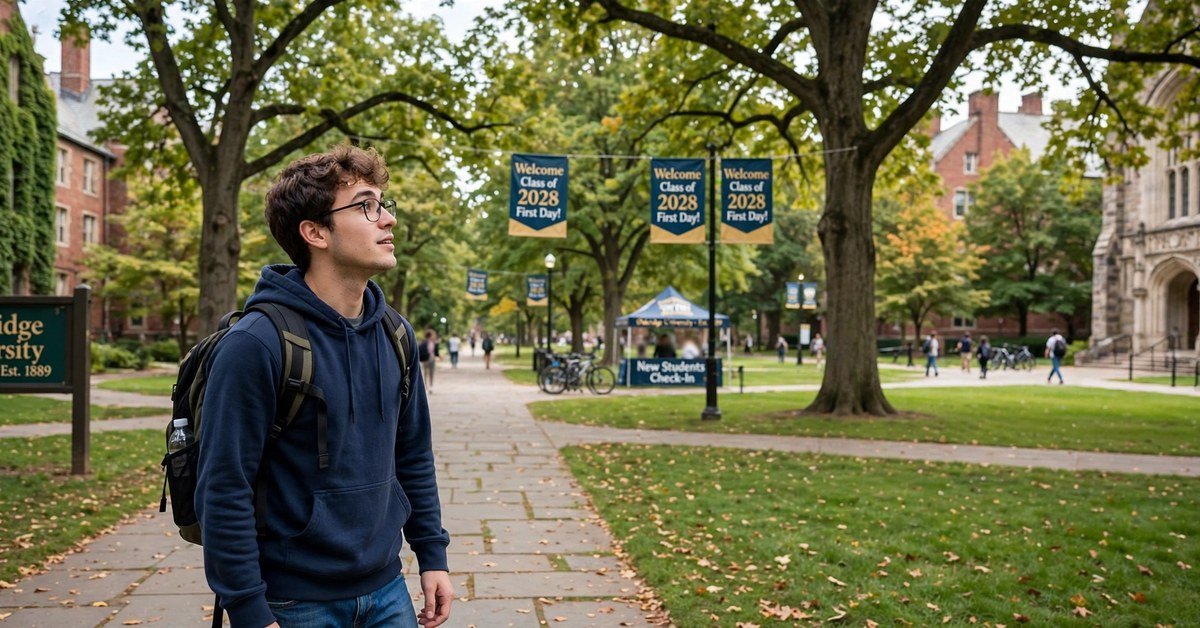
In his first week in Manchester, Bilal understood his lectures almost perfectly. Then he walked up to the library help desk, opened his mouth to ask a simple question… and his mind went completely blank.
Sound familiar? For most international students, the hard part is not the lectures. It’s the small moments in between: the library desk, the cafeteria queue, the admin office, the shared kitchen at midnight. Nobody puts those conversations in a textbook, yet they’re where campus English really matters.
The good news: you don’t need thousands of words for daily campus life. A few dozen phrases cover almost everything. This guide collects the fifty most useful, grouped by situation, each with a note on when to use it. Learn ten before you arrive; the rest will follow.
Quick Answer: What Is Campus English?
Campus English is the everyday English you use around a university, outside the classroom: directions, books, paperwork, lunch and flatmates. A campus is the land and buildings of a university, and campus English is the language that makes life there run smoothly. It is practical, polite and mostly short — no complete fluency needed, just the right sentence at the right moment.
Finding Your Way Around Campus
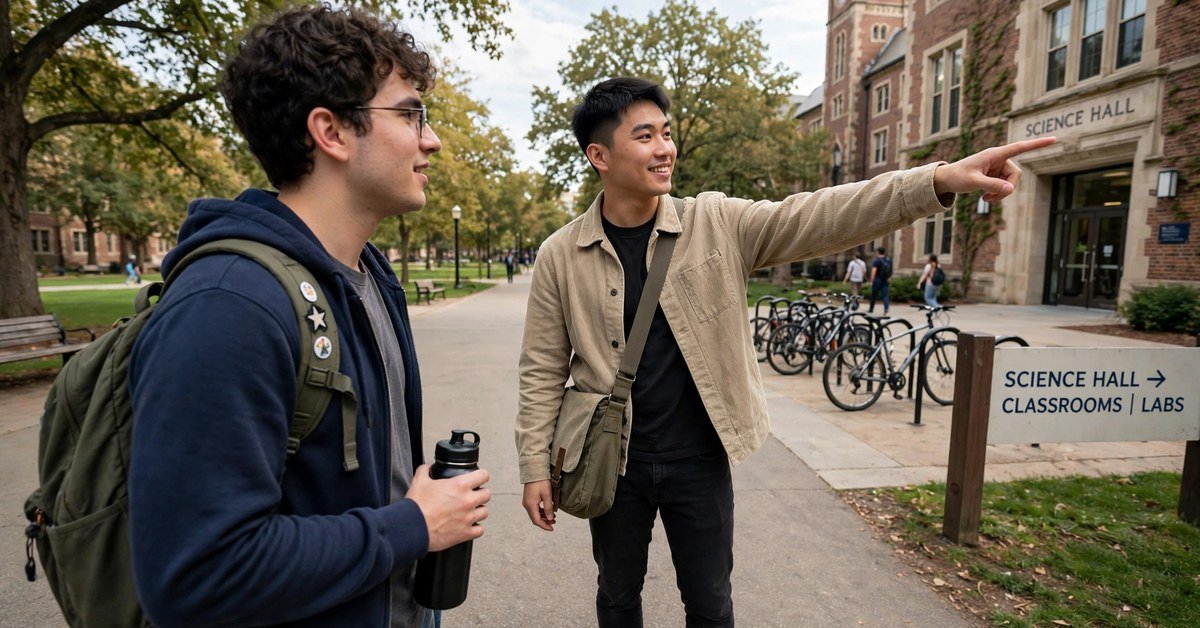
Campuses are small cities, and everyone gets lost in week one — local students too, they just hide it better. These phrases get you pointed in the right direction.
- “Excuse me, could you tell me where the main library is?” — your all-purpose opener; works with absolutely anyone.
- “Is the lecture hall this way?” — a quick yes-or-no check when you’re already walking.
- “How do I get to the science building?” — use it when you need step-by-step directions, not just a point.
- “Is it far from here?” — tells you whether to walk or find a bus.
- “I’m looking for Room 204 in the Arts Building.” — naming the exact room gets a much more precise answer.
- “Could you show me on the map?” — pointing beats a long description every time.
- “I’m new here — it’s my first week.” — six magic words; people instantly get kinder and slower.
At the Library
The library will become your second home, so make friends with the desk staff early. Many libraries also run a writing centre that checks essays free; the Purdue OWL offers similar help online.
- “How do I borrow this book?” — staff will walk you through the self-checkout machine.
- “Where can I find books on economics?” — ask for the floor and section, not just one shelf.
- “Is there a quiet study area?” — most libraries have silent floors — gold during exam season.
- “Can I book a study room?” — group rooms disappear fast before deadlines, so book ahead.
- “How many books can I take out at once?” — limits vary between universities, and guessing is expensive.
- “When is this book due back?” — put the date in your phone; late fines add up quietly.
- “Could you help me print this document?” — printers confuse everyone in week one — you’re in good company.

In Lectures and Seminars
Lectures move fast and accents vary; every international student misses things, and lecturers expect questions. These phrases handle the talking; for the writing side, our guide to academic linking words will sharpen your essays.
- “Sorry, could you repeat that, please?” — quite possibly the most useful sentence in this entire list.
- “Could you speak a little more slowly?” — most lecturers don’t mind — ask without embarrassment.
- “What does this word mean?” — whisper it to a neighbour, or ask the lecturer afterwards.
- “Will the slides be uploaded after the lecture?” — usually yes — saves a lot of panicked note-taking.
- “Is this topic going to be on the exam?” — everyone in the room is wondering; someone has to ask.
- “Could I borrow your notes from Tuesday?” — for the lecture you missed; offer yours in return next time.
- “I have a question about today’s topic.” — a calm, polite way to open your turn in a seminar.
- “Could you explain that in a different way?” — perfect when the first explanation simply didn’t land.

At the Cafeteria and Shops
Lunch hour is short, queues are long, and the menu board may be full of new words. Keep it simple: point, smile, and use these.
- “Can I have the chicken sandwich, please?” — swap in any dish; pointing is fine too.
- “How much is this?” — ask before you reach the till, not after.
- “Do you take card?” — some outlets are card-only now; some small ones are cash-only.
- “Is there a student discount?” — always worth asking; keep your student card in your pocket.
- “Can I sit here?” — sharing big tables at busy times is normal and a sneaky way to meet people.
- “What do you recommend?” — staff will tell you what’s fresh and most popular.
Admin Office and Student Services
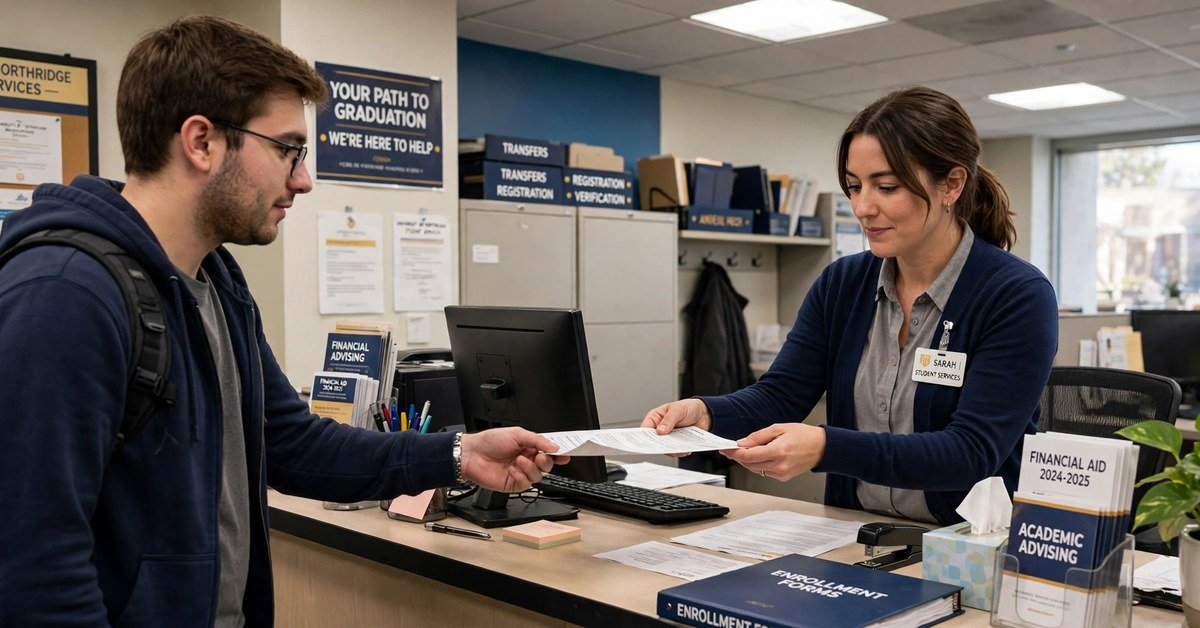
Enrolment forms, fee questions, timetable clashes — the admin office handles the paperwork of your degree, and its staff solve these problems every day. State your problem in one clear sentence. If they ask you to email instead, our guide on how to email your professor covers the polite formulas too.
- “I have an appointment with the admissions office.” — say it at the front desk; they’ll sign you in.
- “Could I have an enrolment form, please?” — “could I have” is the polite shape; never “give me”.
- “I need a letter confirming I’m a student here.” — banks, landlords and embassies ask for this constantly.
- “There’s a problem with my timetable.” — a calm statement of fact; they hear it daily.
- “Who can I talk to about my fees?” — ask for the right desk instead of telling the whole story twice.
- “How long will the application take?” — sets your expectations, so you’re not checking your inbox hourly.
- “Could I make an appointment for next week?” — some offices are appointment-only, so check first.
- “My student card isn’t working.” — short, clear, and it opens every door. Sometimes literally.
Making Friends and Small Talk
Here is a secret: almost everyone in freshers’ week is looking for friends, so starting a conversation is easier than you fear. Worried how you’ll sound? Practise the key phrases aloud first with our pronunciation checker — a little rehearsal makes the real moment easier.
- “Hi, I’m Bilal. What’s your name?” — simple beats clever, every single time.
- “Where are you from?” — the classic opener among international students; everyone has an answer ready.
- “What are you studying?” — the question you will answer roughly two hundred times in your first month.
- “Are you in the same lecture?” — an easy bridge from classmate to friend.
- “Do you want to grab a coffee after class?” — a low-pressure invitation; “grab” just means get one quickly.
- “Have you joined any societies yet?” — societies are where student friendships actually happen.
- “Can I add you on Instagram?” — how campus friendships move from corridor to real life.
- “See you around!” — the standard warm goodbye — you will meet again.
In Student Accommodation
Your flatmates are your first community abroad, and a few friendly sentences early on prevent most awkward moments later. Kitchens run on small polite phrases.
- “Hi, I just moved in — I’m in Room 12.” — introduce yourself before you ever need to ask for anything.
- “Is this shelf in the fridge mine?” — kitchen territory matters more than you expect; ask early, avoid drama.
- “Could we keep the noise down after eleven?” — polite, specific, and very hard to argue with.
- “The shower on our floor isn’t working.” — report problems to reception in this calm shape.
- “Has anyone seen my umbrella?” — shared houses run on lost-and-found honesty.
- “We’re ordering pizza — do you want in?” — “want in” means join us; in week one, say yes often.

Formal vs Casual: The Same Request Two Ways
Most campus requests have two versions: relaxed for friends, polished for staff and lecturers. Choosing right mostly means adding “could” and “please” — a small change, a big impression. You’ll need the formal set again for part-time jobs, where the phrases in our business idioms guide take over.
| Situation | Casual (friends) | Formal (staff and lecturers) |
|---|---|---|
| Asking the way | “Where’s the library?” | “Excuse me, could you tell me where the library is?” |
| Asking for a thing | “Give me the form.” | “Could I have the form, please?” |
| You didn’t hear | “What?” | “Sorry, could you repeat that, please?” |
| Asking for more time | “I need more time.” | “Would it be possible to have a short extension?” |
| Borrowing notes | “Send me your notes.” | “Could I borrow your notes from Tuesday, please?” |
5 Common Mistakes to Avoid
1. Answering “What?” when you didn’t hear. In many languages it’s perfectly normal; in English it can sound annoyed or rude. Swap it for “Sorry, could you say that again?” — same moment, friendly instead.
2. Asking for the “toilet” in North America. British speakers say “toilet” happily; in the US and Canada, ask for the “restroom” or “bathroom” — “Where’s the toilet?” sounds surprisingly blunt there.
3. Translating your requests word for word. Many languages allow a direct “Give me…” or “I want…” without sounding rude. English doesn’t. Add “could I have” or “I’d like” and the request becomes polite.
4. Calling your lecturer “teacher”. At university, “teacher” belongs to school. Say “lecturer”, “Dr Khan”, or “Professor Khan” — when in doubt, copy the name they use in their own emails.
5. Nodding “yes” when you understood nothing. It feels polite, then causes real trouble later — wrong rooms, missed deadlines. Nobody minds being asked twice: “Sorry, I’m still learning English — could you explain it once more?”
Quick Practice
Try these three before you read the answers.
Exercise 1: Choose the polite version. You are at the student services desk and need a form.
a) “Give me an enrolment form.”
b) “Could I have an enrolment form, please?”
Answer: b) — “could I have… please” is the shape staff expect.
Exercise 2: Match the phrase to the place. Where would you say each one: the library, the cafeteria, or the admin office?
- “When is this book due back?”
- “Do you take card?”
- “There’s a problem with my timetable.”
Answers: 1) the library, 2) the cafeteria, 3) the admin office.
Exercise 3: Fix the sentence. A classmate is talking too fast. Rewrite “What? Speak slowly” as a polite request.
Answer: “Sorry, could you speak a little more slowly, please?” Any version with “sorry”, “could you” and “please” earns full marks.
Frequently Asked Questions
How is campus English different from classroom English?
Classroom English is textbooks-and-exams English: essays, grammar, formal vocabulary. Campus English is the spoken, everyday layer around it — queues, forms, small talk, favours. You need both — but most students arrive with far more of the first, which is exactly why the second feels harder.
What if I can’t understand someone’s accent?
You won’t be the only one: universities are full of accents, staff included, and people are used to it. Slow the moment down: “Sorry, could you say that once more, a bit slowly?” Then repeat back the key word you did catch — “The science building, yes?” — and let them confirm.
Is it rude to ask people to repeat themselves?
No — asking twice is normal, especially in your first term. What can sound rude is a bare “What?” with no softener. Add “sorry” and “please”, and nobody thinks twice about it — most people are glad you asked instead of walking off lost.
How many of these phrases should I learn before I arrive?
Start with ten: asking the way, “could you repeat that”, library basics, and a few small-talk openers. You’ll pick up the rest naturally — you’ll hear them daily. Look up odd expressions you overhear in our idiom finder instead of puzzling over them for a week.
Do these phrases work in both the UK and the US?
Almost all of them do. A few words change sides of the Atlantic — “restroom” versus “toilet”, “flatmates” versus “roommates”, “till” versus “checkout” — but the polite shapes work identically everywhere.
Final Thoughts
Here is the truth nobody prints in the university brochure: your degree is taught in lectures, but your life abroad is built in the small conversations around them. Fifty short phrases won’t make you fluent — they’ll do something better: get you fed, enrolled, un-lost, and talking to the people who become your friends.
So tell us: which campus moment worries you most before you arrive — the admin office, the cafeteria queue, or that first knock on a flatmate’s door?