

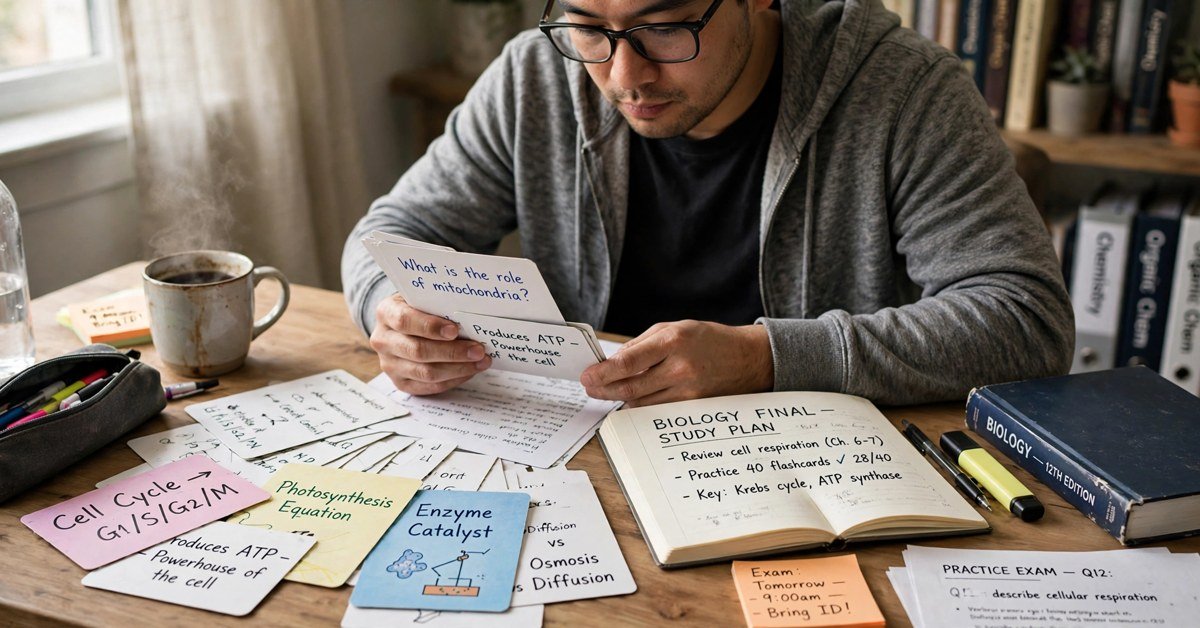
It’s the evening before a big test. Your phone is buzzing, your friends are going out, and your notebook is still closed. You sigh, put the phone face down, and say: “Okay. Time to hit the books.”
If you’ve ever heard this phrase and pictured someone actually punching a book, you’re not alone. Almost every English learner asks about it at some point. The good news? It’s a friendly, everyday idiom, and once you understand it, you’ll start hearing it everywhere — in films, in classrooms, and in group chats the night before an exam.
In this guide, you’ll learn exactly what “hit the books” means, where it comes from, how to use it naturally, and how it differs from similar idioms like cram. There’s a quick practice at the end, too, so you can check yourself.
Quick Meaning
Hit the books means to start studying seriously, with real focus.
That’s it. Nobody is hitting anything, and you don’t need a pile of actual books — your notes, your laptop, and your flashcards all count. When someone says they’re going to hit the books, they’re really saying: “Enough distractions. Study time starts now.”
It’s one of those phrases teachers love, parents quote, and students pass on to each other year after year. Learn this one idiom and you instantly sound a little more natural every time exam season comes around.

What Does “Hit the Books” Mean?
Let’s break it into two parts. The word hit here doesn’t mean to strike something. In casual American English, “hit” can mean to go somewhere and get started — like hit the road (leave on a trip) or hit the shops (go shopping). And the books simply means your study materials: textbooks, notes, slides, whatever you’re learning from.
Put the two together and you get the picture: you’re launching yourself at your studies. The phrase describes the moment you start, not how long you study. You can hit the books for twenty focused minutes or for a whole evening — both count.
You’ll hear it in a few favourite shapes. People say “I need to hit the books,” “It’s time to hit the books,” or “I’m going to hit the books tonight” — and as a friendly order, just “Hit the books!” The continuous form works too: “She’s been hitting the books all week.” Once you spot the pattern, you can bend the phrase to fit almost any study situation.
One more thing: it’s an informal phrase. It’s perfect for talking to classmates, friends, teachers, and family. In a formal essay or a job application, though, you’d write “begin studying” instead.
And no, it doesn’t promise the studying will be easy. Nobody is claiming your chemistry exam is a piece of cake — hitting the books just means you’ve sat down and started, which is honestly the hardest part.
Origin
“Hit the books” is American college slang, and it’s older than you might think. Merriam-Webster records its first known use in 1920, back when university students were inventing half the casual slang we still use today.
That little word hit does a lot of work in the slang of that period. To hit the road meant to set off on a journey. To hit the hay — or the sack — meant to go to bed. So “hitting” something really meant getting to it, and hitting the books meant getting to your studying.
Can we name the first student who ever said it? Sadly, no. Slang spreads by mouth long before anyone writes it down, so the honest answer is that the exact moment is lost. What dictionaries do agree on is the meaning: Cambridge Dictionary defines it as beginning “to study in a serious and determined way” — and that serious, determined feeling is exactly what the phrase still carries today.
How to Use It
The beauty of this idiom is how flexible it is. A sixteen-year-old before her school exams, a nurse training for a licence, and a father studying accountancy at night can all use exactly the same words. Here are the three situations where you’ll hear it most.
Exams and School. This is its natural home. Students say it when a test is coming and playtime is over: “Our maths final is next week, so our whole class is hitting the books this weekend.” Teachers use it too, usually with a smile: “Alright, everyone — time to hit the books.”
Work and Certificates. Studying doesn’t end at school. Adults hit the books for driving tests, IT certificates, language exams, and professional licences. “I’m hitting the books every evening this month — my project management exam is in June.” If you’re learning something with a test at the end of it, this idiom fits.
Casual Everyday Talk. Friends use it as a polite reason to say no. “Can you come out tonight?” “I’d love to, but I have to hit the books.” It’s friendly, a little dramatic, and everyone understands instantly: you’d rather be out, but duty calls. You’ll also hear it as gentle teasing — “Look at you, hitting the books before the teacher has even set the homework!”

10 Example Sentences
Read these out loud if you can. Hearing your own voice use the phrase makes it stick much faster than reading silently.

- My biology exam is on Friday, so I need to hit the books tonight.
- Hira skipped the party because she had to hit the books for her driving theory test.
- “You’ve watched enough videos — hit the books!” Mum said, laughing.
- If I hit the books for one hour every day, I’ll be ready for my English exam in June.
- After dinner, Tomás goes to the library and hits the books until it closes.
- We hit the books together every Sunday to prepare for the accounting exam.
- I can’t talk right now — I’m just about to hit the books.
- He failed his first test, so this time he hit the books weeks in advance.
- Hit the books early, and you won’t need to panic the night before.
- She works in a café all day, but in the evening she still hits the books for her nursing course.
Hit the Books vs Similar Idioms
English has a whole family of study idioms, and learners often mix them up. The secret is timing: each one describes a different moment of the same long evening.
| Idiom | What it means | The key idea |
|---|---|---|
| Hit the books | Start studying | The beginning |
| Burn the midnight oil | Study or work late into the night | It’s already late |
| Cram | Try to learn everything at the last minute | Panic mode |
| Hit the sack | Go to bed | Studying is over! |
Now picture that evening. At seven o’clock you hit the books — you begin. By one in the morning you’re burning the midnight oil, still working under the lamp. And if you only started that night because the exam is tomorrow morning, you’re cramming. Finally, when you can’t keep your eyes open another minute, you hit the sack and sleep.
See the story? Starting, working late, panicking, and sleeping are four different moments — and English has a phrase for each one. Keep them separate and you’ll never mix them up again.
Here’s a memory trick that helps my students: the books come first in your evening, and the sack comes last. If you’re still awake and working, you’re with the books (or the midnight oil). The sack only appears when your eyes close.
Common Mistakes
Taking it literally. Please don’t punch your textbook. Nothing gets hit in this idiom; “hit” just means “get to it.” If your teacher looks worried, you’ve probably misunderstood.
Saying “hit the book.” The idiom is always plural: books. Even if you’re studying from a single book, say “hit the books.” Fixed phrases don’t change their shape to match real life.
Using it for pleasure reading. Reading a novel on the beach is lovely, but it isn’t hitting the books. This idiom is about studying — learning something for school, for work, or for an exam. Save it for study time.
Using it in formal writing. In an exam essay or a professional report, write “begin studying” or “revise” instead. Idioms like this one belong in speech and friendly writing.
Quick Practice
Try these three questions. The answers are right below — no peeking until you’ve had a go!
1. Your friend says: “The test is tomorrow and I haven’t opened my notes yet. I’d better ______.” Should he hit the books or hit the sack?
2. True or false: “Hit the books” means reading a storybook for fun.
3. Which sentence is correct?
a) I need to hit the book tonight.
b) I need to hit the books tonight.
Answers: 1) Hit the books — he needs to start studying (the sack is for sleeping!). 2) False — it’s about studying, not pleasure reading. 3) b — the idiom is always plural: “books.”
FAQ
Is “hit the books” American or British?
It started in the United States, and Americans still use it the most. But British speakers understand it perfectly, and you’ll hear it in the UK too — it just sounds slightly American, in a friendly way.
Can I say “hit the books” if I study on a laptop?
Absolutely. “The books” stands for study material in general, not paper books only. Online courses, videos, apps, and flashcards all count — you’re still hitting the books, just on a screen.
What’s the difference between “hit the books” and “cram”?
Hitting the books is simply starting to study, and it can happen weeks before an exam. Cramming means trying to learn everything at the very last minute, usually in a hurry. One is a plan; the other is an emergency.
Is “hit the books” a formal phrase?
No, it’s informal and conversational. Use it freely with friends, classmates, and in casual messages — but switch to “start studying” in formal essays and professional emails.
What are some other ways to say “hit the books”?
You can say “start studying,” “get down to work,” or “knuckle down.” British English often uses “revise” for studying before an exam, as in “I’m revising for my finals this week.”

One Last Thing
That’s really all there is to it. The next time a test is coming, you have the perfect English sentence ready — and using real idioms like this is a lovely way to break the ice with classmates, because everyone enjoys comparing study habits. Want more phrases like this one? Try the Idiom Finder and look up the next expression that puzzles you.
Now, be honest with me: when do you usually hit the books — nicely in advance, like a model student, or in a last-minute panic the night before? Tell me in the comments. (No judgement at all. We’ve all been in group two.)