

Welcome back — you’ve been asking for a third round, and here it is. Parts 1 and 2 gave you 200 sentences for home, food, travel, the doctor and a dozen other everyday moments.
This new collection of daily use English sentences digs one level deeper into real life: the rushed, half-asleep morning, the serious business of bills and banks, the pharmacy counter, the working week, and the small phone calls that hold friendships together.
New to the series? Start with Part 1: our first 100 daily use English sentences, then work through Part 2: 100 more daily use English sentences. Together, the three parts will give you 300 sentences you can genuinely use — and if you already know the first two hundred, this page is your next hundred.
The method hasn’t changed, because it works: take ten sentences a day, say each one out loud three or four times, and say it as if you were really there. Reading builds recognition, but speaking builds English. Ten honest days from now, these lines will be sitting ready on your tongue.
Daily Use English Sentences: Morning & Getting Ready
Part 1 got you out of bed and out of the door. Part 3 lingers a little longer in the beautiful chaos before that — the alarm that lets you down, the shower that refuses to warm up, and the toothpaste that has somehow run out again.
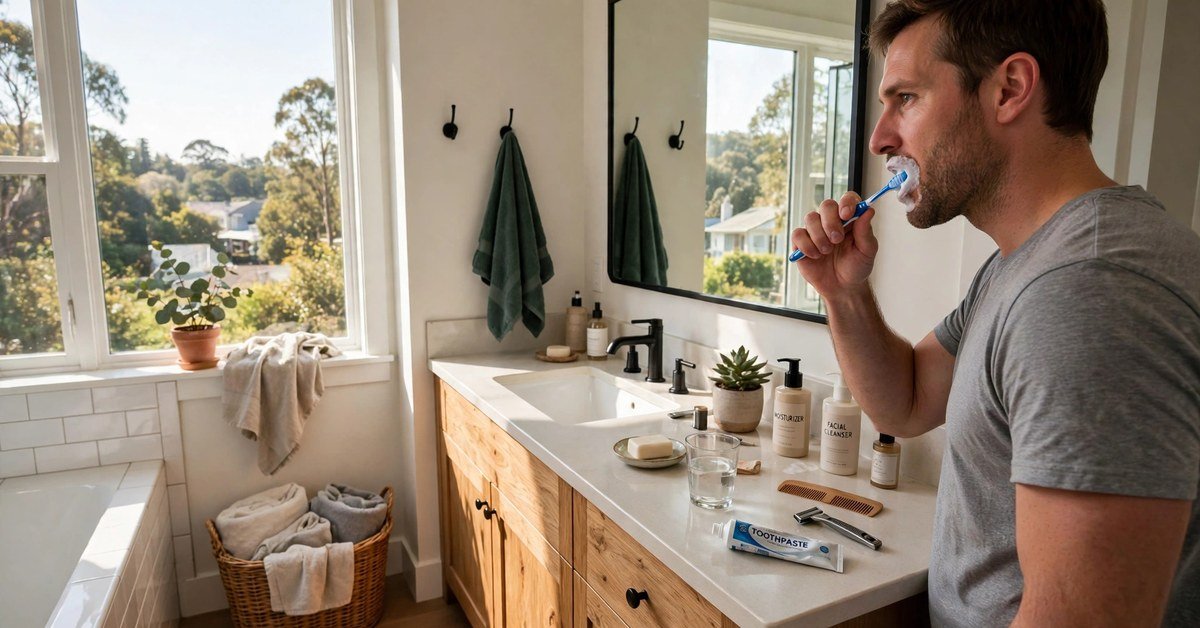
- My alarm didn’t go off this morning. — the classic reason for a late start
- I hit the snooze button twice before getting up. — the snooze button buys you a few more minutes of sleep
- Let me splash some water on my face to wake up.
- The shower takes a while to get warm.
- Could you pass me a clean towel, please?
- I need to iron this shirt before I wear it. — iron = to make clothes smooth with a hot iron
- These trousers don’t fit me any more.
- Let me just zip up your jacket for you.
- I forgot to charge my phone last night.
- Let me check the weather before we head out.
- I’ll take an umbrella, just in case. — just in case = to be ready if it happens
- Have you fed the cat yet?
- Don’t drink that milk — it smells off. — smells off = it has gone bad
- I’ll make us some toast for breakfast.
- We’re out of toothpaste again. — we’re out of = we have none left
- Let me just comb my hair quickly.
- I still look half asleep in this mirror.
- Don’t forget your lunchbox on the counter.
- The bus comes in ten minutes — hurry up!
- I’ll leave a note for you on the fridge. — where all important family messages live
Money, Bills & Banking
Money makes many learners go quiet, but everyday money talk is really just a few honest sentences on repeat. Here are the ones you’ll need for paydays, bills, bank counters, declined cards, and lending a good friend a few pounds until Friday.

- I need to pay the electricity bill today.
- My salary arrives at the end of the month. — salary = the money your job pays you
- Can I pay for this in monthly instalments? — instalments = smaller payments spread over time
- I opened a savings account last week.
- How much interest does this account pay? — interest = extra money the bank pays you
- I’d like to withdraw some cash, please. — withdraw = to take money out of your account
- The cash machine is out of order again. — out of order = broken, not working
- Let me transfer the money to your account now.
- I entered the wrong PIN three times.
- Could you lend me twenty pounds until Friday? — lend = give for a while; borrow = take for a while
- I owe you ten pounds for the taxi yesterday. — I owe you = I must pay you back
- Our rent goes up from next month.
- We’re saving up for a new car. — save up = keep money little by little for one goal
- This month’s bill is higher than usual.
- Could I have a receipt for this payment, please? — receipt = the paper that proves you paid
- My card was declined at the shop this morning. — declined = the bank said no to the payment
- Let me check my balance on the banking app. — balance = how much money is in the account
- Don’t spend it all at once!
- I need to change some money before my trip. — change money = swap it for another currency
- The bank closes at four o’clock on Saturdays.
Health, Medicine & the Pharmacy
Part 2 helped you describe symptoms to the doctor; this group finishes the visit — booking the appointment, understanding the prescription, and coping with life’s small injuries. For the words behind these lines, our guide to English words for health makes a perfect study partner.

- I need to book an appointment with the dentist.
- My back has been aching all week. — aching = hurting with a dull, steady pain
- This medicine makes me feel sleepy.
- Take one tablet twice a day, after meals. — the instruction on almost every medicine box
- I cut my finger while I was cooking.
- Put a plaster on it to keep it clean. — a plaster is a small sticky cover for a cut
- She has a serious allergy to peanuts. — allergy = when your body reacts badly to something
- The nurse took my blood pressure this morning.
- I twisted my ankle during the football match. — twisted = turned suddenly and hurt
- You need plenty of rest and lots of water.
- I have a runny nose and I can’t stop sneezing. — runny nose = your nose won’t stop dripping
- Does this syrup help with a dry cough? — syrup = thick, sweet liquid medicine
- The doctor gave me a prescription for antibiotics. — prescription = the doctor’s note for the pharmacy
- My eyes get tired after long hours at the screen.
- I think I need new glasses.
- Keep the wound clean and dry. — wound = damaged skin, such as a deep cut
- He broke his arm falling off his bicycle.
- The clinic opens at nine in the morning.
- This headache is getting worse, not better.
- Can I buy this medicine without a prescription?
Work, Meetings & Deadlines
Real workplaces don’t speak in textbook English. They speak in short, friendly lines like these — opening the meeting, chasing the deadline, feeding the printer, and rescuing a colleague who’s away. Learn these twenty, and office English feels much less like a performance.

- Let’s start the meeting — everyone’s here now.
- Could you speak up a little, please? — speak up = talk louder
- I’ll share the agenda before the call. — agenda = the list of things a meeting will discuss
- We need to finish this by Thursday afternoon.
- He’s on leave until next Monday. — on leave = away from work on a planned break
- Let me write that down before I forget it.
- The printer has run out of paper again.
- Can we move the deadline to next week? — move the deadline = agree a later finishing time
- I’ll send you the updated version tonight. — updated = with the newest changes added
- She got a promotion last month. — promotion = a better, higher job in the same company
- We work from home two days a week.
- My manager asked for a short summary. — summary = the main points in a few lines
- Let’s go through these figures together. — figures = the numbers in a report
- I have too many emails to answer today.
- The meeting went on longer than we expected. — went on = continued
- Could you reply to everyone, so the whole team sees it?
- I’ll cover for you while you’re away. — cover for someone = do their work while they’re away
- We took on two new staff this month. — take on = employ, hire
- The office will be closed over the holidays.
- Let’s fix a time for tomorrow’s call. — fix a time = agree on a time
Phone Calls, Messages & Plans with Friends
So much of friendship now happens through a phone: the missed call, the quick text, and the hopeful ’are we still on for tomorrow?’ These twenty lines cover the calls and messages you’ll actually send — and the list ends with the sentence every good plan deserves.

- Sorry I missed your call — my phone was on silent.
- I’ll text you the address in a minute.
- Did you see the photo I sent you last night?
- Save me a seat — I’m five minutes away.
- Could you pick me up from the station? — pick someone up = collect them in your car
- We’re thinking of going to the beach on Sunday.
- Text me when you get home safely.
- I’ll add you to the group chat.
- Sorry for the late reply — it’s been a busy day.
- Let’s split the bill for dinner tonight. — split the bill = each person pays half
- You bring the rice, and I’ll make the curry.
- I’m on my way — see you in twenty minutes.
- Call me when you’re free — there’s no rush.
- Let’s find a date that suits everyone. — suits everyone = works for everybody
- He never answers his phone after nine.
- I sent you a voice note — have a listen when you can. — a voice note is a short recorded message
- Are we still on for tomorrow morning? — still on = the plan hasn’t changed
- Bring a jacket — the evenings get chilly here. — chilly = a little cold
- I’ll bring my camera so we can take some photos.
- Let’s not leave it so long next time!
How to Practise These 100 Sentences
Tip 1: Shadow the sentences. Listen to a line — or imagine a confident voice saying it — and speak at exactly the same time, copying the rhythm and music, not just the words. The British Council’s speaking lessons are perfect shadowing material: short, friendly dialogues you can pause and repeat until the sentences live in your mouth, not just in your notebook.
Tip 2: Swap one word and make it yours. Take any sentence from this page and change a single word: ’I need to pay the electricity bill today’ becomes the water bill, the phone bill, or tomorrow instead of today. One small change turns my sentence into your sentence — and your own sentences are the ones you never forget.
Tip 3: Record yourself. Use the voice recorder on your phone and read ten sentences aloud each day. Listen back once a week, kindly, the way you’d listen to a friend. You’ll hear progress your ears miss day to day.
For more ready-made lines to practise with, pair this page with our English phrases for daily conversation and Part 2 of that collection — between them, you’ll never be stuck for something natural to say.
Frequently Asked Questions
How many sentences should I learn each day?
Ten is the sweet spot for most people. It’s few enough that you can say each one out loud several times and genuinely use one or two for real, yet after just ten days you’ve covered the whole page. If ten feels heavy, do five properly instead — five sentences you can say without thinking beat fifty you’ve only read once.
Do I need to learn Parts 1 and 2 before this one?
Not at all — each part stands on its own, and you’re free to start with whichever matches your life right now. But together, the three parts give you 300 daily use English sentences covering almost every situation an ordinary day can invent, from a sleepy morning alarm to a serious meeting at work.
What’s the difference between a phrase and a sentence?
A sentence is a complete thought with a subject and a verb, and it can stand on its own — like ’The bank closes at four.’ A phrase is a smaller chunk, like ’at four o’clock’, that needs a sentence around it to make full sense. If you’d like the tidy grammar view, the Cambridge Dictionary’s entry for the word ’sentence’ explains it very clearly.
How can I stop forgetting sentences I’ve already learned?
Use them or lose them — that’s the honest rule of memory. Pin each sentence to a real moment: say the morning lines while you actually get ready, and the bank lines on your way to the bank.
Then revisit each group after one day, and again after a week. Two short reviews will lock a sentence in far better than one long, tired study session.
Are these sentences British or American English?
Mostly neutral, everyday English that will be understood happily on both sides of the Atlantic. A few lines lean British — pounds instead of dollars, trousers instead of pants — but nothing here will sound strange in New York or Toronto. If a word is different where you live, simply swap it in; the sentence pattern underneath is the real prize.