

You write a quick message to a friend. You want to say you will call after lunch, but you pause. Is it “then” or “than”? The two words look almost the same, and they sound almost the same too.
That tiny pause is very common. Even strong English speakers mix up then vs than when they type fast. The good news is that the rule is simple, and once you learn it, you will spot the right word in a second.
This guide explains then vs than in plain language. You will get a clear difference table, a memory trick, six correct-and-incorrect pairs, and practice questions at the end.
Then vs Than at a Glance
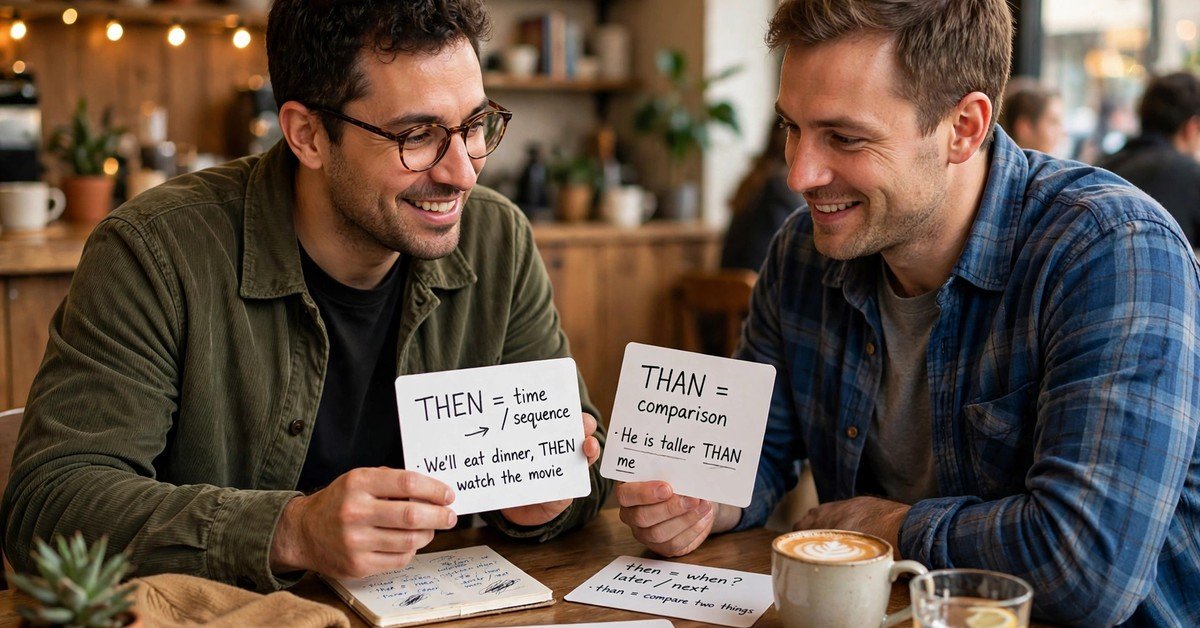
The short answer: “then” is about time, order, or a result. “Than” is about comparison.
Think of “then” as a word that moves a story forward. First this happens, then that happens. It can also show what follows from something else, as in “if it rains, then we stay home.”
“Than” has a different job. It joins two things so you can compare them. You use it after words like better, taller, faster, more, and less. For example, “Ali is taller than Bilal” compares two heights.
If you remember only one line, make it this one: then = time, than = comparison. Tiny-word pairs often cause the same trouble — see also its vs it’s.
Then vs Than: The Difference Table
A table makes the contrast easy to see at a glance. Read across each row and notice how the job of each word stays the same.
| Word | Meaning | Part of speech | Example |
|---|---|---|---|
| Then | At that time, next, or as a result | Adverb | We ate lunch, then we went for a walk. |
| Than | Used to compare two things or people | Conjunction or preposition | Tea is cheaper than coffee. |
| Then | After that, in that case | Adverb | If you finish early, then you can rest. |
| Than | Used after comparative words like more and better | Conjunction or preposition | She runs faster than her brother. |
Notice the pattern in the table. “Then” never compares two things. “Than” never tells you what happened next. When you keep their jobs separate, the choice becomes clear.
That separation is the same skill you build with other sound-alike pairs, like your vs you’re.
How to Remember Then vs Than
Here is a trick that works for most learners. Look at the middle letters of each word. “Then” has an “e” in the middle, just like “time” and “sequence.” Both of those words are about order, and that is the world “then” lives in.
“Than” has an “a” in the middle, just like “comparison.” That link is not perfect spelling, but it is a handy hook for your memory. When you see a comparison, reach for the word with “a” in it.
Another trick is to test the sentence. If you can replace the word with “next” or “after that,” then “then” is right. If you can replace it with a comparison idea, like “compared with,” then “than” is right.
Try it now. “We will eat, ___ we will watch a film.” The word “next” fits, so the answer is “then.” Now try: “This film is longer ___ the last one.” A comparison fits, so the answer is “than.”
One more helper: “than” almost always appears near a comparative word. Look for better, worse, bigger, smaller, more, less, taller, or older. If one of those words is in the sentence, “than” is very likely the word you need.
For a dictionary check, see the Cambridge Dictionary entry for “than”: Cambridge Dictionary — than.
6 Example Pairs: Correct vs Incorrect
The fastest way to learn is to see the right and wrong versions side by side. Read each pair slowly and ask yourself why the correct one works.
Example 1: Time order
Correct: First we finished our homework, then we played football.
Incorrect: First we finished our homework, than we played football.
Why it works: the sentence tells a sequence. One thing happened, and the next thing followed it. There is no comparison here, so “then” is the only fit.
Example 2: A simple comparison
Correct: This bag is heavier than that bag.
Incorrect: This bag is heavier then that bag.
Why it works: two bags are being compared. The word “heavier” is a comparative word, and “than” is the word that follows it. No time order is involved at all.
Example 3: A result after a condition
Correct: If you save money, then you can buy the bike.
Incorrect: If you save money, than you can buy the bike.
Why it works: the second part is a result of the first part. “Then” shows what follows when the condition is true. It does not compare saving money with anything else.

Example 4: More and less
Correct: He drinks more water than juice in summer.
Incorrect: He drinks more water then juice in summer.
Why it works: “more” is a comparative word, and the sentence compares water with juice. Whenever you see “more” or “less,” expect “than” to follow soon after.
Example 5: Then at the start of a sentence
Correct: Then the teacher asked us a question.
Incorrect: Than the teacher asked us a question.
Why it works: “then” can start a sentence when it means “after that” or “next.” It moves the story forward. “Than” almost never starts a sentence in this way, because a comparison needs something before it.
Example 6: A mixed sentence with both words
Correct: She was faster than me then, and she is faster than me now.
Incorrect: She was faster then me than, and she is faster then me now.
Why it works: this sentence uses both words, and each one does its own job. “Than” makes the comparison, and “then” points to a time in the past. Reading it aloud helps you hear the difference.
Notice how each correct sentence feels natural once you know the job of each word.
Common Mistakes to Avoid
Even after learning the rule, a few traps keep catching writers. Watch out for these five, and you will avoid most errors.
Mistake 1: Using “than” for a sequence. This is the most common error. People write “we ate, than we left” because the words sound alike. Remember: a sequence needs “then,” every time.
Mistake 2: Using “then” after a comparative word. Sentences like “better then before” look right at first glance, but they are wrong. After better, worse, more, less, and similar words, the word is “than.”
Mistake 3: Swapping the words in fast messages. When you type quickly, your fingers may pick the wrong one. Slow down for one second on these two words. A short pause now saves an awkward message later.
Fast messages create other traps too, because short forms hide their full meaning. If you enjoy learning those, FR meaning shows how one small shortcut can carry a clear, friendly sense in texts.
Mistake 4: Thinking “then” can compare. It cannot. “Then” never sits between two things being measured against each other. If you are weighing, ranking, or judging one thing against another, you need “than.”
Mistake 5: Forgetting the “next” test. Many learners know the rule but forget to use it. Before you send a message or hand in homework, try the “next” test. If “next” fits, write “then.” If it does not, and a comparison is present, write “than.”

Practice Questions
Try these questions before you read the answers. Cover the answers with your hand, pick a word, and then check yourself.
- We went to the market, ___ we bought fruit. (Answer: then)
- This road is wider ___ the old one. (Answer: than)
- If it rains, ___ we will stay inside. (Answer: then)
- He is younger ___ his sister. (Answer: than)
- ___ she opened the letter and smiled. (Answer: Then)
- I like tea more ___ coffee in the morning. (Answer: than)
- First clean your room, ___ you can play outside. (Answer: then)
- The new phone costs less ___ the old model. (Answer: than)
How did you do? If you missed one, go back to the example pairs and read that pattern again. Mistakes in practice are useful, because they show you exactly which pattern needs one more look.
Conclusion
Then vs than looks like a small problem, but it shows up in almost every kind of writing. You meet it in messages, emails, schoolwork, and work reports. Getting it right makes your writing look careful and clear.
Remember the core line: then = time, than = comparison. Use the “next” test when you are unsure. Look for comparative words like better, more, and taller, because they point straight to “than.”
With a little practice, this pair will stop slowing you down. You will choose the right word without pausing, and your sentences will read smoothly from start to finish.
Once this pair feels easy, you can enjoy the fun side of English too. Idioms add colour to everyday speech, and Speak of the Devil meaning is a friendly next read when you want a break from grammar.

Frequently Asked Questions
Is then vs than about spelling or meaning?
It is about meaning. The two words are spelled differently because they do different jobs. “Then” deals with time, order, or a result. “Than” deals with comparison. Once you know the job, the spelling follows naturally.
Can “then” ever be used for comparison?
No, it cannot. “Then” never compares two people or things. If your sentence compares heights, prices, speeds, or amounts, the word you need is “than.” Keep “then” for sequences and results only.
Can “than” ever show time?
No, it cannot. “Than” does not tell you what happened next or when something happened. For time order, use “then.” For example, say “we ate, then we left,” never “we ate, than we left.”
What is the easiest trick to remember then vs than?
Use the “next” test. If you can replace the word with “next” or “after that” and the sentence still makes sense, use “then.” If the sentence compares two things, use “than.” This one test answers most real-life cases.
Is “more then” ever correct?
No, “more then” is not correct in standard English. After “more,” the word is “than,” as in “more time than before.” The same rule holds after “less,” “better,” “worse,” “bigger,” and “smaller.” If a comparative word comes first, “than” comes next.
For a second dictionary view, see Merriam-Webster’s entry for “then”: Merriam-Webster — then.
Why do so many people mix up then vs than?
They sound alike and look alike, and fast typing makes the mix-up more likely. The fix is one habit: pause, test the sentence, and pick the word that matches its job.
Grammar pairs like this reward patience. The same care helps with other sound-alike words, such as their vs there vs they’re. Each pair has its own small rule, and each rule gets easier with a few honest examples.

1 thought on “Then vs Than: What’s the Difference and How to Use Each One Correctly”