Communication is the art of sharing information. Sometimes, we share our own thoughts, but very often, we share what others have said. This is where the concept of narration comes in. If you have ever wondered, “What is direct indirect narration?” or struggled with the complex rules of converting one to the other, this guide is your definitive resource.
In this exhaustive 2,000-word masterclass, we will explore the definitions, the “Golden Rules” of transformation, the nuances of different sentence types, and the common pitfalls to avoid.
1. Defining the Foundations: Direct vs. Indirect
To master narration, we must first clearly distinguish between the two primary ways of reporting speech.
What is Direct Speech?
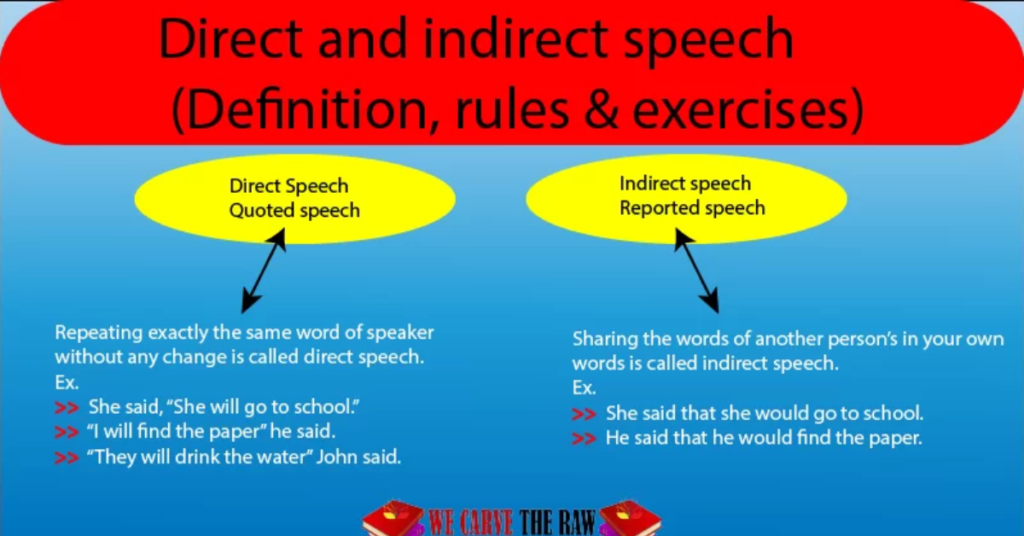
Direct speech involves quoting the exact words spoken by a person. These words are enclosed within quotation marks (inverted commas) to show that they are a verbatim reproduction of the original statement.
- Example: John said, “I am going to the market.”
- Key Components:
- Reporting Verb: said
- Reported Speech: “I am going to the market.”
What is Indirect Speech?
Indirect speech (also known as Reported Speech) conveys the meaning of what someone said without using their exact words. The quotation marks are removed, and the sentence structure is modified to fit naturally into the reporter’s own sentence.
- Example: John said that he was going to the market.
- Key Changes: The pronoun “I” changed to “he,” the tense “am going” changed to “was going,” and the conjunction “that” was added.
2. The Mechanics of Narration: The “Golden Rules”
Converting direct speech to indirect speech is not random; it follows a strict set of grammatical laws. To rank high in English proficiency, you must master these three pillars of transformation.
Pillar I: The Change of Pronouns (The SON Formula)
Pronouns must change to reflect the perspective of the person reporting the speech. A simple way to remember this is the SON formula:
- S (Subject): First-person pronouns (I, we, me, us, my, our) change according to the Subject of the reporting verb.
- Direct: He said, “I am busy.”
- Indirect: He said that he was busy.
- O (Object): Second-person pronouns (you, your, yours) change according to the Object of the reporting verb.
- Direct: He said to me, “You are late.”
- Indirect: He told me that I was late.
- N (No Change): Third-person pronouns (he, she, it, they, him, her, them) remain unchanged.
- Direct: She said, “They have arrived.”
- Indirect: She said that they had arrived.
Pillar II: The Change of Tenses (Backshifting)
If the reporting verb (the word outside the quotes) is in the Past Tense (e.g., said, told, asked), the tense of the reported speech must move one step back into the past. This is known as Backshifting.
| Direct Speech Tense | Indirect Speech Tense |
| Simple Present (write) | Simple Past (wrote) |
| Present Continuous (am writing) | Past Continuous (was writing) |
| Present Perfect (have written) | Past Perfect (had written) |
| Simple Past (wrote) | Past Perfect (had written) |
| Past Continuous (was writing) | Past Perfect Continuous (had been writing) |
| Will / Shall | Would / Should |
| Can / May | Could / Might |
Critical Exception: If the reporting verb is in the Present Tense (says) or Future Tense (will say), the tense of the reported speech does not change.
- Direct: He says, “I am happy.”
- Indirect: He says that he is happy.
Pillar III: Changes in Time and Place (Deictic Words)
Words that indicate “nearness” in time or place must be changed to indicate “distance” because the act of reporting usually happens at a different time and location than the original speech.
- Now → Then
- Today → That day
- Yesterday → The day before / The previous day
- Tomorrow → The next day / The following day
- Tonight → That night
- This / These → That / Those
- Here → There
- Ago → Before
3. Advanced Transformation: Sentence Categories
Reporting a simple statement is easy, but what happens when the speaker asks a question, gives an order, or expresses a wish? Each sentence type has its own set of rules.
Category A: Assertive Sentences (Statements)
Assertive sentences simply state a fact.
- Rule: Use the conjunction “that” to connect the two parts.
- Rule: Change “said to” into “told” if there is an object.
- Example: She said to him, “I have seen this movie.”
- Indirect: She told him that she had seen that movie.
Category B: Interrogative Sentences (Questions)
Reporting questions is where most students make mistakes.
- Rule 1: Change the reporting verb to “asked” or “inquired.”
- Rule 2: For Yes/No Questions, use “if” or “whether” as a connector.
- Rule 3: For Wh- Questions (who, what, why, where), use the question word itself as the connector. Do not use “that.”
- Rule 4: Change the question format into a statement format (put the subject before the verb).
- Direct: He asked, “Where are you going?”
- Indirect: He asked where I was going. (Not: where was I going)
Category C: Imperative Sentences (Commands and Requests)
These sentences involve orders, requests, advice, or suggestions.
- Rule 1: Change the reporting verb to ordered, requested, advised, or forbade.
- Rule 2: Use the infinitive “to + Verb” to connect the speech.
- Direct: The doctor said to me, “Drink more water.”
- Indirect: The doctor advised me to drink more water.
- Direct: He said, “Please help me.”
- Indirect: He requested me to help him.
Category D: Exclamatory Sentences
These express strong emotions like joy, sorrow, or wonder.
- Rule: Change the reporting verb to exclaimed with joy, exclaimed with sorrow, or exclaimed with wonder.
- Direct: They said, “Hurray! We won the match.”
- Indirect: They exclaimed with joy that they had won the match.
4. The “Universal Truth” Exception
There is one major scenario where the tense of the reported speech remains unchanged, regardless of the reporting verb: Universal Truths, Scientific Facts, or Proverbial Sayings.
If the content inside the quotation marks is an unchanging fact of the universe, we do not backshift the tense.
- Direct: The teacher said, “The earth revolves around the sun.”
- Indirect: The teacher said that the earth revolves around the sun. (Writing revolved would imply the earth no longer does this).
5. Why Mastering Narration Is Essential for SEO and Professional Writing
In the world of digital content in 2026, clarity is king. Understanding what is direct indirect narration allows writers to:
- Enhance Narrative Flow: Using indirect speech allows you to blend quotes into your prose seamlessly, improving the “Readability Score.”
- Avoid Repetition: By summarizing direct quotes into reported speech, you can prevent your blog from sounding repetitive.
- Establish Authority: Correct usage of complex grammar structures like narration signals to both Google and your readers that you are a high-authority source.
Conclusion
Mastering direct and indirect narration is a significant milestone in English grammar. It requires a keen eye for detail—tracking pronouns, shifting tenses, and adjusting time markers. While the rules may seem overwhelming at first, they provide a structured framework for clear and effective reporting.
By practicing these transformations, you will not only improve your grammar scores but also your ability to tell stories and report information with professional precision.
Frequently Asked Questions (FAQs)
Q1: Is it mandatory to use “that” in indirect speech?
In assertive sentences, “that” is common but often optional in casual speech. However, in formal writing, it is recommended for clarity.
Q2: How do I change “Must” in narration?
“Must” usually changes to “had to” in indirect speech.
- Direct: He said, “I must go.”
- Indirect: He said that he had to go.
Q3: What happens to “Could,” “Would,” and “Should”?
These modal verbs are already in their past form, so they do not change in indirect narration.
Q4: Can I use “asked” for statements?
No. “Asked” is strictly for questions. For statements, use said or told.