

You’ve probably run into “OOC” while scrolling through a fandom thread, a Discord roleplay server, or a heated comment section and depending on where you saw it, it might have meant something completely different each time. That’s the tricky part about this little three-letter acronym: its meaning shifts with its setting. This guide breaks down every common use of OOC, where the term actually came from. How to use it correctly.
The Two Meanings You’ll Run Into Most
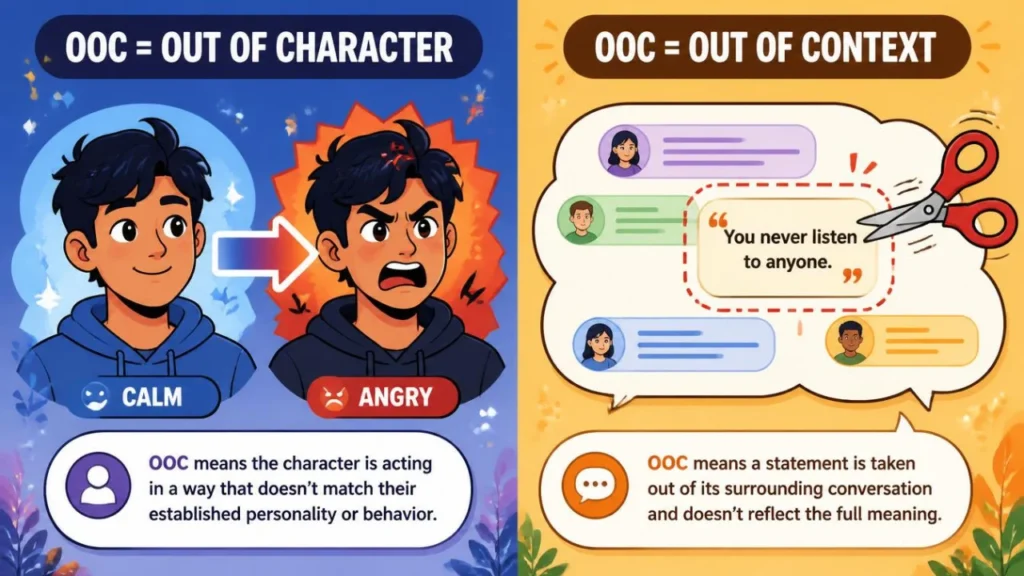
1. Out of Character
This is the acronym’s home turf. It describes a moment when a fictional character behaves in a way that clashes with their established personality think a notoriously guarded character suddenly oversharing their feelings with no buildup. Writers, role players, and fans use this constantly to critique storytelling choices, whether in a published show, a fanfic, or a live roleplay session.
2. Out of Context
The second major use pops up far more in general online discourse than in fandom spaces. It refers to a quote, screenshot, or clip being shared without the surrounding information needed to understand it properly a common complaint in Twitter/X arguments and comment-section pile-ons.
Quick way to tell them apart: context is everything. Roleplay and fanfic communities almost always mean “out of character.” General social media arguments about something someone said almost always mean “out of context.”
Where OOC Actually Comes From
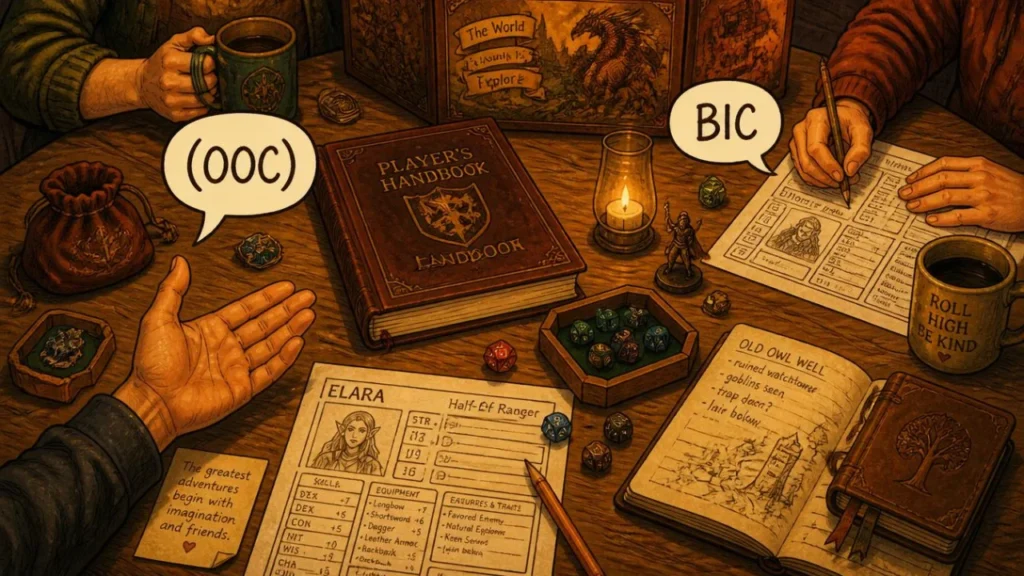
OOC wasn’t born online it started at the tabletop, in games like Dungeons & Dragons, well before internet forums existed.
Tabletop games ask players to stay “in character” for most of a session, similar to actors performing a scene. But sessions still need to pause for ordinary things — a rules clarification, a bathroom break, someone grabbing a snack — without those interruptions getting tangled up in the story itself. OOC became the shorthand for flagging that a comment was real-world talk, not part of the narrative. Players would often bookend it with “BIC” (back in character) once the story resumed.
As roleplay culture migrated to forums, Discord servers, and fanfiction platforms like Archive of Our Own and Wattpad, the term came along with it — and eventually became fandom’s default way of critiquing character consistency too.
Lesser-Known Meanings Worth Knowing
Outside gaming and fandom, OOC occasionally stands for something else entirely:
- Out of control — a chaotic situation, like a party or an argument that’s spiraled.
- Out of curiosity — a casual lead-in before a question, e.g., “OOC, why’d you delete that post?”
- Out of cash — business shorthand for a company running low on funds.
- OOC as an abbreviation for a company name — several organizations, including some in the energy sector, use OOC as part of their branding. This has nothing to do with internet slang and is purely coincidental.
These show up rarely compared to the two main meanings, but it’s worth recognizing them if the context clearly isn’t fandom or gaming related.
How to Use OOC Correctly
The right usage comes down to what you’re actually describing:
- Talking about a character’s behavior not matching their personality? Use “out of character.”
- Talking about someone’s words being shared without their original context? Use “out of context.”
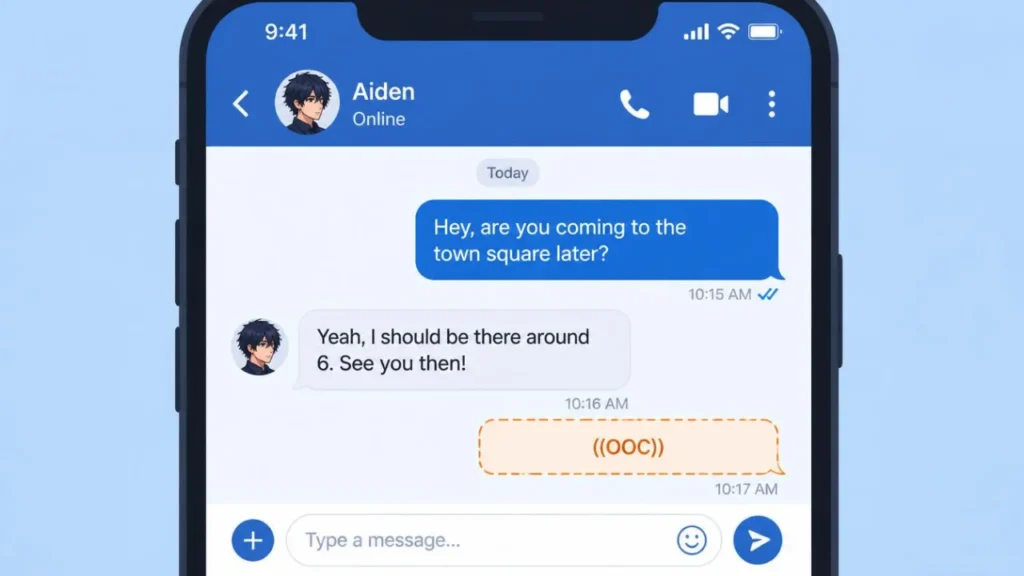
In active roleplay chats, OOC comments are typically wrapped in double parentheses or brackets — for example ((stepping away for a sec)). This isn’t just a style habit; it’s a functional signal that tells everyone else in the chat “this next part isn’t part of the story.”
OOC in Action
In a live roleplay chat:
Player 1: ((brb, dinner’s ready)) Player 2: ((all good, take your time))
In a fanfic review or comment:
“This scene didn’t sit right with me — it goes against everything we know about how guarded he is. He’d never be the one to apologize first.”
Between friends, casually:
“OOC, has Sarah seemed off in the group chat lately?”
Something worth noting: in fandom spaces, calling out something as OOC isn’t usually meant as an insult toward the writer. It’s typically a sign that people care enough about the characters to want them written consistently — a form of engaged, invested criticism rather than random negativity.
Saying It Without the Acronym
If you’d rather skip the shorthand altogether — say, in a formal setting or when writing for an audience that might not know internet slang — spelling it out works just as well:
- Instead of “that was so OOC,” try: “That moment felt inconsistent with his character — he’s far too proud to apologize first.”
- Instead of “this quote is OOC,” try: “This quote is being shared without the context needed to understand it.”
Spelling things out is generally the safer choice in professional emails, formal write-ups, or messages to people who aren’t active in online communities.
Why OOC Matters Most in Tabletop and Live Roleplay
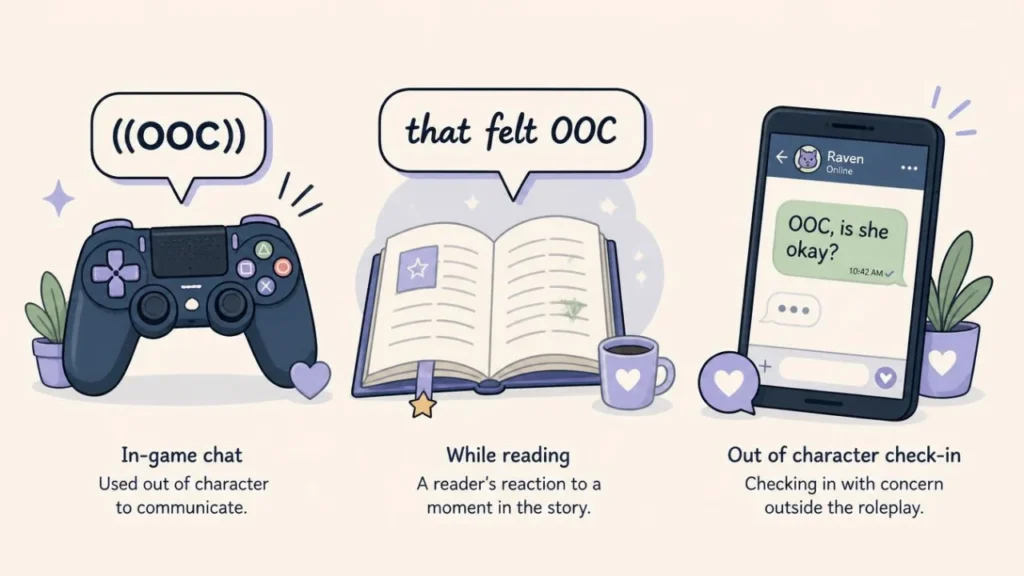
While fandom and social media use OOC to look back and analyze something after the fact, tabletop and live roleplay settings use it in real time. Players are constantly toggling between two modes: staying immersed in the story, and briefly stepping outside it to handle real-world logistics or rules questions.
In this setting, OOC isn’t just a label — it’s an active tool that keeps a session running smoothly and prevents confusion about what’s “really happening” versus what’s just table talk.
Keeping OOC Chatter From Breaking Immersion
The challenge in any roleplay or tabletop setting is letting real-world talk happen without derailing the story. A few things help:
- Keep OOC remarks brief and clearly flagged with brackets or parentheses.
- Save longer discussions — like rules debates — for a proper break rather than mid-scene.
- Set a shared signal with your group in advance so nobody’s ever unsure whether a message is in-story or not.
Groups that stick to these habits tend to run noticeably smoother sessions, since nobody has to stop and ask “wait, was that real or part of the story?”
Common OOC Mistakes to Avoid
- Forgetting to flag it. An unmarked OOC comment can easily be mistaken for part of the story, especially in fast-moving chats.
- Complaining instead of explaining. “This is so OOC” without any reasoning isn’t useful feedback naming the specific inconsistency is far more constructive.
- Assuming everyone knows the term. Outside fandom and gaming circles, OOC can come across as confusing jargon, so it’s worth spelling it out for general audiences.
Frequently Asked Questions
What does OOC mean in slang? Most often, it means “out of character” describing a person or fictional character acting against their usual personality.
What’s the general meaning of OOC? It typically means “out of character,” though “out of context” is a close second depending on the setting.
What does OOC mean in a chat? In gaming or roleplay chats specifically, it flags a message as real-world talk rather than part of the in-progress story.
Does OOC have a meaning outside of fandom or gaming? Occasionally it can mean “out of cash” in a business context, or “out of curiosity” as a casual conversational lead-in. These are far less common than the fandom-related meanings.
Final Words
OOC changes meaning with its surroundings in fandom, it flags a character acting against type; in online arguments, it flags a quote stripped of its original context; and at the gaming table, it’s simply how players step outside the story for a moment. Once you know to check the setting first, you’ll never second-guess those three letters again.
Looking to fully understand what OOC means and how it’s used across fandom, gaming, and social media? Explore idiomsresolve for simple, reader-friendly explanations of OOC and other popular internet slang and expressions.