

You’re scrolling Reddit or Discord late at night. A post is tagged NSFW in bold red letters.
Your thumb hovers over it. What if it opens something you shouldn’t view at work, in class, or on a shared screen?
That one second of hesitation is exactly why this three-letter tag exists.
If you’ve ever typed “NSFW meaning slang” into Google right before opening a link, you’re not alone. In fact, millions of people search this exact term every month. This guide breaks down the real definition, traces where the term came from, compares how each major platform handles it, and flags the mistakes that make people look inexperienced online.
What Does NSFW Mean?
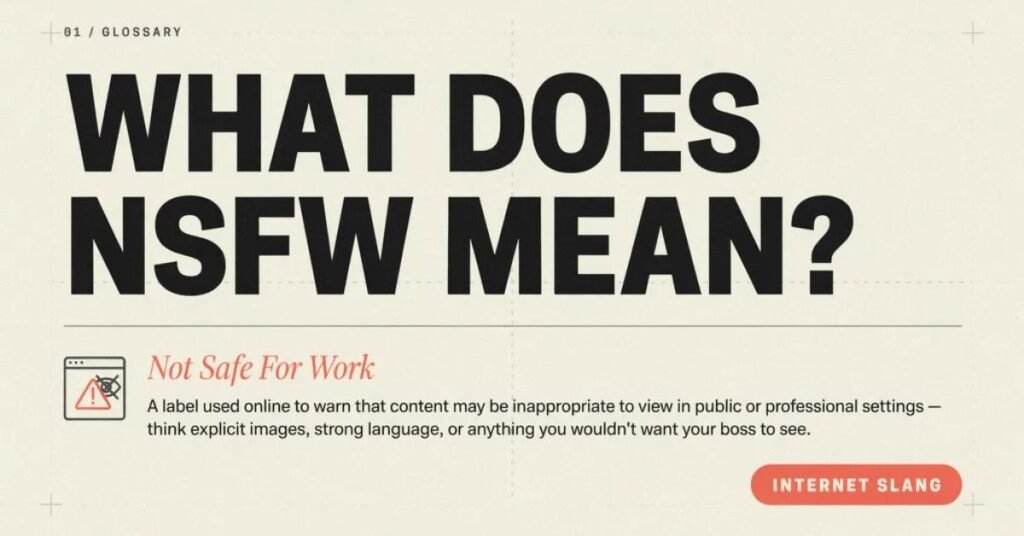
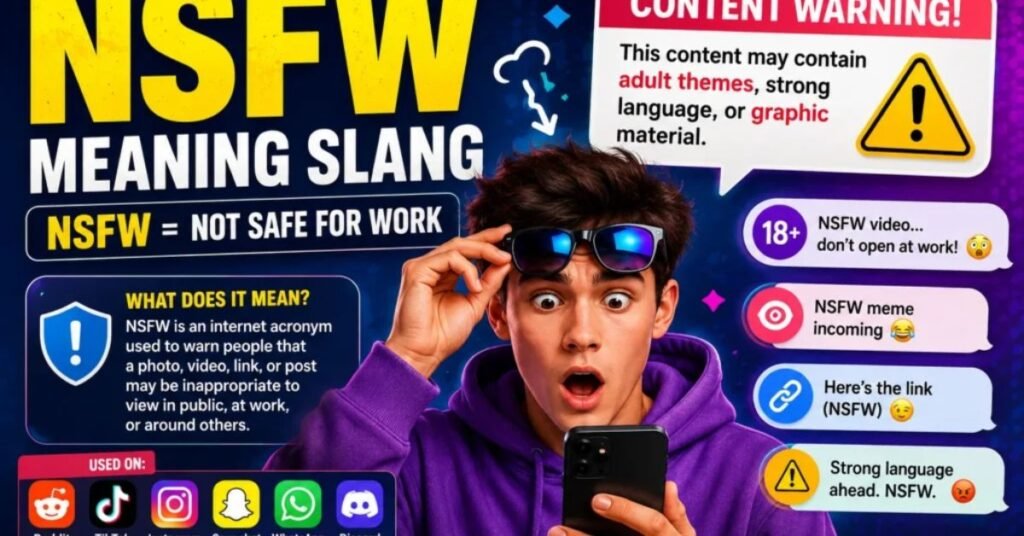
NSFW stands for “Not Safe For Work.”
It works as a warning label, not an insult and not a joke. Essentially, it tells the viewer that the content behind a link, image, or post might be inappropriate to open in a professional, public, or shared environment.
Structure: Not + Safe + For + Work → NSFW
Typically, the NSFW tag applies to content that contains one or more of the following:
- Nudity or sexually suggestive material
- Graphic violence or disturbing images
- Strong profanity or explicit language
- Anything that could embarrass someone if a coworker, teacher, or family member saw their screen
As a simple rule of thumb: if you’d feel awkward opening it in a room full of people, it’s probably NSFW.
Where Did NSFW Come From?
No single app invented the tag. Instead, it grew out of early 2000s internet forums.
Back then, message boards had no built-in image blurring or content filters. As a result, users needed a fast, simple way to flag content before someone accidentally clicked it in public.
Internet users widely credit Reddit and 4chan for popularizing the tag, since both relied on community-driven labeling long before platforms introduced automatic content warnings.
By the 2010s, however, NSFW had spread far beyond forums. It moved into group chats, Slack channels, and even casual office conversation, eventually becoming general shorthand for “you probably shouldn’t look at this right now.”
Today, in 2026, the term is so common that most people use it without ever thinking about what the letters actually stand for.
NSFW vs SFW: What’s the Difference?
| Term | Full Form | Meaning | Example |
| NSFW | Not Safe For Work | Content may be explicit, graphic, or sensitive | “That thread is NSFW, open it later” |
| SFW | Safe For Work | Content is appropriate anywhere | “Don’t worry, this meme is SFW” |
In short, think of SFW and NSFW as two sides of the same coin. One clears content for any audience, while the other flags it for private, careful viewing.
How Each Platform Handles NSFW Content
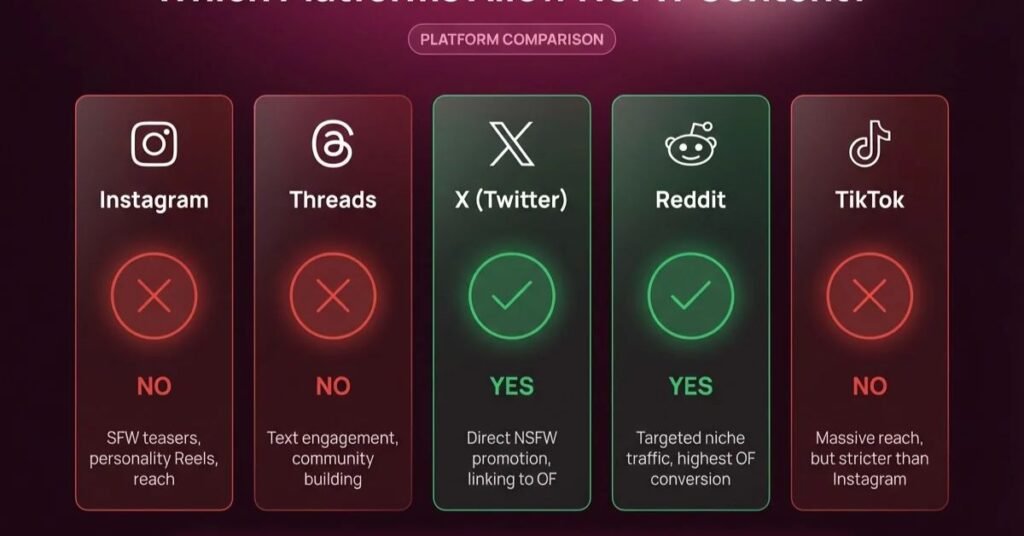
Not every app treats NSFW the same way. Here’s how it plays out across the platforms people use most.
Reddit lets users manually mark entire posts as NSFW. Once tagged, the platform automatically blurs the thumbnail and hides it from anyone who hasn’t enabled adult content in their settings.
- “Marked NSFW by mod, click at your own risk.”
- “Why is this tagged NSFW? It’s just a horror movie clip.”
Discord
Discord lets users label entire channels as NSFW. Because these channels are age-gated, a user has to manually confirm they’re old enough before the content becomes visible.
- “That server has a separate NSFW channel for memes.”
- “You need to verify your age to see NSFW channels.”
X (formerly Twitter)
Similarly, X allows users to add a sensitive content warning to individual posts. This functions the same way as an NSFW tag, even though the platform doesn’t always use the exact letters.
- “This account posts a lot of NSFW art, follow at your own risk.”
Texting and DMs
Here, people often use NSFW casually, as a heads-up before sending something risky, sarcastic, or simply inappropriate for a work chat.
- “Sending you something NSFW, don’t open it at your desk lol”
- “lol that joke was so NSFW”
Slack and Workplace Chats
Even in professional spaces, people use NSFW loosely. It doesn’t always mean explicit content, sometimes it just means anything embarrassing or unprofessional if a coworker glances at a shared screen.
- “Careful, that spreadsheet has some NSFW nicknames in it.”
NSFW Etiquette: Do’s and Don’ts
Using the tag correctly says a lot about how well someone understands online culture. Here’s a quick etiquette guide.
Do:
- Tag content immediately, before anyone else opens it
- Use NSFW even for borderline cases, better safe than embarrassing
- Warn people in DMs before sending anything questionable
Don’t:
- Use NSFW as a joke for content that’s just loud, silly, or cringe
- Assume everyone shares your definition of “risky” content
- Forget to tag something in a group chat or public server
Common Mistakes When Using NSFW
❌ Using NSFW for content that is simply loud or silly ✅ Reserve NSFW for genuinely explicit, graphic, or sensitive material
❌ Assuming NSFW always means sexual content ✅ Remember, people also use it for violent, disturbing, or extremely vulgar content
❌ Forgetting to tag something that should carry a warning ✅ Always tag first, especially in shared or public group chats
❌ Overusing the tag until it loses meaning ✅ Save it for content that genuinely needs a warning, so people still trust the label
Similar Slang You Should Know
| Term | Meaning |
| SFW | Safe For Work, the opposite of NSFW |
| NSFL | Not Safe For Life, used for extremely graphic or disturbing content, a step above NSFW |
| 18+ | A direct age-restriction label, often used alongside NSFW |
| CW | Content Warning, a broader tag used for sensitive topics like trauma or self-harm discussions |
Frequently Asked Questions (FAQs)
What does NSFW mean in a text message?
In texting, NSFW flags a photo, video, link, or joke as possibly inappropriate to view at work, school, or around other people. Because of this, the recipient should stay cautious before opening it.
Is NSFW always about sexual content?
No. While NSFW often refers to nudity or sexual content, people also use it for graphic violence, disturbing imagery, and heavy profanity.
What is the opposite of NSFW?
The opposite is SFW, meaning “Safe For Work.” This label covers content that’s appropriate to view anywhere, including professional settings.
Is it rude to tag something NSFW?
No, most online communities consider it good etiquette. After all, tagging content as NSFW warns others in advance, so they can choose when and where to view it.
Can NSFW get you in trouble at work?
Opening NSFW content on a work device or during work hours can violate company policy, depending on where you work. For this reason, it’s always safer to view it later, on a personal device.
Why do some platforms use NSFW while others use different labels?
Every platform builds its own moderation system. Reddit and Discord use the literal NSFW tag, while X instead uses “sensitive content” warnings that serve the same purpose under a different name.
Conclusion
NSFW ranks among the most widely used internet safety tags, standing for “Not Safe For Work.”
Whether you see it on Reddit, Discord, X, or in a friend’s text message, it always serves the same purpose: warning you before you open something explicit, graphic, or simply inappropriate for the moment.
Ultimately, knowing when, and how, to use it correctly makes you sound like a confident, experienced internet user rather than someone still learning the ropes.