In English grammar, “Since” and “For” are time prepositions (and sometimes conjunctions) that connect an action to a specific point or period in time. They are most commonly used with the Present Perfect and Present Perfect Continuous tenses.
Using them correctly is essential for clarity. A mistake here can change the entire meaning of your sentence, confusing your reader about when an event actually took place.
1. Using “FOR” – The Duration of Time
The word “For” is used when we want to talk about a period of time or a duration. It tells us “how long” an action has been happening.
The Formula:
For + A Period of Time (Number + Time Unit)
Key Rules:
- Use “For” with seconds, minutes, hours, days, months, years, or even “a long time.”
- It can be used with almost all tenses (Past, Present, and Future).
Examples:
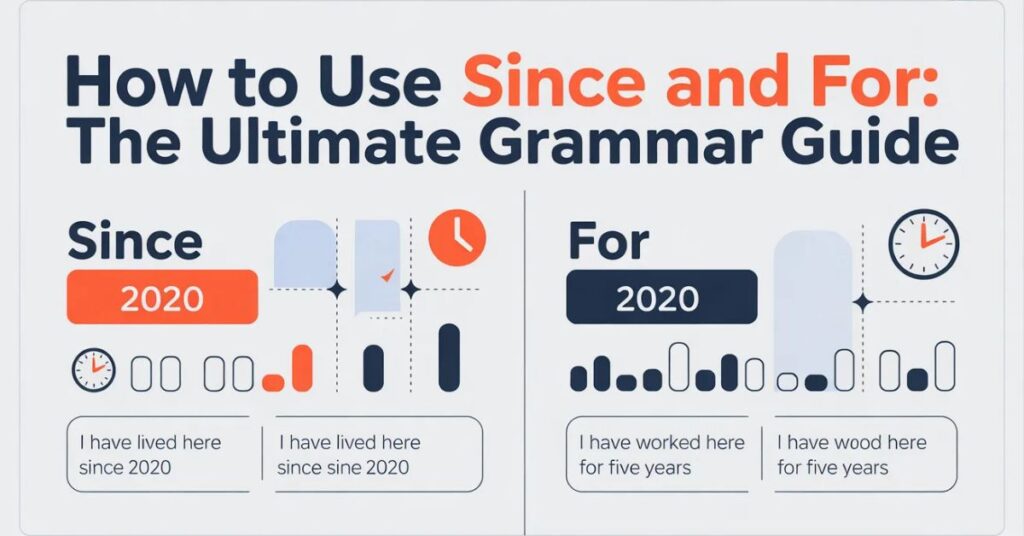
- Present Perfect: “I have lived here for five years.”
- Past Simple: “They worked in that office for six months.”
- Future Simple: “I will be on vacation for two weeks.”
2. Using “SINCE” – The Starting Point
The word “Since” is used to refer to a specific point in time. It tells us when an action started.
The Formula:
Since + A Specific Point in Time (Name of day, month, year, or event)
Key Rules:
- Since” is almost exclusively used with Perfect Tenses.
- It points back to the beginning of an action that is usually still continuing.
Examples:
- Specific Time: “I have been waiting since 8:00 AM.”
- Specific Date: “She has worked here since 2015.”
- Specific Event: “He hasn’t eaten since he arrived.”
3. “Since” vs. “For”: The Comparison Table
To help you visualize the difference quickly, here is a side-by-side comparison:
| Use FOR for a Period | Use SINCE for a Point |
| For 20 minutes | Since 2 o’clock |
| For 5 days | Since Monday |
| For 3 months | Since January |
| For 10 years | Since 2010 |
| For a long time | Since I was a child |
| For ages | Since the beginning of the year |
4. Advanced Usage: “Since” as a Conjunction
While we often use “Since” followed by a date, it can also be used as a conjunction to join two clauses. In this case, the clause after “Since” is usually in the Simple Past.
- Example: “I have been much happier since I started exercising.”
- Analysis: The starting point here is the act of starting exercise (a past event).
5. Common Mistakes and How to Avoid Them
1. Using “Since” with a duration
- Wrong: I have been here since three hours.
- Right: I have been here for three hours.
2. Using “For” with a specific starting point
- Wrong: He has been sick for last Monday.
- Right: He has been sick since last Monday.
3. Using “Since” in the Future Tense
“Since” cannot be used to talk about the future.
- Wrong: I will be there since tomorrow.
- Right: I will be there from tomorrow.
Conclusion
Understanding how to use since and for is all about identifying whether you are talking about a period (For) or a point (Since). Once you master this simple distinction, your English writing will become significantly more professional and accurate.
Practice by looking at your own life: How long have you been studying English? (Use For) When did you start? (Use Since).
Frequently Asked Questions (FAQs)
Can I use “For” with the word “All”?
Usually, no. We say “I have been working all day,” not “for all day.”
Is “Since” always about time?
No! “Since” can also mean “Because.” (e.g., “Since it is raining, we should stay inside.”)
How do I choose between “For” and “During”?
“For” tells you how long. “During” tells you when something happened within a block of time. (I fell asleep during the movie for twenty minutes.)