Understanding Gerund vs Infinitive is an important part of English grammar. Many English learners feel confused about when to use a gerund (-ing form) and when to use an infinitive (to + verb).
Both forms come from verbs, but they function differently in sentences. Learning the correct usage can help you improve your speaking and writing skills.
In this guide, you will learn the definition, rules, differences, examples, and exercises related to gerunds and infinitives.
What is a Gerund?
A gerund is the -ing form of a verb that works as a noun in a sentence.
Structure
Verb + ing
Examples
- Reading improves your knowledge.
- She enjoys swimming in the ocean.
- Cooking is her favorite hobby.
In these examples, reading, swimming, and cooking are verbs, but they function as nouns.
What is an Infinitive?
An infinitive is the base form of a verb with “to” in front of it.
Structure
To + Base Verb
Examples
- I want to learn English.
- She plans to travel next year.
- They decided to start a new business.
Here, to learn, to travel, and to start are infinitive forms.
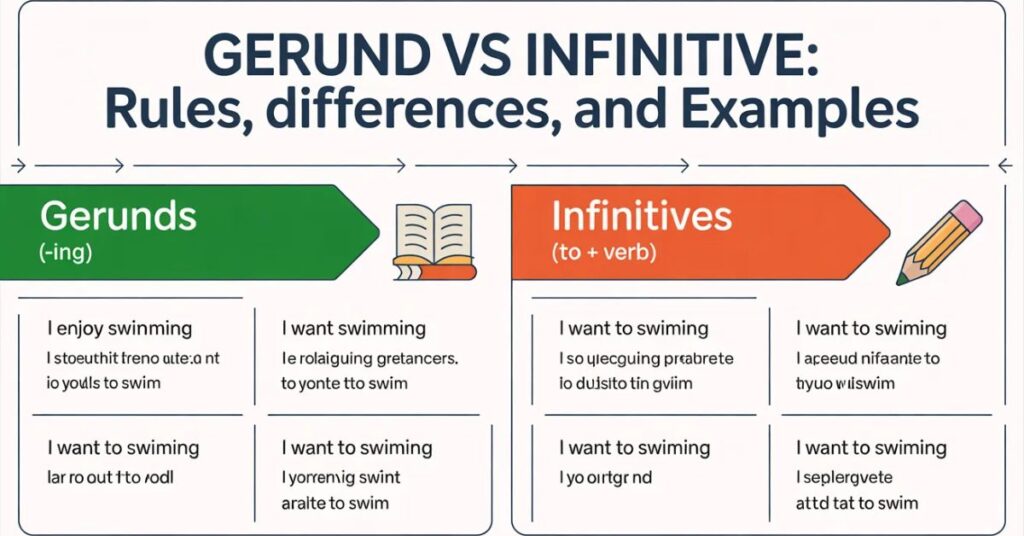
Gerund vs Infinitive: Key Differences
| Gerund | Infinitive |
| Verb + ing | To + base verb |
| Functions as a noun | Often shows purpose or intention |
| Example: Reading is fun | Example: I want to read |
Example comparison:
- I enjoy reading books.
- I want to read this book.
The first sentence describes an activity you like, while the second sentence shows intention.
Verbs Followed by Gerunds
Some verbs are commonly followed by gerunds (-ing form).
Common verbs include:
- enjoy
- avoid
- finish
- suggest
- consider
- keep
- mind
Examples
- I enjoy watching movies.
- She avoided talking to him.
- They suggested going to the park.
Verbs Followed by Infinitives
Some verbs are usually followed by infinitives (to + verb).
Common verbs include:
- want
- decide
- plan
- hope
- learn
- promise
- try
Examples
- I want to buy a new phone.
- She decided to study medicine.
- We hope to meet you soon.
Verbs That Can Use Both Gerund and Infinitive
Some verbs can be followed by either a gerund or an infinitive, but the meaning may change.
Remember
- I remember locking the door.
- Remember to lock the door.
Stop
- He stopped smoking.
- He stopped to smoke.
Try
- Try studying more.
- Try to study harder.
Common Mistakes
❌ I enjoy to play football.
✅ I enjoy playing football.
❌ She decided going home.
✅ She decided to go home.
❌ He suggested to go there.
✅ He suggested going there.
Tips to Master Gerund vs Infinitive
- Learn the common verbs that take gerunds or infinitives.
- Practice writing sentences regularly.
- Read English articles and books.
- Pay attention to grammar patterns in real conversations.
With regular practice, you will quickly understand when to use a gerund and when to use an infinitive.
Practice Exercises
Fill in the blanks using the correct form:
- I enjoy ______ (read) books.
- She decided ______ (study) abroad.
- They suggested ______ (go) to the beach.
Answers
- reading
- to study
- going
Conclusion
The topic Gerund vs Infinitive is essential for mastering English grammar.
- Gerund: Verb + ing used as a noun
- Infinitive: To + base verb used to express purpose or intention
By learning the rules and practicing with examples, you can easily understand how to use gerunds and infinitives correctly in sentences
Frequently Asked Questions (FAQs)
What is a gerund in English grammar?
A gerund is the -ing form of a verb that functions as a noun in a sentence.
What is an infinitive?
An infinitive is the base form of a verb with “to”, such as to read, to write, or to learn.
Can some verbs use both gerund and infinitive?
Yes, some verbs like remember, stop, and try can use both forms, but the meaning may change.
Why is it important to learn gerund vs infinitive?
Understanding this concept helps you create grammatically correct sentences in both writing and speaking.