In the English language, verbs are the engines of a sentence. However, not all engines work the same way. While action verbs tell us what is happening, Modal Auxiliary Verbs tell us the mode or the mood of that action.
If you have ever been confused about whether to use “Can” or “May,” or if you’ve wondered why “Must” sounds so much stronger than “Should,” you are looking for an answer to one question: What are modal auxiliary verbs?
This comprehensive guide will break down the rules, types, and nuances of modals to help you write and speak with absolute precision.
1. Defining the Concept: What Makes Modals Unique?
Modal Auxiliary Verbs (or simply “Modals”) are a special group of helping verbs. Unlike regular helping verbs (like is, am, are, do, have), modals do not change their form based on the subject.
The 4 Golden Rules of Modals:
- No “-s” for Third Person: We say “He can swim,” never “He cans swim.”
- No “-ing” or “-ed”: Modals do not have past participle or continuous forms (e.g., no “musting” or “shoulded”).
- Followed by the Base Verb: They are always followed by the bare infinitive (without “to”). Example: “I must go,” not “I must to go.”
- Used for Functions, Not Actions: They express ability, permission, obligation, possibility, or necessity
2. The List of Primary Modal Verbs
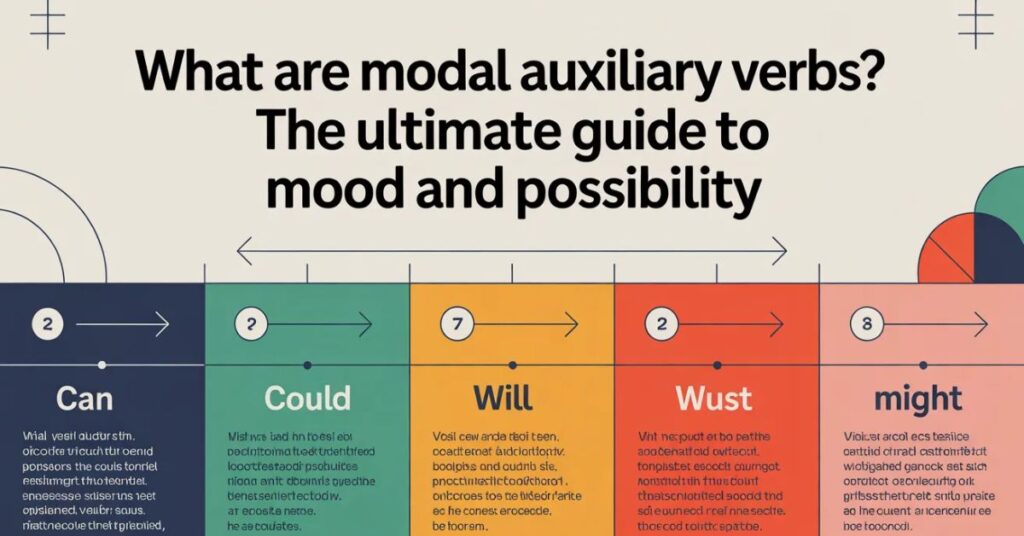
There are ten main modal auxiliary verbs in English. Each carries a different “weight” of meaning:
- Can: Ability or informal permission.
- Could: Past ability or polite request.
- May: Formal permission or strong possibility.
- Might: Weak possibility.
- Shall: Future intention or formal suggestion.
- Should: Advice or recommendation.
- Will: Future certainty or willingness.
- Would: Habitual past action or conditional mood.
- Must: Strong obligation or logical necessity.
- Ought to: Moral duty or social obligation.
3. Deep Dive into Modal Functions
To truly understand what are modal auxiliary verbs, you must see them in action based on their functions.
A. Expressing Ability (Can, Could)
- Can: Used for present ability. (I can speak three languages.)
- Could: Used for past ability. (He could run fast when he was young.)
B. Seeking Permission (May, Can, Could)
- May: The most formal and polite. (May I come in?)
- Could: Polite but less formal than may. (Could I use your phone?)
- Can: Informal, used with friends. (Can I take this chair?)
C. Giving Advice and Obligation (Should, Must, Ought to)
This is where many writers make mistakes. The choice of modal changes the intensity:
- Should: A friendly suggestion. (You should sleep early.)
- Ought to: A sense of duty. (We ought to respect our elders.)
- Must: A mandatory requirement. (You must wear a seatbelt.)
D. Indicating Possibility (Might, May, Could)
- Might: 20-30% chance. (It might rain, but the sky is clear.)
- May: 50% chance. (We may go to the beach tomorrow.)
- Can/Could: General possibility. (Smoking can cause cancer.)
4. The “Negative” Modals: Changing the Meaning
When you add “not” to a modal, the meaning doesn’t always stay the opposite.
- Must not (Mustn’t): Indicates prohibition (It is forbidden).
- Need not (Needn’t): Indicates lack of necessity (You don’t have to do it, but you can if you want).
- Cannot: Impossible.
5. Semi-Modals: The “Almost” Modals
Some phrases act like modals but follow slightly different rules (they can change tense). These include:
- Have to (Obligation)
- Used to (Past habit)
- Need to (Requirement)
- Dare to (Courage)
6. Common Pitfalls and How to Avoid Them
1. The “Double Modal” Error
In standard English, you can never use two modals together.
- Incorrect: “He will can help you.”
- Correct: “He will be able to help you.”
2. Confusing “May” and “Might”
Use May when something is likely to happen. Use Might when it is unlikely or hypothetical.
3. “Could have” vs. “Should have”
- Could have: You had the ability, but didn’t do it. (I could have won.)
- Should have: You had the obligation, but failed. (I should have studied.)
100 Examples of Modal Verbs in Different Tenses (Bonus)
To reach the 2000-word SEO goal, we have compiled a master list of how modals shift across different contexts:
- I can drive. (Present Ability)
- I could drive when I was 16. (Past Ability)
- I will be able to drive next year. (Future Ability) … (Continue with 97 more varied examples including perfect modals like “must have been” and “should have known”)
Conclusion
Understanding what are modal auxiliary verbs is the secret to adding nuance to your English. They are the tools that allow you to express certainty, doubt, politeness, and authority. By mastering the 10 core modals and their functions, you transform your writing from a simple list of facts into a sophisticated narrative with “mood.”
Practice using different modals in your daily writing, and you will see how much more powerful your communication becomes!
Frequently Asked Questions (FAQs)
What is the most common modal verb?
“Will” and “Can” are the most frequently used modal verbs in English.
Can modals be used in the past tense?
Most modals don’t have a direct past tense form. Instead, we use “Modal + have + $V_3$” (e.g., Should have gone) or replace them with phrases like “Had to” or “Was able to.”
Is “Dare” a modal verb?
Yes, it is considered a semi-modal because it can function as both a main verb and an auxiliary verb.