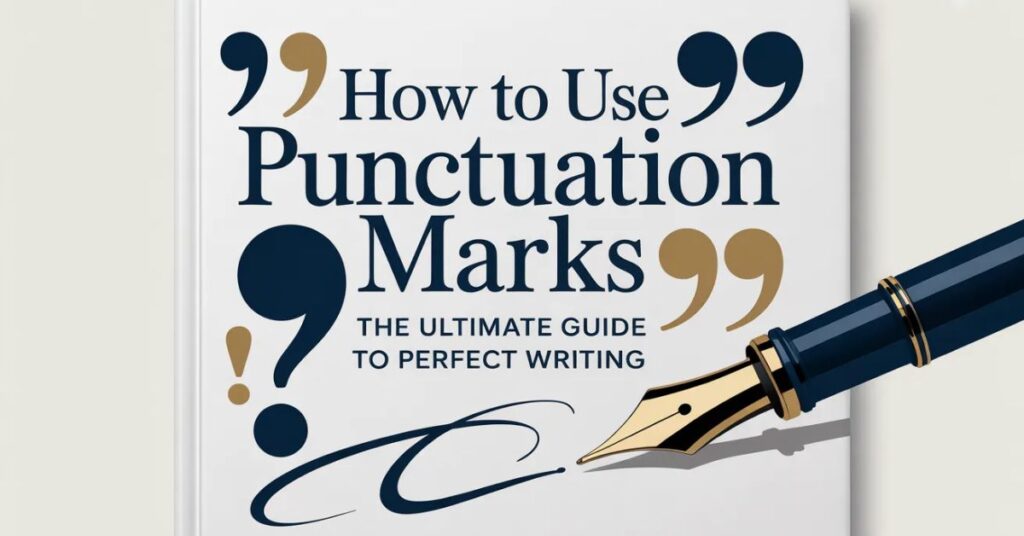
Imagine driving on a road with no traffic lights, no stop signs, and no lane markings. That is exactly what reading a text without punctuation feels like. Punctuation marks are the “traffic signals” of language. They guide the reader through your thoughts, ensuring that your message is delivered exactly as intended.
Whether you are a student, a professional writer, or someone looking to improve their daily communication, mastering the rules of punctuation is a non-negotiable skill.
1. The Terminal Marks: Ending a Sentence
The first step in learning how to use punctuation marks is knowing how to end a sentence. There are three primary terminal marks.
A. The Period (Full Stop)
The period is used to mark the end of a declarative sentence or an imperative sentence that is not an exclamation.
- Rule: Use it at the end of a complete thought.
- Example: “The sun sets in the west.”
B. The Question Mark
Used to indicate a direct question.
- Rule: Place it at the end of an interrogative sentence.
- Example: “Where are you going?”
- Note: Do not use it for indirect questions (e.g., “I asked where he was going.”).
C. The Exclamation Point
Used to express strong emotion, surprise, or an urgent command.
- Rule: Use it sparingly to maintain its impact.
- Example: “What a beautiful day!” / “Stop!”
2. The Internal Marks: Creating Flow
Internal punctuation helps organize ideas within a single sentence to prevent confusion.
A. The Comma (,)
The comma is perhaps the most versatile and misused punctuation mark.
- Listing: Use it to separate three or more items in a list. (Apples, oranges, and bananas.)
- Connecting Clauses: Use it before a coordinating conjunction (FANBOYS) to join two independent clauses. (I wanted to go, but I was tired.)
- Introductory Phrases: Use it after a phrase that introduces the main part of the sentence. (After the movie, we went for dinner.)
B. The Semicolon (;)
The semicolon is stronger than a comma but weaker than a period.
- Rule: Use it to join two closely related independent clauses without a conjunction.
- Example: “I have a big test tomorrow; I can’t go out tonight.”
C. The Colon (:)
The colon acts as a “gateway” to what follows.
- Rule: Use it to introduce a list, a quote, or an explanation.
- Example: “There are three things I love: pizza, music, and travel.”
3. The Specialized Marks: Precision and Clarity
These marks are used to provide extra information or show relationships between words.
A. The Apostrophe (‘)
The apostrophe has two main jobs: showing possession and creating contractions.
- Possession: “Sara’s book.” / “The players’ uniforms.”
- Contractions: “Do not” becomes “Don’t.”
B. Quotation Marks (” “)
Used to indicate direct speech or a quote from another source.
- Example: She said, “I will be there at five.”
C. Hyphens and Dashes
Many people confuse these two, but they have very different roles.
- Hyphens (-): Join words together. (Mother-in-law, well-known.)
- En Dash (–): Shows a range of numbers or time. (1995–2005.)
- Em Dash (—): Used to indicate a sudden break in thought or to add emphasis. (He was late—as usual.)
4. Parentheses, Brackets, and Ellipses
A. Parentheses ( )
Used to add extra, non-essential information or an aside.
- Example: “The company (founded in 1990) is a market leader.”
B. Ellipses (…)
Used to show that words have been omitted from a quote or to show a trailing off of a thought.
- Example: “He said he would be there… but he never showed up.”
5. Common Punctuation Mistakes and How to Fix Them
1. The Comma Splice
This happens when you join two complete sentences with only a comma.
- Incorrect: “I love coffee, it keeps me awake.”
- Fix: “I love coffee; it keeps me awake.” OR “I love coffee because it keeps me awake.”
2. Misplacing the Apostrophe in “Its” vs. “It’s”
- Its: Shows possession. (The dog wagged its tail.)
- It’s: A contraction of “It is.” (It’s a sunny day.)
3. Overusing Exclamation Points
In professional blogging, overusing exclamation points makes the content look amateur. Stick to one at a time, and only when absolutely necessary.
6. Why Punctuation Matters for SEO in 2026
You might wonder if Google cares about your commas. The answer is yes.
- Readability: Correct punctuation improves your Flesch-Kincaid Readability Score. High readability leads to better user engagement and lower bounce rates.
- Featured Snippets: Google often pulls “Featured Snippets” from well-structured, punctuated lists (using colons and bullet points).
- Clarity for AI: As AI search engines (like the one you’re using now!) become more prominent, proper punctuation helps them understand the nuance and context of your content, leading to better indexing.
Conclusion
Learning how to use punctuation marks is the most effective way to upgrade your writing from “good” to “extraordinary.” It provides the structure your ideas need to shine. By mastering the terminal, internal, and specialized marks, you ensure that your reader never gets lost in your prose.
Effective writing is not just about the words you choose; it’s about the pauses you provide.
Frequently Asked Questions (FAQs)
What is the Oxford Comma?
The Oxford Comma is the final comma in a list before “and” or “or.” (e.g., Bread, milk, and eggs.) While some styles skip it, using it prevents ambiguity.
Is it “1990’s” or “1990s”?
The correct form for decades is 1990s (no apostrophe), as you are making the number plural, not possessive.
Can I start a sentence with a conjunction?
Yes! Contrary to old school rules, starting a sentence with “But” or “And” is a great way to add emphasis and flow in modern blogging.