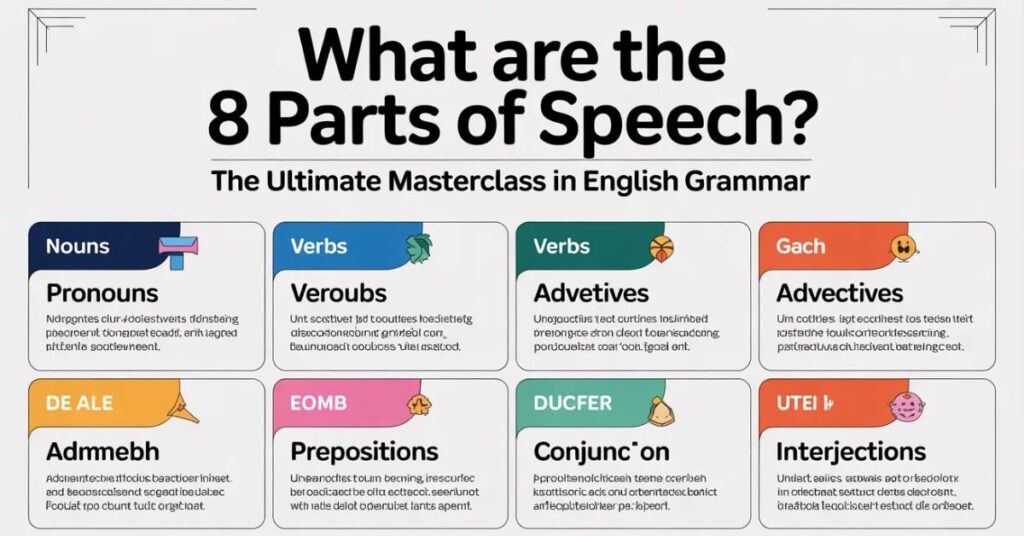
Language is the most powerful tool humans possess. Every time we share an idea, write an email, or post on social media, we are using a complex system of building blocks. To communicate effectively, one must ask: What are the 8 parts of speech?
Understanding these eight categories is like having the blueprint for a skyscraper. Without them, the structure of your sentences would collapse. In this exhaustive guide, we will dismantle the English language and analyze each part to help you master the art of writing and speaking.
1. Nouns: The Foundation of Every Thought
A noun is a word that names a person, place, thing, or idea. They are the “anchors” of your sentences.
Detailed Categories of Nouns:
- Proper Nouns: These name specific entities and are always capitalized (e.g., London, Albert Einstein, Google).
- Common Nouns: General names for things (e.g., city, man, company).
- Abstract Nouns: These name things you cannot perceive with your five senses—ideas, qualities, or conditions (e.g., freedom, love, courage, time).
- Collective Nouns: Words that represent a group as a single unit (e.g., team, flock, audience, family).
- Compound Nouns: Nouns made up of two or more words (e.g., toothpaste, mother-in-law, six-pack).
Why Nouns Matter for SEO:
In digital marketing, nouns are often your keywords. Search engines look for these specific “naming words” to determine the relevance of your content to a user’s search query.
2. Pronouns: The Efficiency Experts
Pronouns are words used in place of nouns. Their primary job is to prevent your writing from becoming repetitive and boring.
The Different Faces of Pronouns:
- Personal Pronouns: Refer to specific people or things (I, you, he, she, it, we, they).
- Possessive Pronouns: Indicate ownership (mine, yours, hers, theirs).
- Relative Pronouns: These connect a clause or phrase to a noun or pronoun (who, whom, which, that). For example: “The book that I bought is great.”
- Demonstrative Pronouns: Point to specific things (this, that, these, those).
Pro Tip: Always ensure your “pronoun-antecedent agreement” is correct. If you start with a singular noun (The student), the pronoun must also be singular (he or she), not plural (they).
3. Verbs: The Engine of the Sentence
If a noun is a car, the verb is the engine. A verb expresses physical action, mental action, or a state of being. You cannot have a complete sentence in English without a verb.
Deep Dive into Verb Types:
- Action Verbs: Express physical or mental activity (run, jump, think, believe).
- Linking Verbs: These do not show action. Instead, they link the subject to a word that describes it (is, am, are, was, were, seem, become).
- Auxiliary (Helping) Verbs: Used together with a main verb to show the verb’s tense or to form a question (have, do, will, can, might).
- Phrasal Verbs: A combination of a verb and a preposition that creates a new meaning (break down, look up, give in).
4. Adjectives: The Painters of Prose
Adjectives modify or describe nouns and pronouns. They answer questions like What kind? Which one? or How many?
The “Order of Adjectives” Rule:
Native speakers instinctively follow a specific order when using multiple adjectives. If you violate this, your sentence will sound “off.” The order is:
- Opinion (Beautiful)
- Size (Huge)
- Age (Old)
- Shape (Square)
- Color (Red)
- Origin (Italian)
- Material (Silk)
- Purpose (Sleeping)
Correct: “A beautiful large old Italian silk sleeping bag.”
5. Adverbs: Adding Precision to Actions
Adverbs modify verbs, adjectives, or even other adverbs. They often end in -ly, but not always. They answer How, When, Where, or To what extent.
Types of Adverbs:
- Adverbs of Manner: Tell us how an action is performed (slowly, gracefully, loudly).
- Adverbs of Frequency: Tell us how often something happens (always, never, sometimes, rarely).
- Adverbs of Degree: Tell us the intensity of something (very, extremely, quite, almost).
Writing Advice: Avoid over-relying on adverbs. Instead of saying “He ran very quickly,” use a stronger verb like “He sprinted.”
6. Prepositions: The Relationship Managers
Prepositions show the relationship between a noun (or pronoun) and other words in a sentence. They usually indicate direction, time, location, or spatial relationships.
Common Prepositional Uses:
- Time: At 5 PM, In the morning, On Monday.
- Place: Under the bridge, Inside the box, At the station.
- Direction: Toward the park, Across the street, Into the house.
The Dangling Preposition: Modern English has moved away from the old rule that you cannot end a sentence with a preposition. “Who are you going with?” is now widely accepted in casual and professional speech.
7. Conjunctions: The Bridges of Language
Conjunctions join words, phrases, or clauses. They allow us to move away from short, choppy sentences and create complex, flowing ideas.
The Three Types of Conjunctions:
- Coordinating Conjunctions: Use the acronym FANBOYS (For, And, Nor, But, Or, Yet, So).
- Subordinating Conjunctions: Connect a dependent clause to an independent clause (because, although, since, while, unless).
- Correlative Conjunctions: Pairs of conjunctions that work together (either/or, neither/nor, both/and).
8. Interjections: The Spices of Speech
Interjections are words used to express strong emotion or sudden feeling. They are grammatically independent of the rest of the sentence.
- Positive: Wow! Yay! Hurray!
- Negative: Ouch! Alas! Ugh!
- Social: Hey! Hello! Bye!
In professional blogging, interjections are rare, but in creative writing or social media marketing, they add “voice” and personality to the content.
Why Understanding the 8 Parts is Crucial for Content Creators
If you are writing for the web in 2026, grammar is about more than just being “correct.”
- Readability Scores: Google prioritizes content that is easy to read. Misusing conjunctions or overusing adverbs can hurt your readability score.
- Voice Search Optimization: People speak in full sentences when using voice search. Knowing how these 8 parts fit together helps you write content that matches natural speech patterns.
- Authority: Typos and grammatical errors ruin your credibility. A site that understands the mechanics of language is seen as more authoritative.
Conclusion
So, what are the 8 parts of speech? They are the Nouns that name our world, the Verbs that drive our actions, and the Adjectives and Adverbs that color our descriptions. They are the Pronouns that simplify our speech, the Prepositions and Conjunctions that connect our thoughts, and the Interjections that express our humanity.
By mastering these eight elements, you are not just learning grammar—you are mastering the art of influence, clarity, and connection.
Frequently Asked Questions (FAQs)
Can a word belong to two different parts of speech?
Yes. The word “well” can be an adverb (“He plays well”), a noun (“The water in the well”), or even an adjective (“I am well”).
Is “The” a part of the 8 parts?
Yes, “the,” “a,” and “an” are Articles. In the standard 8-part system, they are classified as Adjectives because they modify nouns.
Which part of speech is the most common?
Nouns and verbs are the most used, as they form the core of every thought.